

Why Use Budgeting Systems: Complete Family Guide
Nearly 65 percent of families say they feel anxious about managing monthly household expenses. Without a clear system, money can slip away fast, making it tough to reach savings goals or plan for the future. By understanding how a budgeting system works, your family gains control and peace of mind, allowing you to track every dollar and see exactly where your money is going each month.
Table of Contents
- What Are Budgeting Systems for Families?
- Types of Budgeting Systems and Distinctions
- How Budgeting Systems Support Family Goals
- Key Benefits: Organization, Savings, and Peace
- Common Mistakes and How to Avoid Them
Key Takeaways
| Point | Details |
|---|---|
| Importance of Budgeting Systems | Family budgeting systems help manage finances by tracking income and categorizing expenses, enabling families to identify spending patterns and savings opportunities. |
| Various Budgeting Methods | Different budgeting systems, such as zero-based budgeting, envelope budgeting, and the 50/30/20 rule, cater to different family needs and financial habits. |
| Goal Alignment | These systems help prioritize spending and build financial security, supporting both immediate needs and long-term family goals. |
| Common Pitfalls | Families should avoid underestimating expenses and maintain flexibility in their budgets to ensure effective financial planning and management. |
What Are Budgeting Systems for Families?
A family budgeting system is a strategic approach to managing household finances that transforms how you track, plan, and optimize your money. According to research from Penn State Extension, it’s a structured plan designed to help families understand their financial landscape by tracking income sources and categorizing expenses systematically.
At its core, a budgeting system serves multiple critical functions. It helps families identify spending patterns, recognize areas of potential savings, and create a roadmap for financial goals. Research from Georgetown Commons Sense indicates these systems enable households to adapt to financial changes while providing clear visibility into where money is actually being spent.
Effective family budgeting systems typically include several key components:
- Income Tracking: Recording all sources of household revenue
- Expense Categorization: Sorting spending into clear, manageable groups
- Goal Setting: Establishing short and long-term financial objectives
- Regular Review: Monthly or quarterly financial assessments
These systems aren’t about restricting spending – they’re about creating financial clarity and empowerment. By understanding your money’s movement, you can make informed decisions that support your family’s financial health and future dreams. Understanding Your Budget Tracking Guide for Families can provide additional insights into implementing these strategies effectively.
Types of Budgeting Systems and Distinctions
Family budgeting systems come in various approaches, each designed to help households manage money more effectively. According to research from Finally Home, there are several distinct methods families can adopt to track and optimize their financial resources.
Three popular budgeting systems stand out for their unique strategies. The zero-based budgeting method requires every dollar to be assigned a specific purpose, ensuring no money is left unaccounted for. Envelope budgeting involves physically or digitally allocating cash into categorized segments, which helps control spending in specific areas. The 50/30/20 rule provides a straightforward framework by dividing income into three primary buckets: 50% for needs, 30% for wants, and 20% for savings and debt repayment.
Here’s a comparison of popular family budgeting systems:
| Budgeting System | How It Works | Best For | Key Benefit |
|---|---|---|---|
| Zero-Based Budgeting | Assign every dollar a purpose | Hands-on planners | Maximum accountability |
| Envelope Budgeting | Cash split into spending categories | Visual learners Cash spenders |
Tangible control |
| 50/30/20 Rule | Divide income into three set buckets | Beginners Busy families |
Simple, flexible structure |
| Pay-Yourself-First | Save first, spend what’s left | Savers Long-term planners |
Prioritizes savings |
Each budgeting system offers distinct advantages:
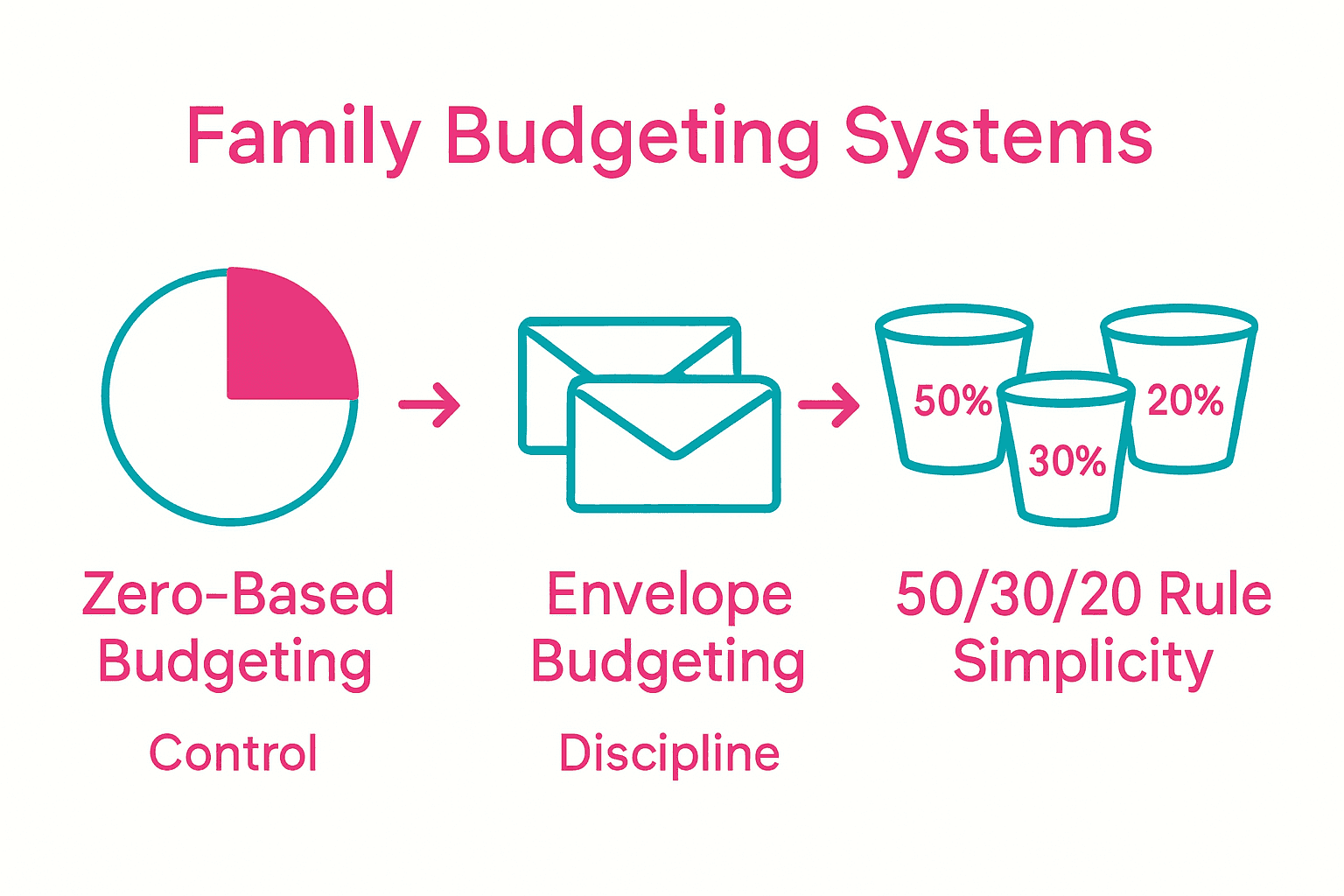
- Zero-Based Budgeting: Maximum accountability for every dollar
- Envelope Budgeting: Tangible spending control and visual tracking
- 50/30/20 Rule: Simple, flexible approach for diverse financial situations
- Pay-Yourself-First Method: Prioritizes savings before other expenses
Choosing the right system depends on your family’s financial habits, discipline, and goals. The key is finding a method that feels natural and sustainable for your household.
IMAGE:descriptive_key_1] [Understanding Your Budget Tracking Guide for Families can help you explore which approach might work best for your unique situation.
How Budgeting Systems Support Family Goals
Budgeting systems are powerful tools that transform financial aspirations into achievable plans. According to the Consumer Financial Protection Bureau, these systems help families ensure they have sufficient funds for necessities while simultaneously working towards broader financial objectives.
At their core, budgeting systems provide a strategic framework for aligning daily spending with long-term family dreams. Whether you’re saving for a family vacation, planning for children’s education, or building an emergency fund, these systems create a clear roadmap for financial success. Research indicates that by systematically managing income and expenses, families can balance immediate needs with future goals, creating a sense of financial security and purpose.
Key ways budgeting systems support family goals include:
- Prioritizing Spending: Identifying and focusing on what truly matters
- Emergency Preparedness: Building financial cushions for unexpected challenges
- Goal Tracking: Monitoring progress towards specific financial milestones
- Reducing Financial Stress: Creating clarity and control over household finances
Successful families understand that budgeting isn’t about restriction – it’s about intentional planning. How to Track Family Expenses can provide additional strategies for turning your financial goals from dreams into reality. By adopting a thoughtful budgeting approach, you’re not just managing money – you’re creating a foundation for your family’s future prosperity.

Key Benefits: Organization, Savings, and Peace
Budgeting systems offer families more than just number tracking – they provide a comprehensive approach to financial well-being. According to research from MIT’s Student Financial Services, these systems bring critical organization to financial management by allowing families to systematically track income, expenses, and spending patterns.
The three primary benefits of a robust budgeting system encompass organization, savings, and peace of mind. By creating a structured framework for financial decisions, families can transform chaotic spending into intentional resource allocation. Research from Georgia Futures indicates that maintaining a budget ensures income consistently covers expenses while simultaneously building towards important savings goals.
Key advantages of implementing a budgeting system include:
- Financial Clarity: Understanding exactly where money flows each month
- Proactive Savings: Automatically setting aside funds for future needs
- Stress Reduction: Eliminating financial uncertainty and surprise expenses
- Goal Achievement: Creating a roadmap for both short-term and long-term financial objectives
Successful families recognize that budgeting isn’t about restriction – it’s about empowerment. Budgeting Tools: How I Organized My Finances and Found Peace of Mind can provide additional insights into transforming your financial landscape. By embracing a thoughtful budgeting approach, you’re not just managing money – you’re creating a foundation for financial confidence and family security.
Common Mistakes and How to Avoid Them
Budgeting mistakes can derail even the most well-intentioned financial plans. According to Penn State Extension, families often fall into predictable traps that can undermine their financial stability and goal achievement.
One of the most common errors is underestimating expenses and failing to account for irregular costs. Research from the Consumer Financial Protection Bureau suggests that families should create flexible budgets that can adapt to changing financial situations. This means building in buffer zones for unexpected expenses, tracking both consistent monthly bills and less predictable costs like annual insurance payments or seasonal expenses.
Key budgeting mistakes to watch out for include:
- Overlooking Small Expenses: Letting minor purchases accumulate unnoticed
- Ignoring Irregular Costs: Forgetting about quarterly or annual expenses
- Rigid Budgeting: Creating a plan with no room for flexibility
- Inconsistent Tracking: Failing to regularly review and update your budget
Successful budgeting is about continuous adjustment and honest self-assessment. Family Finance Organization Guide can provide additional strategies for maintaining a resilient and effective family budget. Remember, a budget isn’t a punishment – it’s a tool for financial empowerment and peace of mind.
Take Control of Your Family Finances Today
Managing your family’s budget can feel overwhelming when unexpected expenses arise or saving feels out of reach. This article highlights common budgeting challenges like underestimating costs and struggling with rigid plans. If you want to break free from financial stress and gain clarity over your money with proven budgeting systems, you are in the right place.
Explore actionable tips and simple strategies that empower you to organize your household budget with ease. We offer practical solutions such as comprehensive How to Track Family Expenses and effective Budgeting Tools that support your journey to financial peace and savings. Ready to transform your budgeting struggles into success? Start building a clear, stress-free financial future for your family.
Frequently Asked Questions
What is a family budgeting system?
A family budgeting system is a strategic method for managing household finances that involves tracking income and categorizing expenses to gain financial clarity and control.
What are the main types of budgeting systems for families?
The main types of budgeting systems include zero-based budgeting, envelope budgeting, the 50/30/20 rule, and the pay-yourself-first method, each offering unique strategies for managing money effectively.
How can budgeting systems help achieve family financial goals?
Budgeting systems align daily spending with long-term goals by prioritizing expenses, preparing for emergencies, tracking progress on financial milestones, and reducing financial stress, thereby creating a roadmap for success.
What are common mistakes families make when budgeting?
Common budgeting mistakes include underestimating expenses, overlooking small or irregular costs, creating rigid budgets, and failing to consistently review and update the budget, all of which can undermine financial stability.
Recommended
- Understanding What is a Family Budget: A Clear Guide –
- Understanding Your Budget Tracking Guide for Families –
- Family Finance Organization Guide –
- How to Track Family Expenses: A Simple Guide for 2025 –
- Best Value Baby Food Maker Under $100: Budget-Friendly Picks | Parent Kitchen Lab
Want a little more help with this? Grab my free Finance & Life Planner over on the Free Resources page — and when you’re ready to go deeper, the First Budget in 30 Minutes will carry you the rest of the way.