

Why Simplify Schedules? 71% Mental Load Reduction
If your family calendar looks like a game of Tetris gone wrong, you’re not alone. Between soccer practice, music lessons, work meetings, and school events, many families run on fumes. But here’s what most parents don’t realize: overscheduling leads to anxiety, sleep problems, and poor performance in children. The good news? Simplifying your schedule isn’t about doing less, it’s about doing what matters. In this guide, we’ll show you exactly how to reclaim your family’s time, reduce stress, and build stronger connections through proven strategies that actually work.
Table of Contents
- Why busy family schedules spiral out of control
- The research-backed costs of overscheduling
- The hidden benefits of simplifying your family’s schedule
- How to actually simplify: Proven strategies for families
- Dealing with real-world challenges and resistance
- Take the next step: More tools for balanced family life
- Frequently asked questions
Key Takeaways
| Point | Details |
|---|---|
| Quality trumps quantity | Fewer, carefully chosen activities support better child development than a packed schedule. |
| Simplifying reduces stress | Streamlined routines help lower anxiety and improve relationships for both kids and parents. |
| Flexibility matters | Adaptable schedules give families the space for rest and real-life changes without guilt. |
| Digital and paper tools | A hybrid approach to family scheduling boosts coordination and mindfulness. |
Why busy family schedules spiral out of control
We’ve all felt it: the pressure to say yes to every opportunity. Soccer, piano, tutoring, debate club. The list grows because we believe busier means better prepared for college and career success. But overscheduling culture is driven by college fears, and experts now prioritize quality over quantity for healthy child development.
Several forces push families toward packed calendars:
- The resume race: Parents worry their child will fall behind without a packed activity list
- Social comparison: Seeing other families juggle multiple commitments creates pressure to keep up
- Fear of missing out: Saying no feels like closing doors on future opportunities
- Lack of boundaries: Without clear limits, commitments multiply faster than we can manage
The impact extends beyond children. Mothers carry 71% of the family mental load, coordinating schedules, managing logistics, and remembering every detail. This invisible labor drains energy and leaves little room for spontaneity or rest.
“The myth that busier is better has created a generation of exhausted families chasing an impossible standard.”
When we examine tips for simplifying schedules, the pattern becomes clear: families thrive when they protect downtime as fiercely as they schedule activities. Understanding why schedule family time matters helps us see that connection beats constant motion every single time.
The research-backed costs of overscheduling
The data tells a sobering story. Overscheduling causes anxiety, sleep issues, and burnout, with seven in ten kids dropping sports by age 13 due to exhaustion. These aren’t just statistics, they’re warning signs that our approach needs adjustment.
Here’s what the research reveals:
| Impact Area | Finding | Recommended Action |
|---|---|---|
| Mental Health | Increased anxiety and stress in overscheduled children | Limit activities to 1-2 per season |
| Physical Health | Higher injury rates and chronic fatigue | Keep total commitments under 10-15 hours weekly |
| Academic Performance | Declining grades despite more tutoring | Prioritize sleep and downtime |
| Family Relationships | Less quality time together | Reserve one night weekly for family |
Key statistic: Experts recommend keeping extracurricular activities under 10 to 15 hours per week to prevent burnout and maintain healthy development.
The burden falls disproportionately on parents, especially mothers. With 71% of mental load on mothers, the constant coordination of schedules, meals, and logistics becomes a second full-time job. Predictable childcare blocks help working parents manage, but without intentional simplification, the weight only grows heavier.

Pro Tip: Track your family’s weekly activity hours for one month. If you’re consistently over 15 hours per child, it’s time to cut back. Start by identifying which activities bring genuine joy versus obligation.
The solution isn’t eliminating all structure. It’s about finding the sweet spot where step-by-step time management creates breathing room instead of suffocation. These time management tips for families show how small adjustments create massive relief.
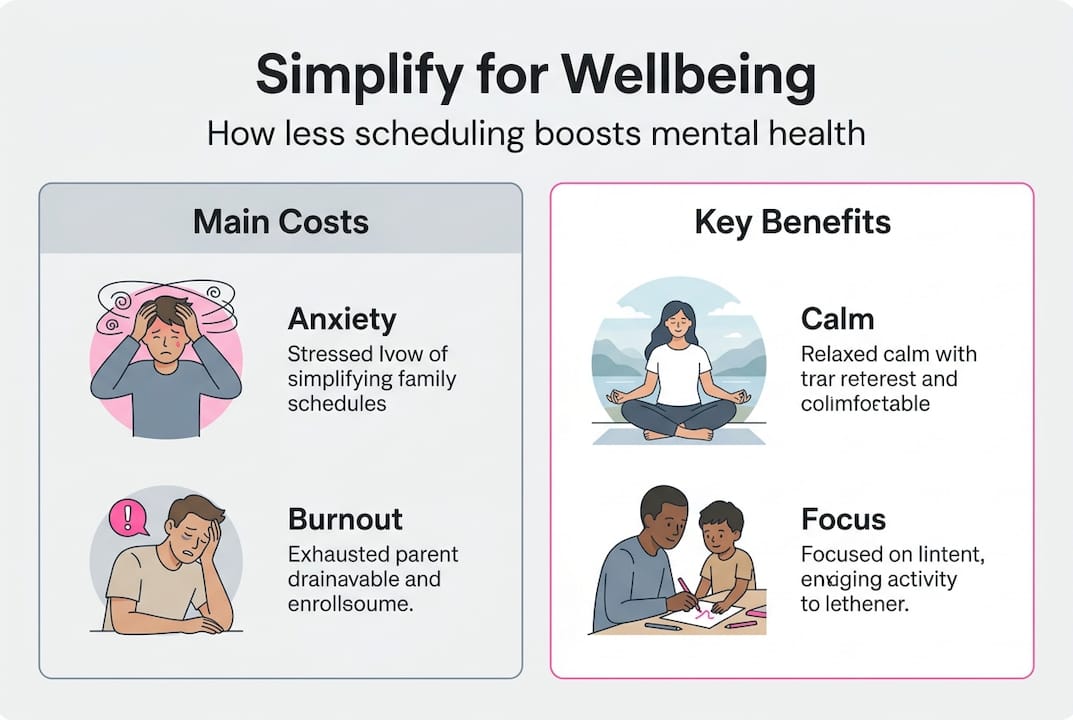
The hidden benefits of simplifying your family’s schedule
What happens when you actually simplify? The benefits surprise most families. Predictable routines enhance security and learning in children, creating a foundation for emotional stability. But here’s the twist: flexibility matters just as much as consistency.
Simplified schedules unlock these powerful advantages:
- Emotional resilience: Kids learn to handle boredom and create their own entertainment
- Stronger relationships: Regular family dinners and game nights build lasting bonds
- Better sleep: Consistent bedtimes without late-night activities improve rest quality
- Creative development: Unstructured time sparks imagination and problem-solving skills
- Reduced stress: Parents and children both experience lower anxiety levels
Think of your family schedule like a garden. Overplanting leaves no room for anything to truly flourish. When you thin out the commitments, the remaining activities get the attention and energy they deserve.
Pro Tip: Create “white space” in your calendar by blocking off at least two evenings per week with no scheduled activities. Protect this time as fiercely as you would a doctor’s appointment.
“Flexibility in routines allows families to adapt to real-life needs without the rigidity that creates additional stress.”
The key is balance. Routines provide security, but rigid schedules create pressure. When families embrace work-life balance tips, they discover that less truly becomes more. Understanding how to achieve family time balance transforms daily life from survival mode to thriving mode.
How to actually simplify: Proven strategies for families
Ready to make real changes? These research-backed strategies give you a clear roadmap. The mechanics include prioritizing core values, using shared calendars, time-blocking, and weekly reviews to maintain balance without losing flexibility.
Step-by-step simplification process:
- Audit current commitments: List every recurring activity for each family member
- Apply the one-to-two rule: Limit each child to one or two activities per season
- Reserve family night: Block one evening weekly for unscheduled family time
- Build in buffer time: Add 15-minute gaps between activities for transitions
- Conduct weekly reviews: Spend 10 minutes each Sunday adjusting the coming week
- Involve the kids: Let children help choose activities and occasionally quit without guilt
| Calendar Type | Strengths | Best For |
|---|---|---|
| Digital Shared | Real-time updates, reminders, accessibility | Coordination between parents |
| Paper Central | Visual overview, tactile engagement, family involvement | Weekly planning sessions |
| Hybrid System | Combines benefits of both approaches | Most families |
Research shows digital calendars aid coordination, but hybrids enhance connection. A shared Google Calendar keeps everyone updated, while a large wall calendar in the kitchen creates a visual hub where family members can see the week at a glance.
Pro Tip: Color-code your calendar by person or activity type. This visual system helps you spot imbalances instantly, like when one child has five activities while another has none.
The tools matter less than the system. Whether you prefer time management tools comparison or dive into block scheduling for families, consistency beats perfection. Our time blocking guide walks you through setting up a system that actually sticks.
Dealing with real-world challenges and resistance
Theory meets reality when you start cutting commitments. Guilt creeps in. What if my child falls behind? What will other parents think? These fears are normal, but working parents benefit from predictable blocks, and allowing children to quit activities supports their overall well-being.
Common obstacles and solutions:
- Parental guilt: Remind yourself that research supports less, not more. Your child needs your presence more than another trophy.
- FOMO in kids: Teach children that missing one opportunity opens space for others. Not every door needs to stay open.
- Co-parenting complexity: Create a shared digital calendar accessible to both households. Consistency across homes reduces confusion.
- Work schedule conflicts: Block predictable childcare times and protect them. Working from home improves balance unless hours extend too long.
- Social pressure: Practice saying, “That sounds great, but we’re keeping our schedule simple this season.” No elaborate explanations needed.
Letting kids quit deserves special attention. We often push children to “finish what they started,” but this can backfire. If an activity causes genuine distress or prevents adequate sleep, quitting becomes the healthy choice. The lesson isn’t about giving up, it’s about recognizing when something no longer serves you.
“Teaching children to make intentional choices about their time is a life skill worth more than any trophy or certificate.”
Single parents and dual-working families face extra challenges. The principles still apply, but implementation requires creativity. Maybe family night becomes Saturday breakfast instead of a weeknight dinner. Perhaps you batch errands and activities on one day to free up others completely.
For practical application, explore these time management tips and discover productivity hacks for families that work with your unique situation, not against it.
Take the next step: More tools for balanced family life
You’ve learned why simplification matters and how to start. Now it’s time to build on this foundation with additional resources designed specifically for busy families seeking sustainable balance.
Our productivity hacks for families offer quick wins you can implement this week. From meal planning shortcuts to morning routine streamlining, these practical tips complement your simplified schedule perfectly.
When your physical space matches your calendar, magic happens. Explore our home organization systems to create an environment that supports your new rhythm. Clutter-free spaces reduce mental load and make simplified living feel natural rather than forced.
For families ready to transform their entire approach, our guide on family management systems shows how to integrate scheduling, household tasks, and family goals into one cohesive system. This holistic approach ensures simplification becomes a lifestyle, not just a temporary fix.
Frequently asked questions
How many activities should kids have each week?
Most experts recommend one to two extracurriculars per child, keeping total commitments under 10-15 hours per week to prevent burnout and support healthy development.
Can a simple schedule help my child’s mental health?
Yes, predictable routines enhance security and well-being in children, reducing anxiety while improving sleep quality and emotional stability.
What’s the best tool for family scheduling?
A combination of digital and paper systems works best for most families, offering both real-time coordination and visual overview for planning.
Should I allow my child to quit an activity?
Experts agree that allowing kids to quit activities when overwhelmed or disinterested supports their overall well-being and teaches healthy boundary-setting.
Recommended
- Essential Tips for Simplifying Schedules in 2025 –
- Why Simplify Meals? Cut Prep Time 40% for Families –
- Stop Wasting Time on Busy Work: Try These 7 Quick Hacks for Real Productivity –
- Block Scheduling: Transform Time for Busy Families –
Want the done-for-you version? The Home Rhythm Planner is the tool for cutting the week back to what actually has to happen.