

7 Smart Types of Saving Challenges for Busy Families
Finding extra money to save for your family can feel overwhelming, especially when daily expenses eat away at your budget. Sometimes, even small steps toward building savings seem out of reach or hard to maintain. But there are proven strategies that help families break through these barriers without complex planning or sacrifices.
This list will reveal practical methods like the 52-week savings challenge and the spare change jar, which can help you save over $1,000 each year and get everyone involved. You’ll also discover easy ways to automate saving, reset spending habits, and turn everyday actions into long-term financial wins.
Get ready for actionable tips that make saving simple, sustainable, and even fun for your entire family. Each strategy is designed to fit busy lifestyles and offer real results you can start seeing fast.
Table of Contents
- 1. The 52-Week Savings Challenge For Steady Growth
- 2. The Spare Change Jar For Easy Family Participation
- 3. The No-Spend Weekend Challenge For Quick Savings
- 4. The Envelope System For Budget Control
- 5. The $5 Bill Challenge For Simple Savings Habits
- 6. The Pantry Challenge For Cutting Grocery Costs
- 7. The Round-Up Challenge For Automatic Savings
Quick Summary
| Key Insight | Explanation |
|---|---|
| 1. Start the 52-Week Challenge | Gradually increase savings weekly to reach $1,378 by year’s end. This method suits various income levels and encourages consistent saving habits. |
| 2. Utilize a Spare Change Jar | Collect coins to teach children about saving, making it a fun and engaging family activity that requires no planning. |
| 3. Implement the No-Spend Weekend | Limit discretionary spending for a weekend to quickly boost savings while promoting family teamwork and financial awareness. |
| 4. Try the Envelope System | Allocate cash for specific categories to control spending and prevent overspending, helping visualize your financial limits easily. |
| 5. Take on the $5 Bill Challenge | Save every $5 bill received to effortlessly build savings over time; this simple practice creates a fun family challenge. |
1. The 52-Week Savings Challenge for Steady Growth
Imagine building a robust savings strategy that grows effortlessly throughout the year without feeling like a financial burden. The 52-week savings challenge is a brilliant method designed for busy families looking to create steady financial momentum.
This innovative savings approach works by incrementally increasing weekly deposits in a systematic way. Here’s how it breaks down:
- Week 1: Save $1
- Week 2: Save $2
- Week 3: Save $3
By following this pattern, you progressively increase your savings amount each week. At the end of 52 weeks, you’ll have saved over $1,378 without feeling overwhelmed.
The beauty of this challenge lies in its flexibility. Families can adjust the strategy to match their income and comfort level. Some choose to start with higher initial amounts or even reverse the challenge during expensive holiday months.
The key is consistent, incremental saving that builds financial discipline without stress.
To make this challenge work, consider these practical implementation strategies:
- Set up an automatic transfer to a dedicated savings account
- Use a printable tracking chart to monitor your progress
- Involve the whole family to create a savings culture
Pro tip: Create a visual savings tracker that your kids can help color in each week to make saving fun and educational.
2. The Spare Change Jar for Easy Family Participation
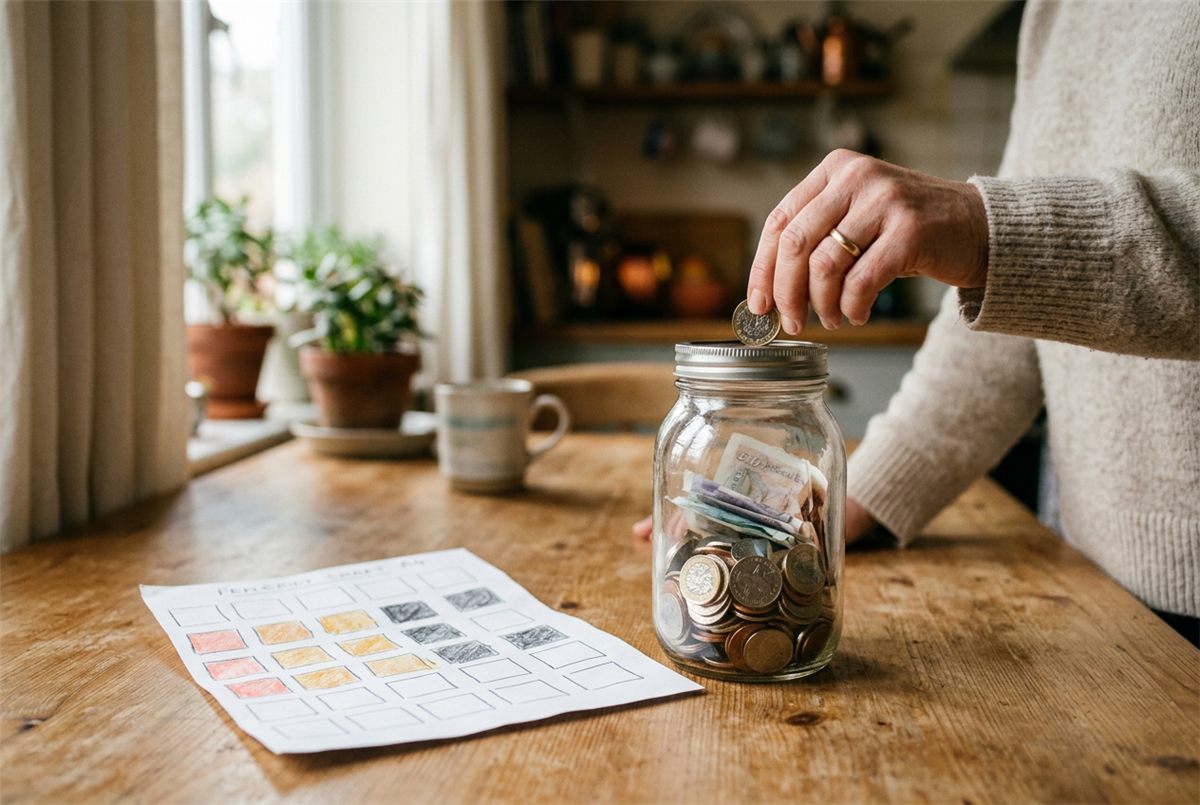
Turning loose coins into a powerful savings strategy can transform how your family thinks about money. The spare change jar is a simple yet effective method that makes saving fun and accessible for everyone.
This approach leverages the power of small, consistent savings that add up surprisingly quickly. By collecting spare change from pockets, purses, and daily transactions, families can build a meaningful savings fund without feeling the pinch.
Here are some compelling reasons to start a spare change jar:
- Teaches financial awareness to children
- Creates a visible representation of saving
- Requires zero advanced planning
- Works for all family members
Every coin dropped is a small victory in financial education.
To make the spare change jar most effective, try these strategies:
- Place the jar in a common family area
- Set monthly family goals for total savings
- Make a ritual of counting and celebrating your savings
Modern families can also automate this savings concept through digital round-up apps that transfer small amounts automatically.
Pro tip: Choose a clear jar so kids can visually track the growing savings and stay motivated.
3. The No-Spend Weekend Challenge for Quick Savings
What if you could save money without feeling like you’re sacrificing everything fun? Enter the no-spend weekend challenge – a powerful strategy for families looking to reset their spending habits and boost their savings quickly.
The concept is simple. Restrict discretionary spending for a full weekend, focusing only on absolute essentials like groceries and emergency needs. This challenge transforms your relationship with money by revealing how much you typically spend on unnecessary items.
Here are key benefits of the no-spend weekend:
- Reduces impulse purchasing
- Increases financial awareness
- Provides a quick savings boost
- Creates family teamwork around financial goals
Saving money isn’t about deprivation – it’s about being intentional.
To make your no-spend weekend successful, follow these steps:
- Plan meals and activities in advance
- Remove temptation by avoiding online shopping sites
- Find free family entertainment options
- Prepare homemade meals and snacks
- Track and celebrate your total savings
Potential weekend savings can range from $50 to $200, depending on your typical spending habits. The real value goes beyond dollars – it’s about changing your financial mindset.
Pro tip: Create a fun family game or challenge around finding free activities during your no-spend weekend to keep everyone motivated and engaged.
4. The Envelope System for Budget Control
What if you could transform your family’s spending habits with one simple strategy? The envelope system is a powerful budgeting technique that turns abstract financial planning into a tangible, easy-to-follow method.
Cash allocation into specific spending categories helps families gain unprecedented control over their monthly expenses. By physically or digitally dividing money into designated envelopes, you create clear boundaries for discretionary spending.
Here are the key advantages of the envelope system:
- Eliminates guesswork in budgeting
- Prevents overspending
- Creates visual spending limits
- Teaches financial discipline
Money management becomes simple when you can literally see your budget.
To implement the envelope system effectively, follow these steps:
- Identify your major spending categories
- Determine monthly budget for each category
- Withdraw cash or set up digital envelope allocations
- Spend only the money in each designated envelope
- Adjust categories as your family’s needs change
Modern families can now use digital envelope budgeting tools that offer the same discipline with smartphone convenience.
Pro tip: Start with just three envelopes – groceries, entertainment, and personal spending – to avoid overwhelming yourself in the beginning.
5. The $5 Bill Challenge for Simple Savings Habits
What if saving money could be as simple as setting aside a single bill every time you get change? The $5 bill challenge transforms pocket money into a powerful savings strategy for busy families.
Small denominations can create significant impact when saved consistently. By committing to save every $5 bill that passes through your hands, you can build a surprising nest egg without feeling the financial strain.
Here are compelling reasons to try the $5 bill challenge:
- Painless savings method
- No complex budgeting required
- Builds consistent saving habits
- Creates a fun family financial game
Small actions compound into remarkable financial results.
Implement the challenge with these simple steps:
- Commit to saving every $5 bill you receive
- Immediately set aside the bill in a designated savings container
- Count and deposit savings monthly
- Track your total accumulated amount
- Celebrate your savings milestones
Inspired by entrepreneurial savings strategies, this approach turns pocket change into meaningful financial progress.
Pro tip: Create a clear jar for your $5 bills so your entire family can see the savings grow and get excited about the challenge.
6. The Pantry Challenge for Cutting Grocery Costs
Busy families are always searching for clever ways to trim their grocery budget without sacrificing nutrition. The pantry challenge is a strategic approach that turns your existing food supplies into a money-saving adventure.
Food pantry resources can save families approximately $1,000 annually by encouraging creative meal planning using ingredients already on hand.
Here are key benefits of the pantry challenge:
- Reduces unnecessary grocery spending
- Minimizes food waste
- Encourages culinary creativity
- Helps organize kitchen inventory
Resourcefulness is the secret ingredient in family budgeting.
Implement the pantry challenge with these strategic steps:
- Take inventory of your current pantry items
- Plan meals using existing ingredients
- Avoid buying new groceries for one week
- Get creative with recipe combinations
- Track your total savings
Community nutrition experts recommend strategic meal planning to maximize food resources and minimize expenses.
Pro tip: Create a fun family game where everyone suggests meals using only pantry ingredients, turning budget-saving into an entertaining challenge.
7. The Round-Up Challenge for Automatic Savings
Imagine saving money without even trying. The round-up challenge transforms everyday spending into an effortless savings strategy that makes building your financial cushion feel almost magical.
Micro contributions from everyday purchases can accumulate surprising amounts of money with zero extra effort. Each time you make a purchase, the transaction is automatically rounded up to the nearest dollar, with the difference transferred directly into your savings account.
Here are compelling advantages of the round-up savings approach:
- Completely automated savings process
- No additional financial strain
- Builds savings without conscious effort
- Works with existing spending habits
Small changes create significant financial transformations.
Implement the round-up challenge through these methods:
- Link your debit card to a round-up savings app
- Choose your preferred savings destination
- Set initial savings goals
- Monitor your growing balance
- Celebrate your effortless savings milestones
Technology has made spontaneous micro-savings increasingly popular among younger generations seeking smart financial strategies.
Pro tip: Choose an app that allows you to customize round-up amounts and transfer frequencies to match your personal financial comfort level.
Below is a comprehensive table summarizing the savings strategies and techniques discussed throughout the article.
| Savings Method | Description | Benefits |
|---|---|---|
| The 52-Week Savings Challenge | Incremental savings approach adding $1 more each successive week for 52 weeks. | Steady accumulation of $1,378 annually through consistency and adaptability to varying financial situations. |
| Spare Change Jar | Collecting and saving loose change from daily transactions into a common container. | Builds family involvement in financial awareness and fosters small but impactful saving habits. |
| No-Spend Weekend Challenge | Restricts discretionary expenses over a weekend, allowing only essential spending. | Encourages financial mindfulness, rapid savings boost, and decreases impulse purchases. |
| Envelope Budgeting System | Allocating cash into specific envelopes for major spending categories to regulate and control expenditures. | Establishes clear financial boundaries, helps track spending, and promotes disciplined budget management. |
| The $5 Bill Challenge | Designating every $5 bill received to savings without exception. | Simple and tangible savings approach that builds a nest egg over time. |
| The Pantry Challenge | Meal planning using ingredients exclusively from pre-existing pantry stock. | Reduces grocery expenses, minimizes food waste, and fosters creativity in meal preparation. |
| Round-Up Savings Automation | Automatically rounding up each purchase amount to the nearest dollar and saving the difference. | Effortless saving technique leveraging technology to build financial reserves from minor everyday transactions. |
Take Control of Your Family Savings and Home Life Today
Busy families face the real challenge of balancing consistent saving habits with everyday responsibilities. This article highlights practical saving challenges like the 52-Week Savings Challenge and the Envelope System that help busy households build financial discipline without added stress. If managing your family budget feels overwhelming or if you want to turn small saving actions into lasting financial habits these smart strategies are the key.
At Its A Southern Life Yall you will find proven organization hacks and simple living strategies tailored for busy families. Discover effective productivity tips and home management systems that complement money-saving challenges to create peace of mind and efficiency in your daily routine. Ready to start transforming your family’s financial future and organize your life with ease Explore our budgeting systems and time management tools now and take the first step toward lasting balance and savings success.
Frequently Asked Questions
What is the 52-week savings challenge, and how can it help my family?
The 52-week savings challenge involves saving an increasing amount each week, starting with $1 and going up to $52 by the end of the year. This method allows families to build savings gradually without significant financial strain, accumulating over $1,378 by the end of the challenge. Start by setting up automatic transfers to a dedicated savings account to make it easier.
How can we effectively implement the spare change jar in our household?
Implementing a spare change jar is simple; just place a clear jar in a common area of your home to collect loose coins. Encourage every family member to contribute their change, and set monthly goals to track your savings progress. This can teach children the importance of saving while making it a fun family activity.
What are some tips for succeeding in the no-spend weekend challenge?
To succeed in the no-spend weekend challenge, plan meals and activities ahead of time and commit to only spending on essentials. Avoid online shopping and find free entertainment options in your community. This can help your family save between $50 and $200, depending on your usual spending habits.
How does the envelope system work for budgeting?
The envelope system involves allocating cash into specific envelopes for different spending categories, creating physical limits around your budget. Withdraw the planned budgeted amounts and only spend what is in each envelope—this prevents overspending and enhances financial discipline. Start with three envelopes for groceries, entertainment, and personal spending to keep it manageable.
What is the $5 bill challenge, and how can it benefit our family’s savings?
The $5 bill challenge means saving every $5 bill you receive, which can quickly accumulate into a significant savings fund over time. To implement this, designate a specific container for your $5 bills and count your total monthly to celebrate your savings milestones. By consistently setting aside these bills, your savings can grow more than you expect.
How can the round-up challenge make saving easier for our family?
The round-up challenge automates savings by rounding up each purchase to the nearest dollar and transferring the difference into your savings account. Link your debit card to this feature and set a savings goal, allowing money to build effortlessly without additional effort. This method can lead to meaningful savings over time with little lifestyle impact.
Recommended
- Types of Savings Strategies for Families – It’s a Southern Life Ya’ll
- 20 Time-Tested Family Hacks to Break the Paycheck-to-Paycheck Cycle (Strategies That Actually Work with Kids) – It’s a Southern Life Ya’ll
- Sinking Funds: Everything You Need to Know – It’s a Southern Life Ya’ll
- 10 Genius Ways to Save $200 This Month Without Cutting the Fun Stuff – It’s a Southern Life Ya’ll
- Complete Guide to Workflow for Austin Family Adventures | Trinity Concierge
Want a little more help with this? The Debt-Free & Saving Smart Playbook gives the challenge somewhere to go once the month is over.