

Family Time Management Strategies for Busy Households
Over half of American families say that balancing work and home life feels more challenging now than ever before. Juggling school projects, careers, and family commitments leaves little room for true connection. As everyday routines grow more complicated, understanding family time management becomes crucial for American households seeking harmony. This guide spotlights practical solutions and flexible strategies that help families reclaim quality time together, even amid busy schedules.
Table of Contents
- Defining Family Time Management Today
- Types of Family Schedules and Approaches
- Building Effective Family Routines and Habits
- Essential Tools and Technology for Families
- Common Time Traps and How to Avoid Them
Key Takeaways
| Point | Details |
|---|---|
| Effective Family Time Management | Focus on creating flexible systems that adapt to changing family needs and prioritize quality interactions over rigid scheduling. |
| Utilize Technology for Coordination | Implement shared digital calendars and task management tools to streamline communication and reduce scheduling conflicts. |
| Tailored Family Scheduling Approaches | Recognize that family schedules should be customized to fit unique household dynamics, blending various strategies for optimal balance. |
| Regularly Review and Adapt | Conduct regular family meetings to assess schedules, redistribute tasks, and identify potential time traps proactively. |
Defining Family Time Management Today
Family time management is about intentionally creating space for meaningful connections while balancing multiple responsibilities. Understanding modern family dynamics requires recognizing how work and personal life intersect in increasingly complex ways.
Today’s families face unprecedented challenges in maintaining balance. According to research on work-life equilibrium, achieving harmony between professional commitments and family interactions has become more critical than ever. Families are no longer operating on traditional schedules but navigating fluid, dynamic environments that demand strategic planning and intentional communication.
Successful family time management isn’t about perfection but creating flexible systems that adapt to changing needs. Effective strategies involve understanding each family member’s unique schedule, establishing clear communication channels, and prioritizing quality interactions over rigid time tracking. Modern families need dynamic approaches that recognize individual rhythms while maintaining collective goals.
Pro Tip: Create a shared digital calendar that allows every family member to input their commitments and activities, ensuring transparent communication and reducing scheduling conflicts.
With time blocking techniques for parents, families can transform chaotic schedules into structured yet responsive systems that honor both individual and collective needs.
Types of Family Schedules and Approaches
Family schedules are not one-size-fits-all solutions but complex systems tailored to unique household dynamics. Understanding the various approaches helps families design strategies that maximize efficiency and quality time together.
Research on work schedule arrangements in two-adult households reveals multiple coordination strategies families use to balance professional and personal responsibilities. These approaches typically include staggered work shifts, flexible hours, and carefully planned childcare handoffs that ensure continuous family support.
Different family structures require different scheduling models. For instance, parenting schedules for separated families demonstrate the importance of structured yet flexible time-sharing arrangements. Common approaches include alternate weekend plans, 50-50 shared care models, and customized arrangements that prioritize children’s emotional well-being.
Modern families often blend multiple scheduling techniques to create personalized systems. Some popular approaches include:
- Block scheduling: Dedicating specific time blocks for work, family, and personal activities
- Flexible work arrangements: Utilizing remote or hybrid work options
- Tag-team parenting: Parents alternating primary caregiving responsibilities
Pro Tip: Conduct a monthly family schedule review where everyone contributes input, allowing for continuous adaptation and alignment of individual and collective needs.
With practical productivity hacks for families, households can transform chaotic schedules into streamlined, supportive systems that work for everyone.
Here’s how common family scheduling approaches compare:
| Approach | Ideal For | Flexibility Level | Main Advantage |
|---|---|---|---|
| Block Scheduling | Busy families, students | Moderate | Predictable routines |
| Flexible Work Arrangements | Remote workers, freelancers | High | Adapts to changing needs |
| Tag-Team Parenting | Families with varying shifts | High | Continuous child coverage |
| Shared Care Models | Separated or co-parenting homes | Moderate | Balanced child involvement |
Building Effective Family Routines and Habits
Creating consistent family routines is more than just scheduling activities. It’s about establishing predictable patterns that provide emotional stability, reduce stress, and help everyone function more smoothly as a cohesive unit.

Research on family routines demonstrates that stable daily activities significantly impact children’s development and overall family functioning. Consistent routines like regular meal times, bedtime rituals, and shared activities contribute to reduced attention problems and improved emotional well-being for children.
Structuring family habits requires thoughtful planning and flexibility. Academic growth studies highlight how designated routines such as shared study times and structured meal conversations can create supportive learning environments. Effective family routines typically include:
- Morning preparation rituals
- Evening wind-down sequences
- Weekend planning sessions
- Consistent communication check-ins
Successful routine implementation involves gradual introduction and collective family input. Start with small, manageable changes and adjust based on everyone’s feedback and evolving needs.
With time management strategies for families, households can develop personalized systems that create structure without feeling restrictive.
Pro Tip: Create a visual routine board where family members can track and modify daily responsibilities, ensuring transparency and shared accountability.
Essential Tools and Technology for Families
Technology has transformed how families manage time, communication, and coordination. Modern households now rely on sophisticated digital tools that streamline complex schedules and enhance collective productivity.
Research on information workers’ scheduling techniques reveals the critical role of digital platforms in managing family activities. Advanced tools like shared digital calendars, collaborative task management apps, and integrated communication platforms enable families to synchronize schedules, track responsibilities, and maintain real-time connectivity.
Technological advancements in work-life balance demonstrate how flexible technologies support families navigating increasingly complex schedules. Essential technological tools for modern families include:
- Shared cloud calendars
- Task management applications
- Family communication platforms
- Automated reminder systems
- Remote work collaboration tools
Successful technology integration requires selecting tools that match your family’s unique communication style and needs. Consider factors like ease of use, cross-platform compatibility, and customization options when choosing digital solutions.
With comprehensive time management tool comparisons, families can discover technologies that genuinely simplify their daily coordination.
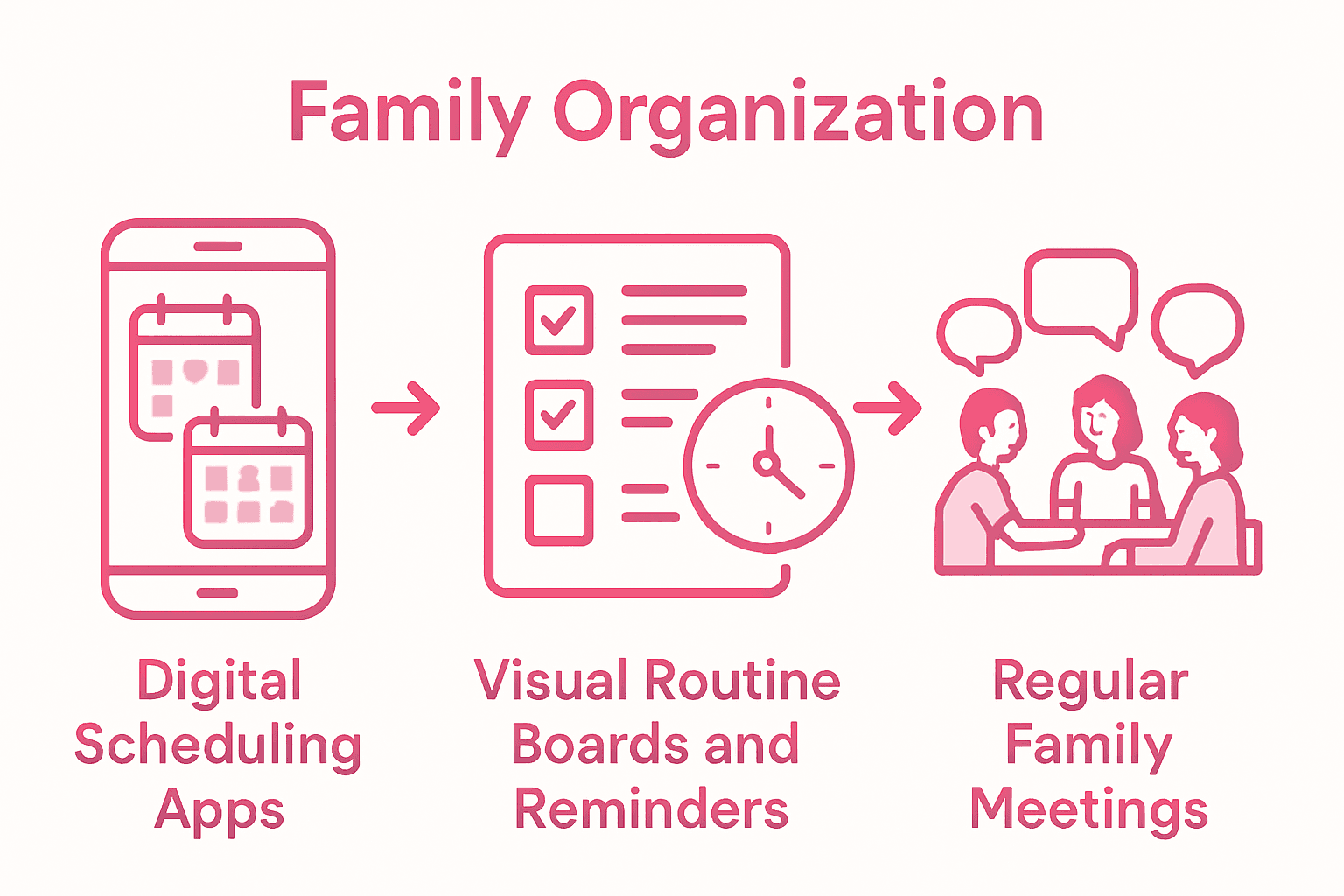
To help you choose, here’s a summary of popular digital tools for family time management:
| Tool Type | Example Use | Key Benefit |
|---|---|---|
| Shared Cloud Calendars | Organizing activities | Prevents scheduling conflicts |
| Task Management Apps | Assigning chores | Tracks completion and responsibility |
| Communication Platforms | Quick updates, reminders | Keeps everyone informed instantly |
| Automated Reminders | Appointments, routines | Reduces forgetfulness and stress |
Pro Tip: Conduct a monthly family technology review, evaluating which digital tools are working and which need replacement to keep your system efficient and responsive.
Common Time Traps and How to Avoid Them
Every family encounters time management challenges that can quickly derail productivity and create unnecessary stress. Understanding these common pitfalls is the first step toward creating more efficient household systems.
Time poverty research reveals that overcommitment is a significant barrier to effective family time management. Families often find themselves trapped in cycles of continuous activity without meaningful progress, spreading their energy too thin across multiple responsibilities.
The Time Bind concept highlights how work and home life boundaries have become increasingly blurred, leading to chronic stress and reduced quality family interactions. Common time traps that families frequently encounter include:
- Constant digital interruptions
- Overcommitting to external activities
- Inefficient task management
- Poor prioritization strategies
- Lack of systematic planning
Successful time management requires conscious effort to recognize and redirect energy toward meaningful activities. This means learning to say no, establishing clear boundaries, and creating intentional systems that protect family time.
With productivity tips for parents, families can develop strategies that transform time management from a challenge into an opportunity.
Pro Tip: Implement a weekly family meeting to review schedules, redistribute tasks, and proactively identify potential time traps before they become overwhelming.
Take Control of Your Family Time Today
Busy households often struggle with balancing work-life demands, managing complex schedules, and creating meaningful family routines. If the challenge of family time management, overcoming time traps, and building flexible yet structured systems sounds familiar, you are not alone. Many modern families seek practical solutions to reduce stress and foster genuine connections.
At ItsASouthernLifeYall, you will find proven organization hacks, productivity tips, and simple living strategies designed for busy families just like yours. Explore our time management tools and strategies to transform chaotic days into peaceful, well-orchestrated routines. Start creating a home environment where every family member’s schedule flows smoothly with less conflict and more quality time.
Don’t wait to reclaim your family’s time. Visit ItsASouthernLifeYall now to access easy-to-implement systems and expert advice that will help you master family time management once and for all.
Frequently Asked Questions
What are effective strategies for managing family time?
Successful family time management involves understanding each family member’s unique schedule, establishing clear communication channels, and prioritizing quality interactions over rigid time tracking.
How can a shared digital calendar improve family time management?
A shared digital calendar allows every family member to input their commitments and activities, ensuring transparent communication and reducing scheduling conflicts.
What types of family schedules can help balance responsibilities?
Common approaches include block scheduling, flexible work arrangements, tag-team parenting, and shared care models tailored to the specific needs of the family structure.
How can technology aid in effective family time management?
Essential technological tools include shared cloud calendars, task management applications, communication platforms, automated reminder systems, and remote work collaboration tools that help synchronize schedules and enhance productivity.
Recommended
- 7 Time Management Tips for Families to Balance Life – It’s a Southern Life Ya’ll
- Time Blocking Guide for Parents – It’s a Southern Life Ya’ll
- 7 Family-Friendly Examples of Productivity Hacks That Work – It’s a Southern Life Ya’ll
- Top Time Management Tools – Expert Comparison 2025 – It’s a Southern Life Ya’ll
- House Cleaning Basics: Essential Guide for McKinney Homes 2025
Need a little more than a blog post? The Home Rhythm Planner puts those strategies on one page you can hang up.