

How to teach kids budgeting: practical strategies for parents
Teaching your kids about money can feel overwhelming when you’re already juggling work, household responsibilities, and a packed family schedule. You want your children to grow up financially savvy, but finding the time and knowing where to start often feels impossible. The good news is that teaching budgeting doesn’t require complex financial expertise or hours of formal lessons. With practical, hands-on strategies woven into everyday life, you can equip your children with money management skills that will serve them well into adulthood. This guide breaks down actionable steps busy parents can implement immediately to foster financial literacy at any age.
Table of Contents
- Key takeaways
- Preparing to teach kids budgeting: what you need and key concepts
- Step-by-step guide to teaching kids effective budgeting skills
- Common challenges and troubleshooting when teaching budgeting to kids
- Measuring success: how to verify and reinforce your child’s budgeting skills
- Support your family’s financial literacy journey
- FAQ
Key Takeaways
| Point | Details |
|---|---|
| Project based learning | Research shows project based learning outperforms traditional lectures for middle school budgeting comprehension. |
| Real account management | Teens who manage real accounts before age 16 show about 40 percent better budgeting skills in adulthood. |
| Practical tools and practice | Use age appropriate tools like jars worksheets and kid friendly apps and practice money skills weekly. |
| Set clear goals | Set age appropriate financial goals tied to personal interests to keep kids engaged. |
Preparing to teach kids budgeting: what you need and key concepts
Before you start teaching budgeting, you need to understand the core concepts yourself and gather a few simple tools. This preparation ensures you can explain financial ideas clearly and provide hands-on learning experiences that stick.
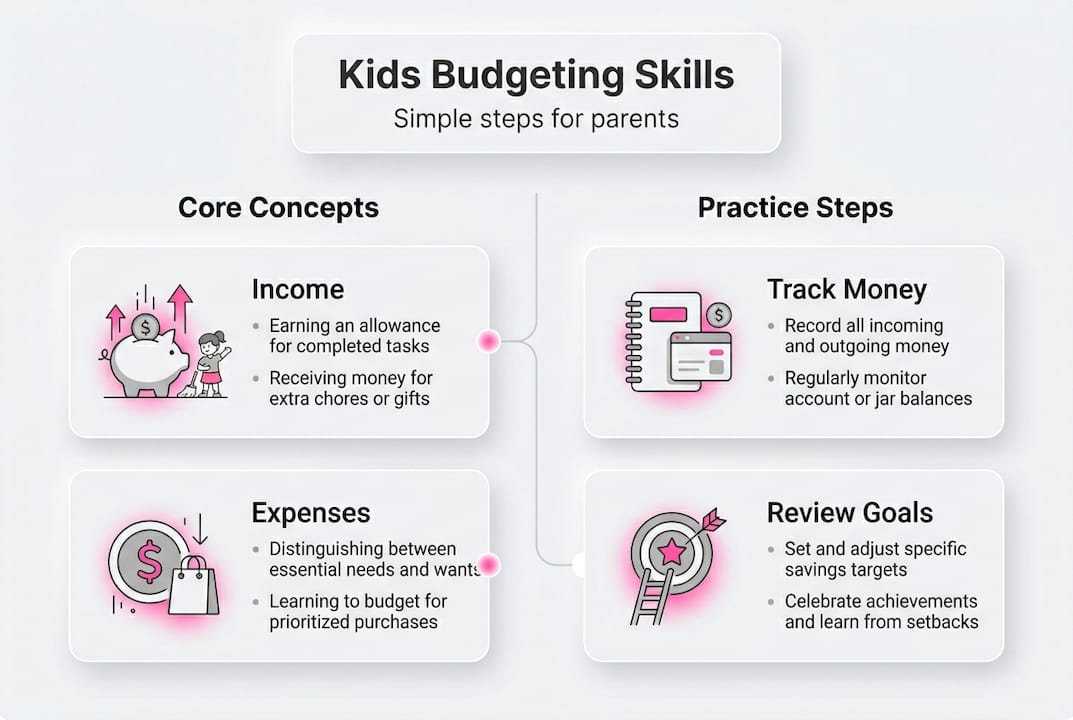
Start by defining four fundamental concepts in language your child understands. Income is money coming in, whether from allowance, birthday gifts, or small jobs. Expenses are purchases or things money gets spent on. Saving means setting money aside for future use. Goals are specific things your child wants to buy or achieve with their money.
Research shows that project-based learning outperforms traditional lectures for middle-school budgeting comprehension. This means your kids will learn better by actually managing money than by listening to explanations about how money works. Skip the formal lectures and focus on creating real experiences.
Here’s what you’ll need to get started:
- Physical tools like three clear jars labeled “Spending,” “Saving,” and “Giving”
- A simple budget worksheet or kid-friendly app like Greenlight or GoHenry
- Real money in small denominations for younger children
- A notebook or digital document for tracking income and expenses
- Age-appropriate financial goals your child actually cares about
The tools you choose should match your child’s developmental stage. Preschoolers do well with visual systems like jar sorting. Elementary students can handle basic worksheets. Teens benefit from apps that mirror adult banking experiences.
| Age Group | Recommended Tools | Learning Focus |
|---|---|---|
| Ages 3 to 6 | Clear jars, play money | Recognizing coins, basic counting |
| Ages 7 to 11 | Simple worksheets, piggy banks | Tracking spending, saving for goals |
| Ages 12 to 15 | Budgeting apps, prepaid cards | Account management, needs vs. wants |
| Ages 16+ | Real bank accounts, investment apps | Complex budgeting, long-term planning |
Pro Tip: Connect budgeting lessons to something your child genuinely wants. A 10-year-old saving for a new video game will engage far more than one working toward an abstract “future” goal. Make it personal and immediate.
Set up a regular time for money conversations, even if it’s just 10 minutes weekly. Consistency matters more than duration. You might review spending every Sunday evening or discuss financial decisions before weekend shopping trips. For more foundational concepts, explore these teaching kids about money tips that build on core values.
Step-by-step guide to teaching kids effective budgeting skills
Now that you’ve prepared the groundwork, it’s time to actively teach budgeting through concrete actions your child can practice regularly.
1. Start with allowance allocation
Give your child a small, consistent allowance and immediately divide it into categories. For younger kids, use the three-jar method: spending, saving, and giving. Older children can add categories like “long-term goals” or “emergency fund.” The key is making the division visual and immediate.
2. Introduce real-world simulations
Use everyday situations as teaching moments. Before grocery shopping, give your child $10 and a small list of items to find within budget. Let them compare prices, make choices, and experience the satisfaction of staying under budget or the disappointment of overspending.
3. Implement hands-on money management

Research demonstrates that teens managing real accounts before 16 show 40% better budgeting skills in adulthood. Even younger children benefit from managing actual money rather than abstract concepts. Let them hold cash, make purchases, and receive change.
4. Teach income and expense tracking
Show your child how to record every dollar coming in and going out. Younger kids can draw pictures of purchases in a notebook. Older children can use a simple spreadsheet or budgeting app. Review these records together weekly to spot patterns and discuss decisions.
5. Schedule regular budget reviews
Set aside time every week or two to sit down with your child and review their budget. Ask questions like “What did you spend money on this week?” and “Are you closer to your savings goal?” Celebrate wins and problem-solve challenges together without judgment.
Pro Tip: Turn budgeting into a game by creating challenges with small rewards. Who can find the best deal on a needed item? Who can save the most in a month? Competition and fun make financial lessons memorable.
Here are engaging activities that reinforce budgeting concepts:
- Play board games like Monopoly Junior or The Game of Life that involve money decisions
- Create a pretend store at home where kids “buy” items with play money
- Let children plan and budget for a family meal or outing
- Involve kids in comparing prices during actual shopping trips
- Set up a family savings challenge for a shared goal like vacation activities
For teenagers specifically, consider these 7 steps to teaching teens about money that build on these foundational practices. The transition from childhood money concepts to teen financial responsibility requires intentional progression.
Remember that learning happens through repetition and mistakes. Your child will overspend, forget to track expenses, or make impulse purchases. These moments provide the most valuable teaching opportunities. Instead of rescuing them from poor decisions, discuss what happened and how they might choose differently next time. When you’re ready for deeper conversations, these tips on talking to kids about money can help navigate more complex financial discussions.
Common challenges and troubleshooting when teaching budgeting to kids
Even with the best intentions and solid strategies, you’ll encounter obstacles when teaching your children about money. Recognizing these common challenges and knowing how to address them keeps your financial education efforts on track.
Keeping kids engaged remains the biggest hurdle for most parents. Children naturally find budgeting boring compared to screen time or play. Combat this by making every lesson interactive and relevant to their lives. Studies confirm that project-based learning is more effective for middle-schoolers’ budgeting comprehension than passive instruction. Create projects around real goals your child cares about.
Here are specific troubleshooting strategies for common obstacles:
- Lack of interest: Connect budgeting directly to something they want. A child saving for a skateboard will engage more than one learning abstract principles.
- Frustration from mistakes: Reframe errors as experiments. Ask “What did you learn?” instead of “Why did you do that?”
- Inconsistent practice: Build money conversations into existing routines like Sunday dinner or car rides rather than scheduling separate sessions.
- Sibling comparison: Avoid comparing children’s financial choices. Each child learns at their own pace and has different interests.
- Impatience with saving: Break large goals into smaller milestones with mini-celebrations along the way.
Your child will make financial mistakes, and that’s exactly the point. A 12-year-old who spends their entire month’s allowance in one day learns a powerful lesson about impulse control and delayed gratification. Resist the urge to bail them out or lecture extensively. Instead, express empathy and ask guiding questions.
“I can see you’re disappointed you don’t have money for the movie this weekend. What do you think you could do differently next month to make sure you have money when you want it?”
This approach teaches problem-solving and personal responsibility far more effectively than criticism or rescue.
Inconsistency derails many families’ budgeting education efforts. Life gets busy, and money conversations fall off the schedule. Combat this by keeping sessions short and linking them to regular activities. Review spending while driving to weekend activities. Discuss saving goals during dinner. Make it a natural part of family life rather than a formal event.
Some children develop misconceptions about money that need gentle correction. They might believe money appears magically from ATMs, that credit cards provide free money, or that all adults have unlimited funds. Address these misunderstandings directly but without shame. Explain how money actually works using concrete examples from your own life.
For teens approaching independence, these challenges intensify. The stakes feel higher as they near adulthood. If you’re navigating this transition, consider these strategies for preparing teens for financial independence that address age-specific obstacles.
Measuring success: how to verify and reinforce your child’s budgeting skills
Knowing whether your teaching efforts are working requires concrete ways to measure progress and reinforce developing skills. Success in teaching budgeting isn’t about perfection but about steady improvement in financial awareness and decision-making.
Start by establishing clear criteria for evaluating your child’s budgeting progress. These benchmarks should match their age and experience level:
1. Track decision-making improvements
Notice whether your child pauses before purchases to consider if they have enough money or if the item aligns with their goals. This pause indicates developing financial awareness.
2. Monitor goal achievement
Does your child successfully save for and purchase desired items? Meeting savings goals demonstrates understanding of delayed gratification and planning.
3. Assess tracking consistency
Check whether your child records income and expenses without constant reminders. Consistent tracking shows the habit is becoming internalized.
4. Evaluate problem-solving ability
When financial challenges arise, does your child propose solutions or immediately ask you to fix the problem? Independent problem-solving signals growing financial maturity.
5. Observe voluntary money conversations
Kids who initiate discussions about money, prices, or savings without prompting demonstrate genuine engagement with financial concepts.
Research shows that teens managing real accounts before age 16 have 40% better budgeting skills in adulthood. This underscores the importance of moving from simulated to real money management as children mature. Gradually increase the complexity and responsibility as they demonstrate competence.
| Skill Level | Age Range | Appropriate Responsibility |
|---|---|---|
| Beginner | 5 to 8 | Managing small allowance with guidance |
| Intermediate | 9 to 12 | Tracking spending, saving for medium-term goals |
| Advanced | 13 to 15 | Managing prepaid card, budgeting for personal expenses |
| Expert | 16+ | Real bank account, budgeting for major expenses |
Celebrate milestones to maintain motivation and reinforce positive behaviors. When your child successfully saves for a goal, acknowledge the discipline that required. When they make a smart spending choice, point out the good decision-making. Positive reinforcement builds confidence and encourages continued effort.
Create simple tests or checklists to assess understanding. Ask your child to explain budgeting concepts in their own words. Have them create a budget for a hypothetical situation. These informal assessments reveal gaps in understanding without feeling like school tests.
Pro Tip: Increase financial responsibility gradually based on demonstrated competence rather than age alone. A mature 11-year-old might handle more than an impulsive 14-year-old. Match responsibility to individual readiness.
Plan age-appropriate increases in budgeting responsibility as your child masters current skills. A child successfully managing $5 weekly might be ready for $10. A teen handling clothing money might take on entertainment expenses next. Progressive responsibility builds confidence and competence.
As your family develops stronger financial habits, these budgeting strategies for family stability can help you model the organized approach to money management you’re teaching your children. Kids learn as much from watching your financial behaviors as from direct instruction.
Support your family’s financial literacy journey
Teaching your children effective budgeting skills is just one piece of creating a well-organized, financially healthy family life. As you work to instill money management habits in your kids, you might find that streamlining other aspects of family life makes consistent financial education easier to maintain.
Busy parents often struggle to find time for intentional teaching moments. That’s where smart productivity strategies come in. Explore these productivity hacks for families that create more time and mental space for the important work of raising financially literate children. When daily chaos decreases, meaningful conversations about money happen more naturally.
Keeping financial materials organized also supports ongoing budgeting education. If your child’s budget worksheets, savings jars, and goal trackers are scattered and hard to find, the teaching momentum stalls. Discover home organization systems that help you maintain a dedicated space for family financial activities. A simple money station with everything in one accessible spot makes regular budget reviews effortless.
Finally, managing your own time effectively models the planning and prioritization skills underlying good budgeting. Your children notice how you balance competing demands and allocate limited resources, whether time or money. These productivity tips for parents help you demonstrate the organizational thinking that translates directly to financial management.
FAQ
How early should I start teaching my child budgeting?
You can introduce basic money concepts as early as preschool age, around 3 to 4 years old, by letting children sort coins and understand that money buys things. Simple budgeting activities work well starting in elementary school, around ages 6 to 8, when kids can grasp saving for specific goals. Adjust your approach based on your individual child’s maturity and interest level rather than strictly following age guidelines.
What are some fun activities to teach kids budgeting?
Board games like Monopoly, Payday, or The Game of Life make budgeting entertaining while teaching money management. Create hands-on experiences like pretend stores at home, family savings challenges for shared goals, or letting kids plan and budget for a special meal or outing. Shopping trips where children compare prices and make purchasing decisions within a set budget provide real-world practice that feels like adventure rather than schoolwork.
How do I handle mistakes my child makes with money management?
Treat every financial mistake as a valuable learning opportunity rather than a failure requiring punishment. When your child overspends or makes a poor purchasing choice, express empathy and ask questions that guide them toward better future decisions. Avoid rescuing them from natural consequences like running out of money before the week ends, as experiencing these outcomes teaches responsibility more effectively than lectures ever could.
Are real bank accounts necessary for teaching budgeting?
While not absolutely necessary, real bank accounts significantly improve budgeting outcomes. Teens managing real accounts before 16 show 40% better budgeting skills in adulthood compared to those who don’t. If opening an actual account isn’t feasible due to age or other constraints, use physical money, piggy banks, and budgeting apps to simulate real money management as closely as possible until your child is ready for the real thing.
Recommended
- 7 Steps to Teaching Teens About Money: Where to Start –
- Talking to Kids About Money—Building Lifelong Skills –
- How to Feed a Family on a Budget –
- Budgeting for Families – Creating Stability at Home –
- Come organizzare i compiti a casa per bambini con ADHD: guida pratica – Sara Conti
Want the printable version of this?
The Three-Jar Start is the whole system on paper — the three rules that make it stick, what money means at every age from 2 to 12, cut-out labels for the jars, and an eight-week Save tracker. Seven pages, free, and it sets up in fifteen minutes at the kitchen table.
Already got the jars going? The Kids & Money Starter ($9) is the rest of it — the allowance decision laid out honestly so you can pick the version that fits your house, an Earn-It chart for the extra jobs, four kitchen-table conversations, and the honest answers for the store meltdown and “are we poor?” Printable, fillable and an app, all one price.
Keep reading: more parenting help
Want the done-for-you version? The Homefire Kids & Money Starter puts all of this on paper in a fifteen-minute setup — the three jars, the chore-and-allowance chart, and the supper-table questions that keep it going past week two.