
Why explaining money to kids builds lifelong skills
TL;DR:
- Early financial education by parents enhances children’s future confidence and responsible money habits.
- Age-appropriate, hands-on activities help children understand key financial concepts progressively.
- Incorporating daily family routines and open conversations reinforces money skills more effectively than formal lessons.
Low financial literacy costs Americans $390 billion every single year. That number is staggering, and it points to a quiet crisis happening in homes across the country. Many parents assume their kids are too young to understand money, or that school will handle it eventually. But most children never receive consistent, meaningful money education at home or in the classroom. The good news? You don’t need a finance degree to raise a money-smart child. Starting simple, honest conversations today plants seeds that grow into lifelong confidence, resilience, and financial independence. This article gives you practical, age-by-age strategies to make that happen right now.
Table of Contents
- Why explaining money matters: Beyond math and piggy banks
- When and what to teach: Money lessons by age
- Practical strategies: Making money lessons stick at home
- What most parents miss: Digital risks and real-world realities
- How to measure impact: Building confidence for real-world results
- Our take: Money talks at home matter more than any textbook
- Take organization and money wisdom further as a family
- Frequently asked questions
Key Takeaways
| Point | Details |
|---|---|
| Start early | Children as young as three can begin learning about money with simple activities. |
| Match lessons to age | Tailor financial discussions and hands-on experiences to your child’s developmental stage. |
| Home is the key classroom | Parental guidance outshines formal education in building financial confidence for life. |
| Embrace new risks | Modern cashless and digital pitfalls require active conversations and supervision. |
| Confidence drives results | Celebrating small progress and ongoing discussions prepares children for real-world financial decisions. |
Why explaining money matters: Beyond math and piggy banks
Money is about so much more than numbers on a page. It shapes how our children handle stress, make decisions, and build their futures. When we understand the real stakes, it becomes clear why waiting is not an option.
Research consistently shows that early financial education from parents improves children’s future financial literacy and behaviors well into adulthood. Financial habits, attitudes, and even emotional responses to money begin forming before age 8. That means the window for influence is wide open during your child’s earliest years, and your everyday conversations carry enormous weight.
“Financial habits are formed in childhood, long before most formal education begins. Parents are the first and most powerful financial teachers a child will ever have.”
The cost of skipping these lessons is real. Low financial literacy costs Americans $390 billion per year through poor borrowing decisions, missed savings opportunities, and costly financial mistakes. These aren’t abstract statistics. They represent families stretched thin, adults drowning in debt, and young people unprepared for independence.
Here is what the research tells us about why early money education matters so deeply:
- Confidence grows early. Children who learn about money at home report higher financial confidence as adults.
- Stress decreases. Adults with strong financial literacy experience less money-related anxiety and better overall well-being.
- Habits stick. Saving, budgeting, and giving behaviors learned in childhood tend to follow kids into adulthood.
- Knowledge gaps are common. Only about half of children and teens can correctly answer basic financial questions, revealing how much room there is for parental guidance.
Understanding the importance of family financial literacy is the first step toward intentional teaching. When you see money education as a core family value, not just a school subject, everything changes. You stop waiting for the perfect moment and start using everyday life as your classroom.
When and what to teach: Money lessons by age
One of the most common questions parents ask is, “When should I start?” The answer is earlier than you think, and the lessons should grow right alongside your child.
Here is a simple framework for age-appropriate money education, based on developmental research:
| Age range | Key concepts | Practical activities |
|---|---|---|
| 3 to 5 | Coins, needs vs. wants | Sort coins, play store |
| 6 to 9 | Earning, saving, giving | Chore commissions, three-jar system |
| 10 to 13 | Comparison shopping, budgeting basics | Grocery decisions, simple spending plan |
| 14 to 18 | Digital money, credit, investing | Bank accounts, budget apps, part-time work |
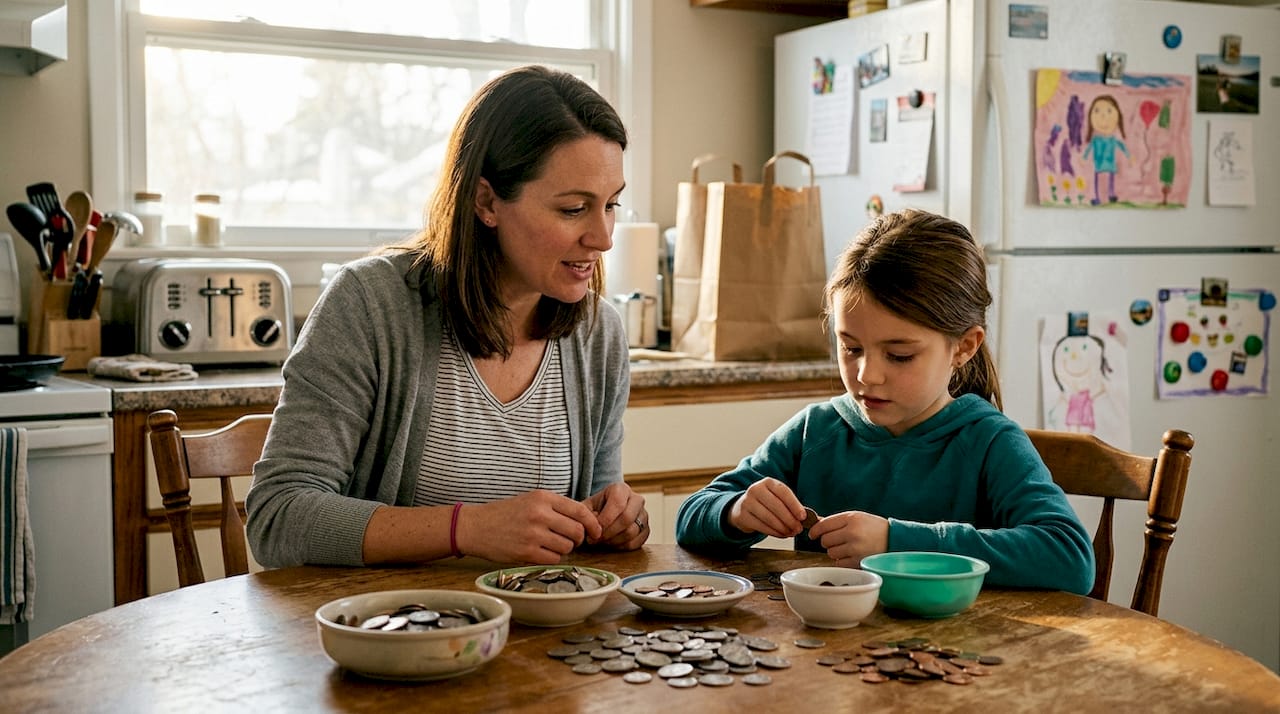
For toddlers and preschoolers, keep it physical and playful. Let them hold real coins, sort them by size, and pretend to buy things at a toy store. These tactile experiences build a foundation that abstract concepts later attach to.
In the early elementary years, focus on the connection between work and reward. This is where practical tips for teaching kids money really shine. Replace a flat allowance with commissions tied to specific chores. This teaches that money is earned, not simply given.
Preteens are ready for comparison shopping and simple budgeting. Take them to the grocery store and let them choose between two brands. Explain why you pick one over the other. These small decisions build critical thinking that lasts a lifetime.
Teens face a whole new world of digital payments, credit cards, and online spending. This is the time to explore teaching teens about money in a more structured way. Open a bank account together. Walk through a simple monthly budget. Let them experience the natural consequences of overspending their own money.

Pro Tip: Role-playing is one of the most powerful tools at any age. Set up a pretend store at home, let your child be the cashier, and practice making change. Even ten minutes of play can cement concepts that a lecture never could.
Here is a quick action list to get started this week:
- Identify your child’s current age range and matching concepts from the table above.
- Choose one hands-on activity to try in the next seven days.
- Have a short, casual money conversation during dinner or a car ride.
- Celebrate any question your child asks about money. Curiosity is the goal.
Practical strategies: Making money lessons stick at home
Knowing what to teach is only half the battle. The real magic happens when money education becomes woven into your daily family life, not treated as a special lecture.
Here are proven, family-tested strategies that make lessons stick:
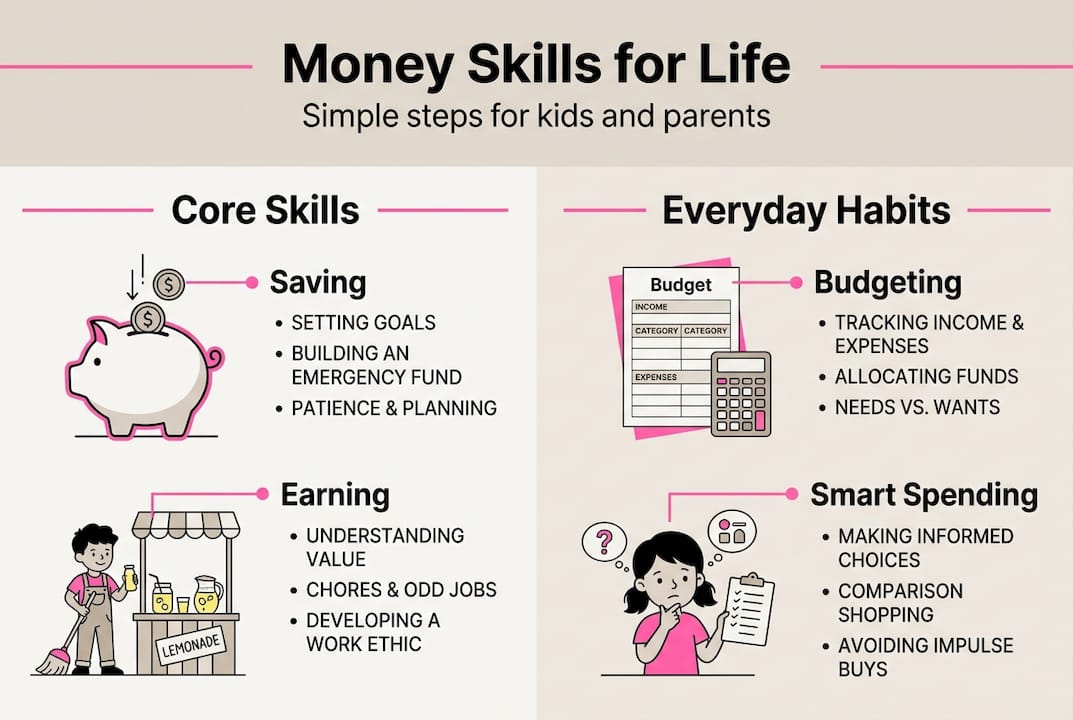
- Use clear jars instead of a piggy bank. When kids can see their money divided into saving, spending, and giving jars, the concept becomes visual and real. Watching the saving jar grow is genuinely motivating.
- Pay commissions, not allowances. Linking money to completed tasks teaches the value of work. Commissions not allowances is one of the most recommended shifts by financial educators.
- Involve kids in real shopping decisions. Hand your child a small budget at the grocery store and let them make choices. The experience of running out of money before getting everything on the list is a lesson no worksheet can replicate.
- Let small mistakes happen. If your child spends their entire week’s commission on candy and then wants a toy, resist the urge to rescue them. That disappointment is priceless teaching.
- Model your own habits openly. Talk about your own spending choices out loud. Say things like, “I’m choosing the store brand because it saves us three dollars and that adds up over time.”
For more ideas on talking to kids about money in ways that feel natural, you will find that consistency matters far more than perfection. You don’t need a formal lesson plan. You just need to keep the conversation going.
Pro Tip: Try a weekly “money minute” at dinner. Each family member shares one money decision they made that week, good or bad. This normalizes financial talk and removes shame from the conversation.
Exploring family money hacks can also help you build systems that make these habits automatic rather than effortful. And if you have been making some common family finance mistakes, now is the perfect time to course-correct together as a family.
What most parents miss: Digital risks and real-world realities
We live in a world where kids can spend money without ever touching it. Tap-to-pay, digital wallets, and in-app purchases have made money feel invisible, and that invisibility creates real danger.
Digital money abstraction and social media risks are among the most urgent modern challenges for families. When money is just a number on a screen, children lose the natural friction that helps them pause before spending. Teaching kids to mentally “see” money leaving their account is a skill that requires intentional practice.
Here is a comparison of traditional versus digital money risks:
| Money type | Key risk for kids | How to address it |
|---|---|---|
| Cash | Losing it physically | Teach safe storage habits |
| Debit cards | Overspending without noticing | Review statements together weekly |
| Digital wallets | Invisible spending, impulse buys | Set spending limits and notifications |
| Social platforms | Scams, money muling schemes | Discuss red flags openly and regularly |
Money muling is a serious and growing concern. Scammers target young people on social media, convincing them to transfer money through their accounts in exchange for a cut. Many teens don’t realize this is illegal until it is too late. Having a frank conversation about these risks is part of modern financial literacy.
Gender gaps in financial confidence are small but worth noting. Both boys and girls benefit equally from parental guidance, and making sure daughters receive the same level of money education as sons is an intentional act of empowerment.
School programs do help. Financial education in schools shows a measurable improvement of about 0.25 standard deviations in knowledge and 0.05 in behavior. That is meaningful progress. But it is not enough on its own. Home is where context, values, and repetition live. Building a strong grasp of financial literacy basics at home gives school lessons something solid to build on.
How to measure impact: Building confidence for real-world results
How do you know if your money lessons are actually working? You look for signs, not test scores.
Children who are developing genuine financial understanding will start doing things like asking where money comes from, setting small savings goals on their own, comparing prices before asking you to buy something, and talking about what they want to save up for. These behaviors are the real report card.
Less than half of young people learn about money at home or school in a meaningful way, and 39% of adults still lack confidence in managing their finances. You are working against a real cultural gap. Every conversation you have with your child is closing that gap, one small step at a time.
A study involving 437 families found that parental financial education is directly linked to healthier financial behaviors in young adults. The parents in that study weren’t financial experts. They were simply engaged, consistent, and willing to talk openly about money.
Here is how to keep building momentum:
- Celebrate progress, not perfection. If your child saves half their commission instead of spending it all, that is worth acknowledging warmly.
- Revisit conversations as your child grows. A lesson that worked at age 7 needs to evolve by age 14.
- Ask questions instead of giving answers. “What would you do if you only had five dollars?” teaches more than telling them what to do.
- Keep the tone positive. Money talks should feel safe, not stressful.
“The goal is not to raise a child who never makes a financial mistake. The goal is to raise a child who knows how to learn from one.”
For practical ways to save money while raising kids, you will find that the habits you build now pay dividends for decades.
Our take: Money talks at home matter more than any textbook
Here is something we believe deeply: no classroom curriculum will ever replace the power of a parent saying, “Let me show you how this works.”
Textbooks can explain compound interest. But they cannot replicate the moment a child watches their parent choose to save instead of splurge, or hears an honest conversation about a tight month. Those moments build resilience. They build trust. They build the kind of financial intuition that no test can measure.
We also want to say this clearly: you do not have to be a financial expert to teach your kids about money. Imperfect conversations are infinitely better than silence. When you admit you made a money mistake and explain what you learned, you are teaching more than any lesson plan could.
Letting kids learn the value of hard work alongside money lessons creates a complete picture. Try, fail, adjust, and try again. That is the real secret to financial confidence, and it starts at your kitchen table.
Take organization and money wisdom further as a family
Applying these money lessons becomes so much easier when your family has simple routines and organized systems already in place. When your home runs smoothly, there is more mental space for intentional conversations about finances, goals, and values.
At It’s a Southern Life Y’all, we have resources built specifically for busy families who want to thrive. From family management systems that bring order to your household to family budgeting tools that make tracking money feel peaceful rather than stressful, we are here to walk alongside you. Explore these tools and take the next step toward a home where both organization and financial wisdom grow together.
Frequently asked questions
What is the right age to start teaching kids about money?
Begin money conversations as early as age 3 using simple coins and real-world examples, then adjust lessons as your child grows and their understanding deepens.
How can I make money lessons fun for my children?
Use clear jars, role-play shopping, and allow hands-on choices with small amounts of real money to keep kids engaged and learning through experience.
What are the biggest money mistakes parents make with kids?
Avoiding money topics entirely, skipping real-life examples, and not letting kids handle actual money decisions are the habits most likely to leave children underprepared.
Do schools teach kids enough about personal finance?
School financial education can meaningfully boost knowledge, but the most lasting impact comes from consistent, values-driven conversations at home with family.
Recommended
- 20 Time-Tested Family Hacks to Break the Paycheck-to-Paycheck Cycle (Strategies That Actually Work with Kids) –
- Talking to Kids About Money—Building Lifelong Skills –
- Teaching Kids About Money: Southern Values & Practical Tips That Actually Stick –
- 7 Steps to Teaching Teens About Money: Where to Start –
- Smart Investing for Beginners: How to Grow Money Wisely
Want the printable version of this?
The Three-Jar Start is the whole system on paper — the three rules that make it stick, what money means at every age from 2 to 12, cut-out labels for the jars, and an eight-week Save tracker. Seven pages, free, and it sets up in fifteen minutes at the kitchen table.
Already got the jars going? The Kids & Money Starter ($9) is the rest of it — the allowance decision laid out honestly so you can pick the version that fits your house, an Earn-It chart for the extra jobs, four kitchen-table conversations, and the honest answers for the store meltdown and “are we poor?” Printable, fillable and an app, all one price.
Keep reading: more parenting help
Ready to start the conversation this week? The Homefire Kids & Money Starter gives you the jar labels, the tracker, and the questions to ask, built for ages four to twelve.