

Talking to Kids About Money—Building Lifelong Skills
Every parent faces those everyday moments when questions about spending come up at the kitchen table or during a quick trip to the store. Making time for honest money talks can feel challenging, but these conversations do more than teach kids about dollars—they help your child build real confidence with practical skills. By focusing on foundational money management skills like earning, saving, and responsible spending tailored to different age groups, you set your children up for independent decisions and brighter financial futures.
Table of Contents
- What Talking About Money Really Means
- Age-Specific Approaches For Money Talks
- Everyday Family Budgeting Made Simple
- Common Money Mistakes Families Make
- Encouraging Honest Money Conversations
Key Takeaways
| Point | Details |
|---|---|
| Talking About Money is Essential | It’s crucial to engage children in conversations about money to build their financial literacy and confidence. |
| Age-Appropriate Discussions | Tailor money discussions to your child’s developmental stage for maximum understanding and impact. |
| Budgeting is Fundamental | Involve children in family budgeting to teach them practical financial skills and the importance of planning. |
| Encourage Open Communication | Foster a safe environment for discussing finances to demystify money and eliminate shame around financial topics. |
What Talking About Money Really Means
Talking about money with your kids is not really about the currency itself. It’s about teaching them how to make choices, understand value, and build confidence around one of life’s most important skills. When you sit down to discuss money, you’re laying groundwork for their entire financial future.
At its core, talking about money means explaining how it works as a tool. Your kids need to understand that money is a medium of exchange, a unit of account, and a store of value. Translation: money is how we trade for things we need, how we measure cost, and how we save for tomorrow. These aren’t abstract concepts. They’re the real mechanisms your child will use their entire life.
It also means teaching the practical side. This includes showing your kids how people actually earn money—through allowances, chores, part-time jobs, or starting their own small projects. It means explaining why we save a portion rather than spending everything. And it means helping them recognize that their choices today create their reality tomorrow.
Beyond the mechanics, these conversations build something deeper: financial literacy and confidence. When children understand foundational money management skills like earning, saving, spending, and responsible use, they stop seeing money as mysterious or intimidating. They see it as something they can control and shape. That shift changes everything.
Your role is to translate money from an abstract idea into something real and manageable. When you make money conversations normal and age-appropriate, you’re not just teaching math. You’re teaching your kids that they have agency. They can make decisions. They can plan. They can build a life they actually want.
Pro tip: Start money conversations early and keep them simple—even a five-year-old can understand that money buys things and that saving means waiting for something better.
Age-Specific Approaches for Money Talks
One size does not fit all when it comes to talking about money with your kids. A five-year-old needs completely different conversations than a fifteen-year-old. The key is matching what you’re teaching to where your child actually is developmentally.
Young Children (Ages 5-8)
At this stage, kids are just beginning to understand that money exists and has value. Keep it concrete and tangible. Show them actual coins and bills. Explain that money is how we buy the things we need. Talk about earning through small chores like helping set the table. Focus on the basics: money buys things, and we save for things we want later.

Don’t worry about interest rates or investment strategies. They won’t stick. Instead, use real-world examples they see every day—stopping at the store, choosing between toys, waiting to buy something special.
Middle School Years (Ages 9-12)
Now your kids can handle more nuance. They understand that different jobs pay different amounts and that choices matter. This is when you introduce the idea of a simple allowance tied to responsibility. Teach them the three basic categories: spending, saving, and giving.
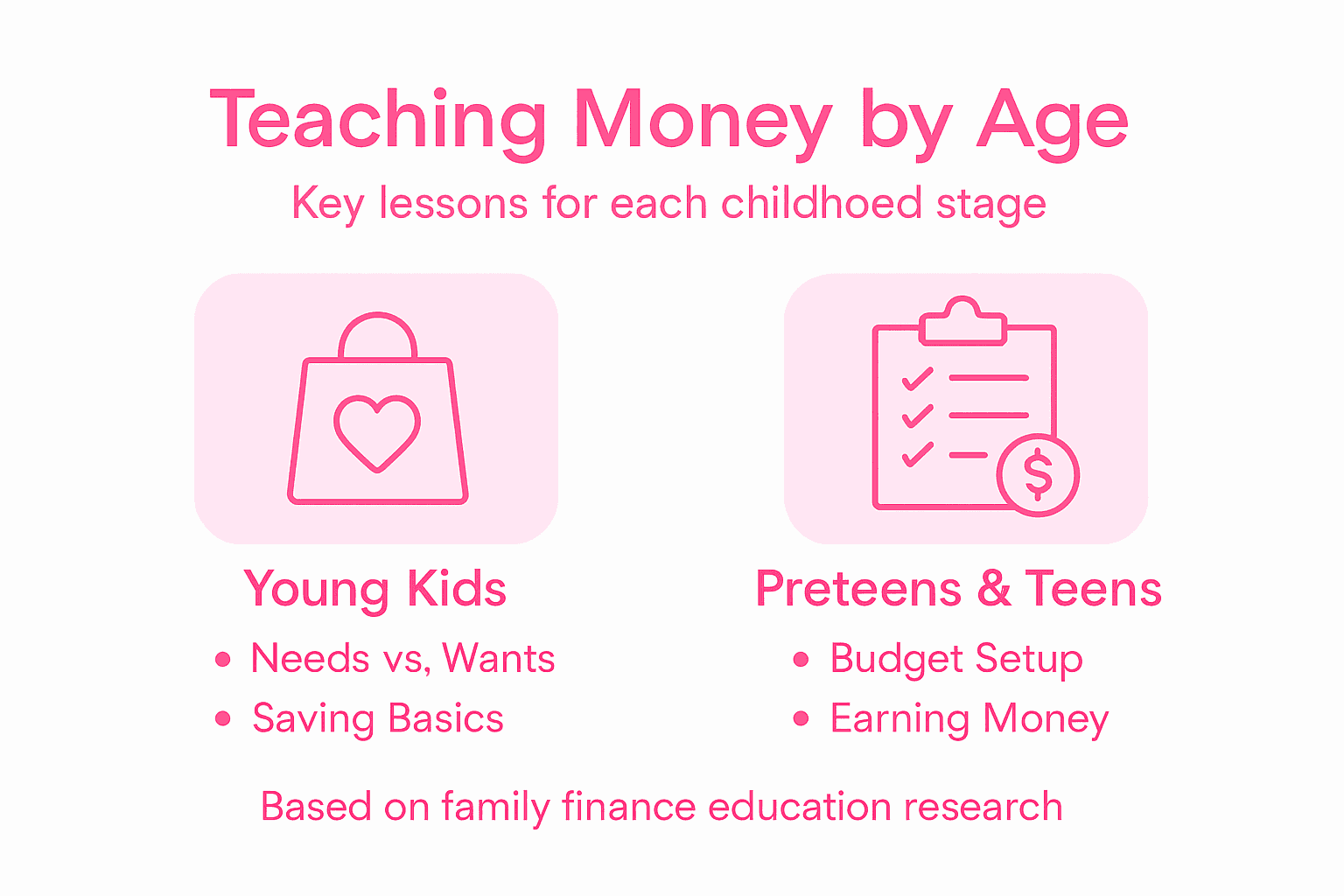
At this age, age-appropriate financial concepts become more relevant. Your kids can grasp budgeting basics—what comes in, what goes out, and what’s left over. They’re ready to think about longer-term goals too, like saving for something three months away.
Use their interests as teaching tools. If they want a video game, help them calculate how many weeks of chores it takes to earn the money.
Teens (Ages 13-15)
Teenagers need to understand real financial responsibilities. This is the time to discuss part-time jobs, introduce the concept of taxes, and explain credit basics. They can handle conversations about debt, interest, and why borrowing money isn’t free.
At this stage, tailored resources for different age groups work well because teens respond to age-appropriate discussions. They’re building independence, so give them more control over their money decisions—and let them experience real consequences in a safe environment.
Talk about their future. College costs, cars, starting out on their own. Make money real by connecting it to their actual goals and dreams.
Pro tip: Ask your child what money-related questions they have before you start teaching, then tailor your answers to their actual curiosity rather than what you think they should know.
Here’s how money lessons progress by age group:
| Age Group | Key Focus | Typical Learning Methods | Practical Skill |
|---|---|---|---|
| 5-8 | Basic value of money | Hands-on play, visuals | Delaying gratification |
| 9-12 | Responsibility and budgeting | Allowance, setting goals | Managing simple budget |
| 13-15 | Real-life financial decisions | Part-time jobs, discussions | Understanding credit/debt |
Everyday Family Budgeting Made Simple
Family budgeting sounds intimidating, but it doesn’t have to be. At its heart, it’s just a realistic plan that shows where your money comes from and where it goes. When you teach your kids budgeting, you’re giving them one of the most practical life skills they’ll ever need.
Start by writing down all your income sources. This might be your paycheck, your partner’s paycheck, or side income. Then list everything you spend money on each month. Include the obvious stuff like rent or mortgage, groceries, and utilities. But also capture the sneaky expenses like streaming services, coffee runs, and birthday gifts. Creating a realistic plan that accounts for both fixed and variable costs is where most families struggle, so be honest about what you actually spend, not what you think you should spend.
Once you can see the full picture, you’ll spot opportunities. Maybe you’re spending more on groceries than you realized, or perhaps there’s a subscription service you forgot about. This is where the real learning happens for your kids. Show them how small adjustments add up.
The budget isn’t a one-time thing. Families monitor spending daily and compare it against the budget each month, then adjust as needed. Life changes. Your expenses will too. When your family budget shifts, bring your kids into the conversation. Explain why and how you’re adapting.
Make budgeting visual if possible. A simple spreadsheet, a notebook, or even a whiteboard in the kitchen works. When your kids can see the numbers, they understand better. They see that choosing to spend less on one thing means more money for something else. That’s the real lesson—it’s all connected.
Pro tip: Set up a simple family budget meeting once a month where everyone discusses what they spent and what the priorities should be for next month, making it a team effort rather than something parents do alone.
Key benefits of involving kids in family budgeting:
| Benefit | How It Helps Kids | Long-Term Impact |
|---|---|---|
| Transparency | Builds trust, prevents confusion | Confidence handling finances |
| Collaboration | Encourages teamwork and problem-solving | Prepares for adult responsibilities |
| Visibility | Makes numbers less abstract | Better decision-making skills |
Common Money Mistakes Families Make
Most families aren’t trying to mess up their finances. They just fall into patterns without thinking about it. The good news is that once you recognize these mistakes, you can avoid them and teach your kids a better way.
Overspending Without a Plan
This is the biggest one. You spend money without knowing where it goes, then wonder why your account is empty. It usually starts with impulse purchases—a little here, a little there. Before you know it, you’ve spent hundreds on things you didn’t plan for. When kids see this happening in real time, they learn the same habits. They think money just disappears.
Prioritizing needs over wants and making intentional spending decisions is how you break this cycle. Sit down and decide what actually matters to your family. Then stick to it.
Skipping the Emergency Fund
Life happens. The car breaks down. Someone gets sick. A pipe bursts in the basement. Without emergency savings, these events become financial disasters. Many families don’t save for this because they’re already living paycheck to paycheck. But even small emergency savings—even $500 to start—makes a difference.
Show your kids why this matters. When you have a cushion, you’re not panicked. You can make smart decisions instead of desperate ones.
Not Talking About Money As a Family
When parents hide financial information, kids get confused. They don’t learn. They don’t understand why sometimes money feels tight or why certain purchases can’t happen. Worse, when they grow up, they repeat the same patterns because they never learned any different.
Transparent family communication about finances builds trust and understanding. Your kids need to know the real picture, even if it’s not perfect. They’ll respect honesty far more than secrecy.
No Budget, No Direction
Without a budget, you’re just hoping things work out. They rarely do. A budget gives you control. It shows your kids that you have a plan instead of just reacting to life as it happens.
Pro tip: When you catch yourself making a money mistake, don’t hide it from your kids—explain what went wrong and how you’ll do it differently next time, turning your mistake into their learning opportunity.
Encouraging Honest Money Conversations
Money talk can feel awkward. You might worry about saying the wrong thing, or you’re uncomfortable discussing finances yourself. But your kids pick up on that hesitation. They learn that money is something to hide or feel ashamed about. That’s not the lesson you want them to carry into adulthood.
Honest conversations start with creating safety. Your kids need to know they won’t be judged or punished for asking questions about money. They shouldn’t feel stupid for not understanding. When you create a safe environment where people can discuss financial topics openly without shame or fear, you’re building trust. You’re also teaching them that money is just another topic worth talking about.
Start small if you need to. You don’t have to have one big “money talk” that covers everything. Instead, have conversations throughout everyday life. When you’re at the grocery store, talk about prices. When your kid asks for something, explain your decision. When you make a money mistake, admit it. These casual moments are actually more powerful than formal sit-downs.
Be honest about your own struggles. If you grew up without learning about money, say that. If you’re working to improve your finances, share that journey. Your vulnerability gives your kids permission to be honest too. They’ll see that you’re learning, which is powerful.
Overcoming the discomfort around money discussions takes practice, but it’s worth it. When you foster open communication and set clear financial goals together, you empower your entire family. Your kids learn that money conversations are normal. They learn that you can ask questions and work through problems together.
Remember, this isn’t about being perfect with money. It’s about being real about it. That authenticity teaches your kids far more than any lecture ever could.
Pro tip: Ask your kids open-ended questions like “What do you wonder about money?” or “What confused you about what we spent today?” rather than waiting for them to bring up concerns.
Build Strong Money Habits and Organized Family Life
Talking to your kids about money is essential for teaching them value, responsibility, and confidence. The challenge many families face is keeping these conversations simple, honest, and age-appropriate while managing daily life demands. If you want to turn these valuable lessons into lasting habits, the key is creating an environment where organization and budgeting become natural parts of your family’s routine.
At ItsASouthernLifeYall.com, we understand how overwhelming it can be to juggle financial talks, family budgeting, and home management all at once. Our proven organization hacks and simple budgeting systems are designed to help families like yours bring clarity and peace to household finances. Start by exploring our strategies to create easy-to-maintain home management systems and practical budgeting tips that involve your entire family. Empower your kids with money skills and build a peaceful, well-organized home where everyone thrives.
Every step you take today builds a stronger tomorrow for your kids and your home.
Frequently Asked Questions
How can I start talking to my kids about money?
Start by introducing the concept of money in simple terms, using everyday examples. Use real coins and bills to illustrate that money buys things and encourage conversations about saving and spending.
What age is appropriate to begin discussing money with my children?
You can start talking about money as early as age five. Use age-appropriate language and concepts, gradually introducing more complex ideas as your child matures.
What are some key money concepts to teach young children?
Focus on basic concepts such as the value of money, the importance of saving, and the distinction between needs and wants. Use tangible examples to make these ideas relatable.
How can I involve my kids in family budgeting?
Include your children by discussing your family’s income and expenses. Create a visual representation of the budget together and encourage them to suggest ways to save or spend wisely.
Recommended
- Teaching Kids About Money: Southern Values & Practical Tips That Actually Stick – It’s a Southern Life Ya’ll
- 7 Steps to Teaching Teens About Money: Where to Start – It’s a Southern Life Ya’ll
- Financial Literacy: Everything You Need to Know – It’s a Southern Life Ya’ll
- The Top 5 Ways To Save Money While Raising Kids in 2024 – It’s a Southern Life Ya’ll
Keep reading: more parenting help
Want a little more help with this? Grab my free Age-by-Age Chore Chart over on the Free Resources page — and when you’re ready to go deeper, the First Budget in 30 Minutes will carry you the rest of the way.