Creative Ways to Give Money for Christmas: 21 Ideas by Age (Plus Free Printable Money Holders, Folded in 15 Minutes)
Hey, y’all! Somewhere around the second week of December, every mom I know hits the same wall: the one person on the list who is impossible to buy for, or the teenager who has quietly told you that what they really want is money, or the grown kid three states away who does not need another sweater. Cash is the right gift more often than we admit; the trouble is that a bill in an envelope feels like you ran out of time. So here are 21 creative ways to give money for Christmas, sorted by age from the two-year-old to the grandparents, every one doable at the kitchen table in 15 minutes or less, plus free printable money holders you can have in your hands tonight.
Quick answer: The five best ways to give money for Christmas are a printable money holder shaped like a gingerbread man or ornament, a clear jar of bills they can see and count, a “money tree” of folded bills clipped to a small branch, a roll of ones hidden inside a candy-cane tube or cookie tin, and for teens and grown kids, cash tucked into a card that names what it is for. Match the idea to the age (little kids want to see it, teens want it to feel like a real gift), fold it in 15 minutes, and set the amount from one line in your holiday budget. The full list by age is below.
Why cash is a good Christmas gift (and how to make it feel like one)
I spent close to thirty years as a CFO, first for my husband’s construction company from a desk in the corner of our kitchen and then for a law firm, and all that time with other people’s numbers taught me one thing about presents: the gift that gets used is the good gift. A twenty-dollar bill gets used. The sweater in the wrong size does not.
What cash does not do on its own is feel like a present, and that is the whole job of this post. A gift of money feels like a gift when one of three things is true: they can see it (a clear jar, a tree of bills), they have to do something to get it (unroll it, unfold it, find it), or the card names what it is for (“for the trip in March,” “toward the car fund”). Pick one of the three and you are done.
And the amount does not have to be big to be a real gift. Five ones folded into a gingerbread man are a real gift to a six-year-old. A ten in a card that says exactly what it is for is a real gift to a nineteen-year-old. We set the number from the budget, not from the neighbors.
Creative ways to give money for Christmas, by age
Each idea takes 15 minutes or less to put together, most of them far less.
Littles (2 to 4): they need to see it and hold it
- The see-through jar. A small clear jar with a few one-dollar bills loosely folded so they fill it up. Bills only at this age; coins stay with the grown-ups because a two-year-old will put one in her mouth before you finish the sentence. She will shake it, open it and spread the bills on the floor, and that is the gift.
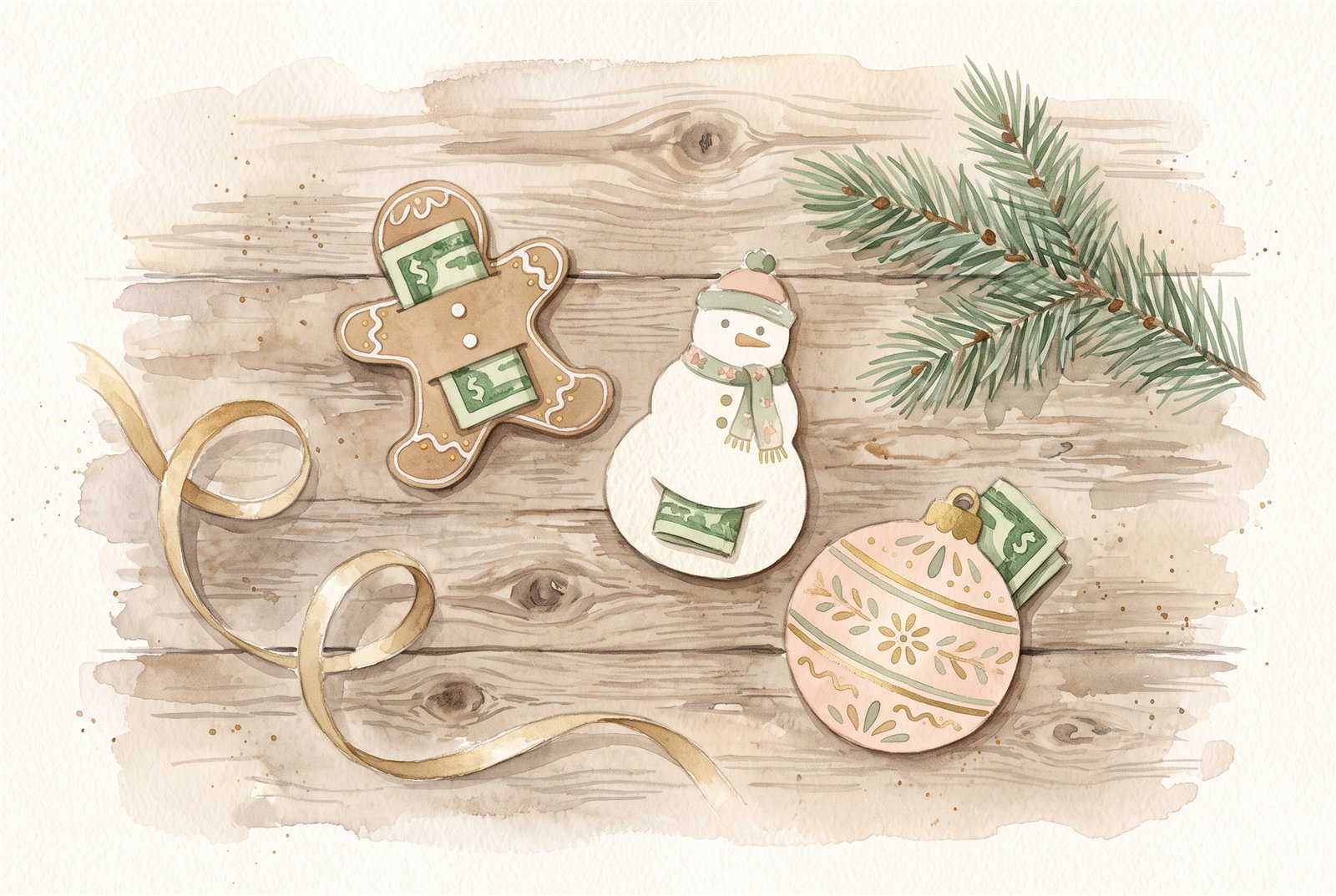
- The money holder with a face. A paper gingerbread man or snowman with a single bill tucked in his belt. At this age the holder is the present and the bill is a bonus.
- The “pick one” envelope. Three small envelopes, each with one bill and a sticker on the front. She picks one to open now and two to open after lunch. Choosing is the fun part.
Early Elementary (5 to 7): counting is the fun
- The countdown roll. Five or ten one-dollar bills rolled tight together, tied with a ribbon, with a tag that says to unroll one a day. A six-year-old who has just learned to count by ones will make this last a week on purpose.
- The money hunt. Three bills hidden in three places with a three-line rhyming clue card. Fifteen minutes to write the clues, five minutes of the happiest chaos on Christmas morning.
- The ornament pocket. A flat paper ornament with a pocket on the back and a bill inside, hung on the tree with their name on it. The ornament goes back on the tree every year after.
Big Kids (8 to 10): the first “real money” gift
- The three jars. A set of three small jars marked save, spend and give, with the gift split between them. More on this below, because it is the idea I would pick above all the others for this age.
- The puzzle gift. A dollar-store jigsaw puzzle, with the money folded under the pieces and a note on the lid that says the gift is at the bottom. They have to finish the puzzle to find it, which is a quiet hour on Christmas afternoon.
- The “toward” card. A plain card that says what the money is toward: the bike they have been saving for, the trip to the trampoline park. Write the running total inside so they can see how close they are.
Tweens (11 to 12): make it feel grown-up
- The money tree. A small bare branch in a jar of rice or beans, with bills folded into fans and clipped on with mini clothespins. It takes 15 minutes to build, and a tween will leave it standing on the dresser for a month.
- The first real wallet. A plain wallet with the money already inside, one bill in each slot. Giving a tween somewhere to keep money is half of teaching them to keep money.
- The matched gift. A card that says you will match whatever they put in savings from this gift, dollar for dollar, through January 31. It buys you a conversation about saving that you did not have to start.
Teens (13 to 15): the card has to say something
- The named-purpose card. Cash in a card that names one thing: “for concert tickets,” “for the spring trip,” “for the phone case you keep talking about.” A teenager can tell the difference between money you thought about and money you grabbed.
- The cookie tin. A tin of the make-ahead Christmas cookies you already baked, with the bills folded flat under the parchment on the bottom layer. They eat their way to the gift.
- The balloon. Rolled bills slipped inside a balloon, blown up, tied, and put in a gift bag. They have to pop it. No quieter gift to wrap, no louder one to open.
Older Teens (16+) and grown kids: respect the budget they are learning to run
- Gas money, said plainly. For the driver in the house, a card that says “gas for January” with the cash inside. At 16 and up the most loving gift is money for the line that worries them.
- The grocery envelope. For the one in a first apartment or a dorm: cash in an envelope marked “first grocery run of the year.” Not glamorous, and exactly what they need on January 3.
- The “one thing you would never buy yourself” card. The money comes with one rule: it goes on something they want and would not spend their own money on. A grown kid who budgets hard all year needs permission more than cash.
Grandparents giving to grandkids (and grandkids giving back)
- The then-and-now card. A card with two lines: what a dollar bought when Grandma was their age, and what it buys now. Add the cash. It turns a bill into a story.
- The same jar every year. The same clear jar with a bill for every year of the child’s age. Seven ones at seven, eight at eight. By twelve they are counting it before you hand it over.
- The reverse gift. For the grandkids giving to grandparents who have everything: a small jar with a bill or two and a note that says “for coffee with me,” redeemable in January. It is money, it is a date, and it is the gift the grandparents talk about.
Want the printable money holders that go with this list?
The free Christmas Cash Pocket Pack is eight cut-and-fold money holders (a gingerbread man, a snowman, a reindeer, an ornament with a hang hole, a Santa’s belt, a candy-cane band, a card that does not look babyish for the teen, and a grandparent card with the then-and-now line), a cash and gift-card envelope, and a one-page “ways to give cash by age” cheat sheet. Print, cut, fold, tuck. Fifteen minutes for the whole stack.
Ways to give money as a Christmas gift: the presentations that work at any age
If none of the age ideas fit the person in front of you, these three presentations have never once failed at my table, at any age. Each is a 15-minute job.
- The rolled-bill ornament. A clear plastic fillable ornament from the craft aisle, with bills rolled tight and slid inside. Hang it on the tree with their name on a tag. It looks like a decoration until you look closely.
- The box within a box. Anything that makes them work for ten seconds: a box inside a box inside a box, a plastic egg inside a stocking, bills folded into paper “cookies” in an empty tin. The work is the fun.
- The folded card with a window. The simplest of all: a card with a square cut out of the front so the corner of the bill shows through. The pack below has one; scissors and an index card do the same job.
If you want a bag of the clear ornaments, mini clothespins or a tin or two, the holiday shelf of my Southern Life Amazon page has the ones I use. As an Amazon Associate I earn from qualifying purchases, and the price to you is the same.
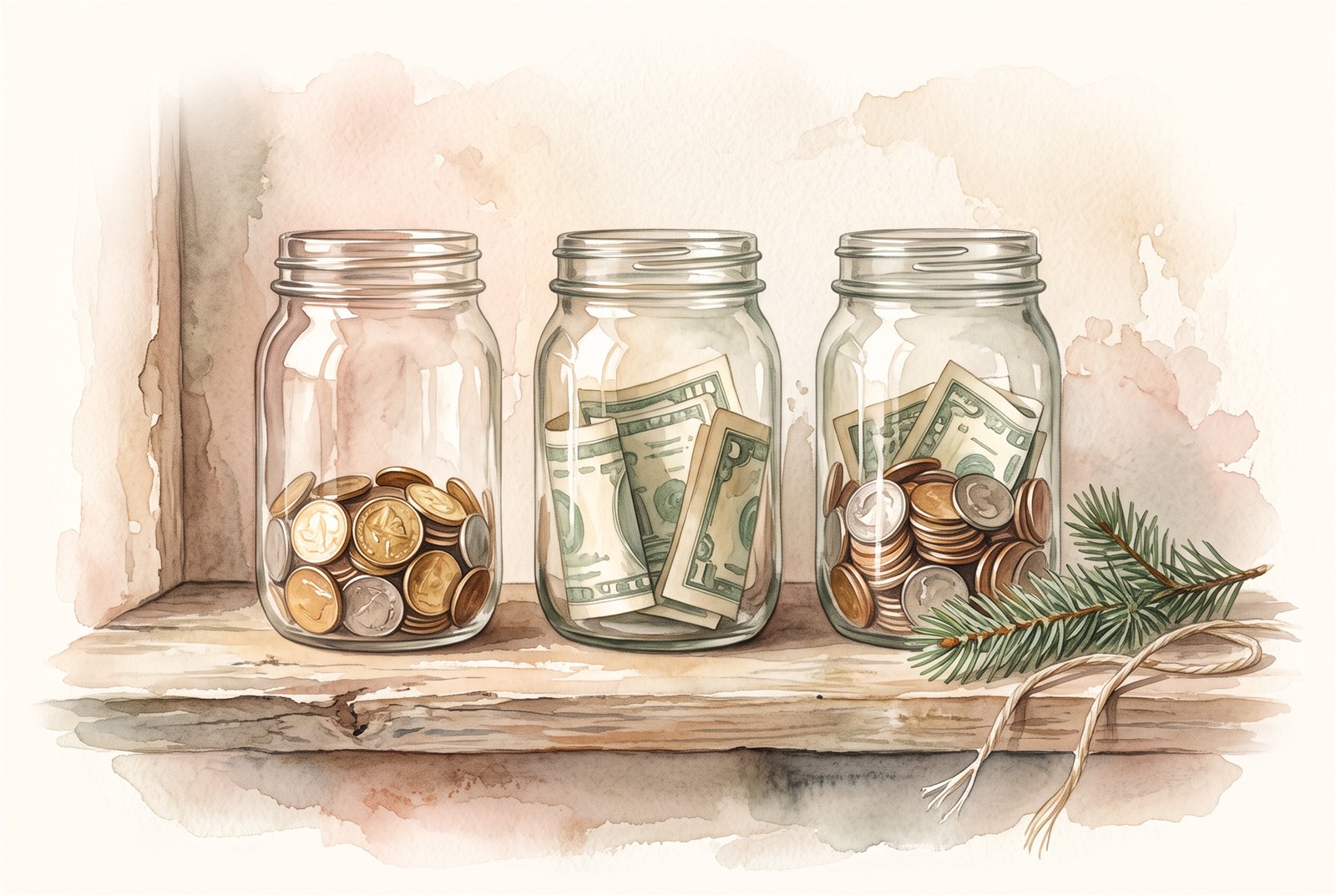
Giving money with a purpose: save, spend, give
Here is the idea I would pick for any child from about eight up, because it does the most good long after Christmas. Three jars: save, spend, give. The Christmas money gets split between them, and the child decides the split, with one rule: nothing in any jar is zero.
The spend jar is theirs, no questions, and a child who is allowed to spend some freely will be far more willing to save the rest. The save jar is for the thing on the “toward” card, and they watch it grow. The give jar is where the Christmas part comes in; in our house it often turned into a shoebox the next November, and the Operation Christmas Child shoebox post walks through packing one with your kids. For the longer version, including what to do when they blow the spend jar in a day (they will, and that is the lesson working), the post on how to teach kids budgeting has the whole system.
How much money to give for Christmas: one line in the budget
This is the question under all the others, and it has a plain answer: the cash gifts are one line in the holiday budget, decided before December, and the number is whatever that line can hold divided by the number of people getting cash. Not what you gave last year. Not what your sister gives. One line.
If you have not set that number yet, the free Holiday Budget Calculator gives you one figure for the whole season with the gifts broken out, and the Christmas on a budget plan is the longer version of how we keep December inside it. For the small extras around the cash, the stocking, the teacher, the neighbor, the stocking stuffer ideas by age post sorts them in 15 minutes.
Then the kitchen-table rule that has kept me honest for thirty Christmases: a smaller amount folded into a gingerbread man with the child’s name on it is a better gift than a bigger amount that lands on January’s card statement. The presentation is free. The peace in January is not.
If you want the whole gift list, cash and all, on one set of pages
The Homefire Holiday Season Planner is the planner I built for Thanksgiving through New Year’s: the gift list with a column for who gets cash and how much, the one budget line all of it comes from, the menus, the cookie tin and a day-of page for Christmas Eve and Christmas Day. It is $17, printable and fillable, with a phone app so the list rides to the store with you. One 15-minute sit-down a week in December and the month runs on the pages instead of in your head.
When it goes wrong (because something will)
The Little tears the gingerbread man in half before the bill comes out. That was the gift. Tape him up, put the bill in the jar, and know that the three-year-old had the best thirty seconds of the morning.
The teen opens the card, says thanks, and puts it in a pocket. That is a teenager receiving a gift correctly. Ask in February what the money went to; you will get a real answer then.
You ran out of time and it really is just a bill in an envelope. Then write one sentence on the envelope about what it is for, and it is a gift. Done is better than perfect, on Christmas Eve most of all.
Frequently asked questions
Is it tacky to give cash for Christmas?
No. Cash is the gift that gets used, and the people who asked for it meant it. What makes any gift feel thoughtless is the thirty seconds of handing it over, not what is inside. A printable money holder, a clear jar, a money tree or a card that names what the money is for turns the same twenty dollars into a present someone remembers.
How do I give money to a teenager without it feeling like an afterthought?
Name what it is for on the card: “for the spring trip,” “toward the car fund.” Then make them work for ten seconds: cash under the cookies in a tin, inside a balloon they pop, or in a card with a window cut in the front. A teen can tell the difference between money you planned and money you grabbed.
Should I give a gift card or cash for Christmas?
Cash, almost every time. A gift card locks the gift to one store, can carry fees or expire in some states, and loses whatever is left under the last purchase. The exception is a gift card you know they will use to the penny, from a place they already go.
Ready to have every cash gift on your list folded and done tonight?
Grab the free Christmas Cash Pocket Pack, print it on plain paper, and sit down with the scissors for 15 minutes. By the time the coffee is cold you will have a gingerbread man for the Little, a snowman for the first-grader, the grown-up card for the teen and the then-and-now card for Grandma to fill in, every one of them with its bill tucked in and ready for the tree. That whole corner of the list, closed, with the money already decided.
From the kitchen table where seven grandchildren have unrolled a lot of ones to yours: keep tending the fire, y’all.