
How to Turn Your Blog Into a Business (Without Quitting Your Day Job)
Long days at work, family meals on the go, and late nights spent chasing blog traffic are a reality for many North American parents who want more from their side hustles. Striking a balance between steady income, creative satisfaction, and precious family time can feel like a juggling act. By embracing strategic blog monetization methods and workflow improvements, you can turn your blog into a reliable income source without sacrificing what matters most at home.
Table of Contents
- Step 1: Clarify Your Blog’s Monetization Goals
- Step 2: Set Up Efficient Workflows For Balance
- Step 3: Establish Multiple Revenue Streams
- Step 4: Automate Growth With Smart Tools
- Step 5: Track Progress And Adjust Strategies
Quick Summary
| Key Point | Explanation |
|---|---|
| 1. Clarify Monetization Goals | Define clear monetization goals to align your passion with potential income avenues. |
| 2. Establish Efficient Workflows | Optimize your work processes to balance blogging with your other commitments effectively. |
| 3. Diversify Revenue Streams | Create multiple income sources to build financial resilience and reduce risk. |
| 4. Automate with Smart Tools | Leverage automation tools to save time and enhance productivity without sacrificing quality. |
| 5. Monitor Progress Regularly | Consistently track your blog’s metrics to make informed adjustments and drive growth. |
Step 1: Clarify Your Blog’s Monetization Goals
Turning your blog into a profitable side hustle starts with crystal-clear monetization goals. Before diving into strategies, you need a roadmap that aligns your passion with potential income streams.
Successful bloggers understand that monetization isn’t one-size-fits-all. Strategic blog monetization methods require careful planning and audience understanding. Here are key considerations for defining your blog’s financial potential:
- Identify your blog’s unique value proposition
- Assess your current audience demographics
- Determine potential revenue channels matching your niche
- Calculate realistic income expectations
Most bloggers have multiple monetization paths. These might include:
Here’s how popular blog monetization strategies differ:
| Monetization Method | Upfront Effort Required | Earning Potential | Best For |
|---|---|---|---|
| Affiliate Marketing | Low to moderate | Moderate | Product-focused blogs |
| Sponsored Content | Moderate | High | High-traffic blogs |
| Digital Product Sales | High | Very High | Expert-driven blogs |
| Display Advertising | Low | Low to moderate | News or magazine sites |
| Consulting/Coaching | High | Very High | Niche authority blogs |
- Affiliate marketing
- Sponsored content
- Digital product sales
- Advertising revenue
- Consulting or coaching services
Your monetization strategy should feel authentic to your blog’s core mission and audience needs.
Research shows that successful bloggers don’t just pick random income streams – they strategically select methods that resonate with their specific audience. This might mean crafting targeted digital products or developing sponsored content partnerships that genuinely serve your readers.
Pro tip: Track your blog’s performance metrics religiously to understand which monetization strategies generate the most engagement and revenue.
Step 2: Set Up Efficient Workflows for Balance
Transforming your blog into a business requires strategic time management and workflow optimization. Creating a system that allows you to balance your day job, blog, and personal life is crucial for sustainable success.
Effective workflow strategies help you maximize productivity without burning out. Consider implementing these key workflow techniques:
- Use digital productivity tools for task tracking
- Establish clear boundaries between work and blogging time
- Create a consistent content creation schedule
- Batch similar tasks to minimize context switching
- Automate repetitive administrative tasks
Your workflow should include specific elements that support your blogging goals:
- Dedicated writing blocks
- Content planning sessions
- Marketing and promotion time
- Performance review periods
- Skill development windows
Successful side hustlers treat their blog like a strategic business – not a hobby.
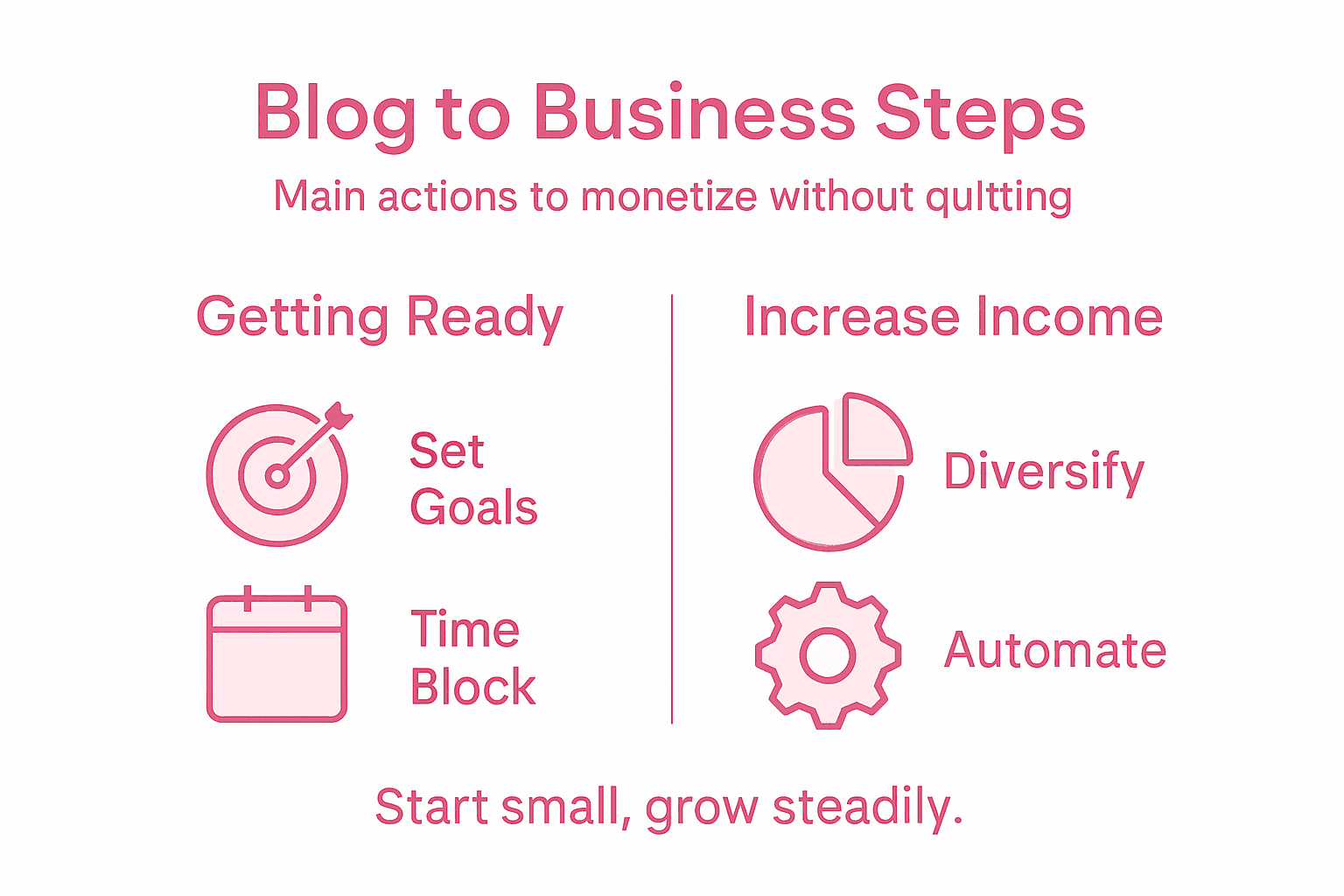
Most bloggers find that structured time blocking helps them maintain momentum without feeling overwhelmed. This means intentionally scheduling specific hours for content creation, marketing, and blog management around your existing professional commitments.

Pro tip: Invest in a digital calendar or project management tool that allows you to visualize and protect your blogging time effectively.
Use this table to match time-saving tools with workflow needs:
| Workflow Need | Recommended Type of Tool | Key Benefit |
|---|---|---|
| Content Scheduling | Editorial calendar app | Keeps posts consistent |
| Task Prioritization | Project management platform | Organizes key objectives |
| Admin Automation | Workflow automation software | Reduces manual tasks |
| Team Collaboration | Communication app | Enhances team efficiency |
Step 3: Establish Multiple Revenue Streams
Turning your blog into a sustainable business means creating diverse income opportunities that protect you from financial unpredictability. You cannot rely on a single monetization method if you want long-term success.
Revenue stream diversification strategies help bloggers build financial resilience and minimize risk. Consider these potential income channels:
- Affiliate marketing partnerships
- Sponsored content collaborations
- Digital product sales
- Online course offerings
- Consulting or coaching services
- Display advertising
- Membership or subscription models
Your revenue strategy should include multiple approaches that complement each other:
- Start with low-effort, passive income streams
- Gradually introduce higher-value offerings
- Continuously test and refine your monetization mix
- Track performance of each revenue channel
- Reinvest earnings into growing your most successful streams
Successful bloggers treat their platform like a business – with multiple income sources and strategic planning.
Most content creators find that strategic income diversification allows them to build financial stability while maintaining the creative freedom they love. This means developing complementary revenue streams that don’t compete but instead support each other.
Pro tip: Allocate at least 10% of your blog income toward experimenting with new monetization methods to continuously expand your revenue potential.
Step 4: Automate Growth with Smart Tools
Turning your blog into a thriving business demands strategic technological leverage that amplifies your productivity without consuming every waking moment. Automation is your secret weapon for scaling impact while maintaining your sanity.
Digital automation strategies can dramatically transform how you manage and grow your blog. Key tools can help you work smarter, not harder:
- Social media scheduling platforms
- Email marketing automation systems
- Content management tools
- Analytics and performance tracking software
- Workflow management applications
- AI-powered writing assistants
- Automated invoicing and payment systems
Your automation strategy should focus on these critical implementation steps:
- Identify repetitive tasks in your blogging workflow
- Research tools that integrate seamlessly
- Start with 2-3 core automation solutions
- Gradually expand your technological ecosystem
- Continuously evaluate tool performance
Automation isn’t about replacing human creativity – it’s about freeing your time to focus on what truly matters.
Successful bloggers understand that intelligent tool selection can transform their side hustle from a time-consuming hobby into a streamlined, professional operation. The right mix of automation tools can help you manage content, marketing, and administrative tasks with minimal daily intervention.
Pro tip: Invest at least one hour monthly reviewing and updating your automation toolkit to ensure you’re using the most efficient technologies available.
Step 5: Track Progress and Adjust Strategies
Transforming your blog into a successful business requires consistent performance monitoring and strategic adaptability. Understanding your blog’s growth trajectory helps you make informed decisions that drive sustainable success.
Progress monitoring techniques enable bloggers to evaluate their performance and make data-driven adjustments. Key metrics you should track include:
- Website traffic volumes
- Engagement rates
- Revenue per post
- Conversion percentages
- Audience growth metrics
- Social media interactions
- Email list expansion
Your tracking strategy should follow these systematic steps:
- Select relevant performance indicators
- Establish baseline measurements
- Set realistic growth targets
- Implement monthly review processes
- Create actionable adjustment plans
Data transforms guesswork into strategic decision-making.
Successful bloggers view performance tracking as a continuous improvement process. By regularly analyzing your blog’s metrics, you can identify strengths, address weaknesses, and develop targeted strategies that amplify your growth potential.
Pro tip: Invest in analytics tools that provide comprehensive insights and automate much of the tracking and reporting process.
Boost Your Blog’s Success While Balancing Life
Turning your blog into a thriving business without quitting your day job can feel overwhelming. The key challenges include managing time efficiently, setting up smart workflows, and creating multiple revenue streams that suit your unique lifestyle. This article highlights essential steps like strategic monetization, workflow optimization, and leveraging automation to grow your blog sustainably.
If you want to stop feeling stretched thin and start building your blog into a profitable side hustle, discover practical solutions designed for busy individuals. At Its A Southern Life Yall, we specialize in proven organization hacks, productivity tips, and home management systems that help you reclaim your time and focus. Learn how simple living strategies and dedicated time management tools can support your blogging goals.
Explore our expert advice on time management tools and productive home organization to create space for your blogging ambitions. Take control of your schedule now and turn your passion into a business that fits your life. Start today with the right systems in place and watch your blog flourish alongside your busy family life.
Frequently Asked Questions
How can I clarify my blog’s monetization goals?
To clarify your blog’s monetization goals, identify your unique value proposition and assess your audience demographics. Write down potential revenue channels that match your niche and set realistic income expectations to create a focused roadmap.
What are some effective workflows for blogging while working a full-time job?
To manage your blog efficiently alongside your day job, establish clear boundaries and create a consistent content creation schedule. Consider using digital productivity tools to track tasks and automate repetitive administrative work to free up more time for content generation.
How can I establish multiple revenue streams for my blog?
Establish multiple revenue streams by diversifying your income sources, such as affiliate marketing, sponsored content, and digital product sales. Start with low-effort income streams and gradually introduce higher-value offerings to create a balanced income portfolio.
What automation tools should I consider for my blog business?
Consider tools such as social media scheduling platforms, email marketing automation systems, and content management tools to streamline your blogging process. Start with 2–3 core automation solutions to manage repetitive tasks effectively and evaluate their performance regularly.
How do I track my blog’s performance effectively?
To track your blog’s performance, select relevant key metrics such as website traffic, engagement rates, and revenue per post. Implement a monthly review process to assess these metrics and create actionable plans to adjust your strategies for better growth.
What steps should I take to balance my blog and my personal life?
To balance your blog with your personal life, use time-blocking techniques to schedule dedicated writing and content planning sessions. Make it a priority to protect your blogging time while maintaining boundaries to prevent burnout and ensure sustainable success.
Recommended
- how to become a blogger – It’s a Southern Life Ya’ll
- become a blogger – It’s a Southern Life Ya’ll
- how to start a blog – It’s a Southern Life Ya’ll
- start a blog – It’s a Southern Life Ya’ll
- Website Builder Business | AI and Digital Marketing Service by MCNM
Want a little more help with this? The Blog Starter covers the money side of the blog without asking you to quit anything.