

Real benefits of weekly planning for busy parents
Planning for just 30 minutes a week can cut Sunday anxiety by 41%, yet most parents still feel like they’re running on empty by Wednesday. Sound familiar? Between school pickups, work deadlines, dinner prep, and everything in between, family life can feel like a river that never slows down. Weekly planning isn’t about adding more to your plate. It’s about finally getting ahead of the current instead of fighting it. In this guide, we’ll walk through the research-backed benefits, bust the myths that keep parents stuck, and give you a simple, flexible routine you can actually stick with.
Table of Contents
- Why weekly planning works: The science-backed benefits
- Common challenges and misconceptions about planning
- How to set up an effective weekly planning routine
- Real-life weekly planning scenarios: Success and adjustment
- What most advice on weekly planning misses
- Ready to simplify your family life?
- Frequently asked questions
Key Takeaways
| Point | Details |
|---|---|
| Reduces family stress | Weekly planning dramatically lowers anxiety and gives everyone more peace. |
| Boosts productivity | By mapping priorities, families get more done and avoid last-minute chaos. |
| Encourages flexibility | A good plan includes room for unexpected events and fun moments alike. |
| Teaches life skills | Involving kids in planning builds responsibility and time awareness for everyone. |
Why weekly planning works: The science-backed benefits
Parents often wonder if planning just creates more work. Let’s start with the proven benefits research has uncovered.
The truth is, weekly planning is one of the most powerful tools a busy family can have. It’s not just about writing things down. It’s about creating a sense of order that ripples through your entire household. When you know what’s coming, you stop reacting and start leading your week with intention.
Time management strategies like planning, goal-setting, and prioritization are proven to boost productivity, reduce stress (with correlations ranging from r=0.16 to r=0.43), and improve job satisfaction. That’s not a small win. That’s a life shift.
Here’s a quick look at what the research tells us:
| Benefit | Impact |
|---|---|
| Stress reduction | Correlation r=0.16 to r=0.43 |
| Job satisfaction improvement | Effect size η²=0.31 |
| Planning skill improvement from training | Effect size η²=0.29 to 0.35 |
| Sunday anxiety reduction | 41% drop with Friday planning |
| Context-switching reduction | Up to 37% less |
| Rework reduction | Up to 26.7% less |
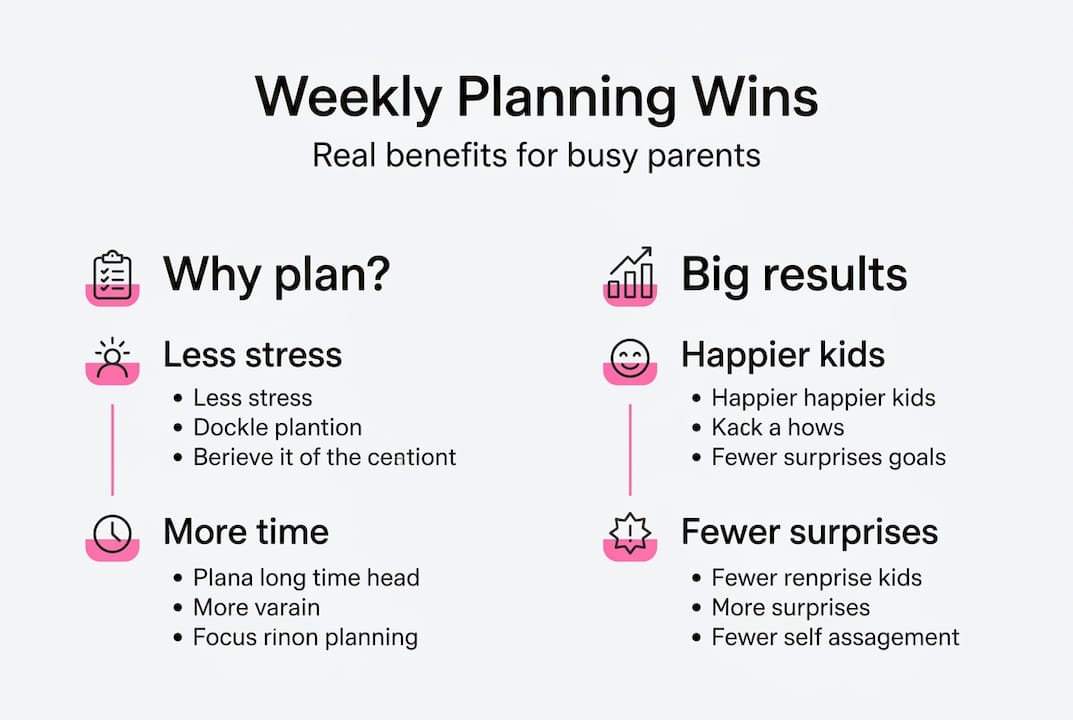
Think about what reducing context-switching by 37% means for a parent. Fewer mental restarts. Less of that foggy, scattered feeling. More energy left for the people you love most.
Here are the core benefits families experience with consistent weekly planning:
- Reduced chaos at the start of each day because you already know the plan
- More quality time with kids because you’re not scrambling to figure out logistics
- Better sleep because Sunday night dread fades when the week is already mapped out
- Stronger sense of control, which research links directly to better health and wellbeing
You can explore more family time management tips and take a deeper look at time management steps that work specifically for families juggling it all.
Common challenges and misconceptions about planning
With benefits clear, it’s critical to address why many parents find planning intimidating or frustrating.
One of the biggest myths is that planning means rigidity. Parents imagine a color-coded spreadsheet that falls apart the moment a child gets sick or a meeting runs long. But that’s overplanning, not planning.
“While beneficial, excessive planning can feel rigid or lead to overplanning; multitasking increases stress but is moderated by autonomy; some prefer spontaneity, requiring hybrid approaches with buffers and check-ins.”
The research actually supports a hybrid approach. That means planning your core commitments while leaving intentional breathing room for the unexpected. Think of it like packing a suitcase. You lay out the essentials, but you leave a little space for what you pick up along the way.
Here’s what gets in the way for most parents:
- Fear of failure when the plan doesn’t go perfectly
- All-or-nothing thinking, believing planning only works if it’s followed exactly
- Overloading the plan with too many tasks, which leads to burnout
- Skipping the review, so the plan never gets adjusted or improved
Multitasking feels productive but actually increases cognitive load and stress. Planned time blocks, on the other hand, feel manageable because your brain knows what’s coming next. It’s the difference between sprinting blindly and running a race where you can see the finish line.
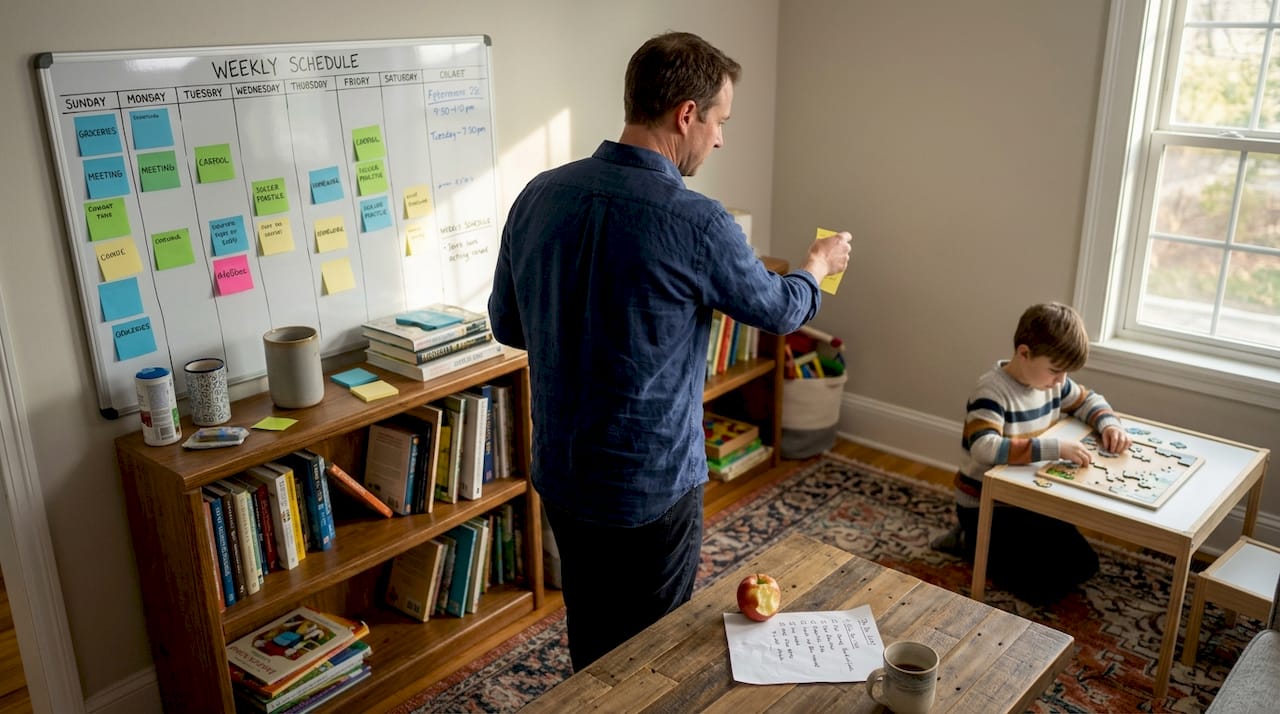
You can simplify your family schedule with a few smart adjustments, and block scheduling for families is one of the most effective ways to bring structure without suffocation.
Pro Tip: Build two or three buffer blocks into your weekly plan. These are open slots you don’t fill in advance. When something unexpected comes up, it lands in a buffer instead of derailing everything else.
How to set up an effective weekly planning routine
Now that misconceptions are addressed, here’s exactly how you can build a sustainable weekly planning routine.
The good news? You don’t need a fancy system. You need a consistent time, a simple process, and the willingness to keep it flexible. Research shows that planning skill training produces strong results, with effect sizes of η²=0.29 to 0.35, meaning even small improvements in how you plan can make a meaningful difference.
Here’s a step-by-step routine that works for real families:
- Pick your planning time. Friday afternoon or Sunday evening both work well. Friday lets you close the week and preview the next. Sunday gives you a fresh-start feeling.
- List your non-negotiables. Write down every appointment, school event, and work deadline for the coming week.
- Identify your top three priorities. These are the things that, if done, would make the week feel successful.
- Add self-care and connection time. Yes, schedule it. If it’s not on the plan, it gets skipped.
- Insert buffer blocks. Leave at least two open slots for the unexpected.
- Do a quick review at week’s end. Five minutes to note what worked and what to adjust next time.
Now, one common question is whether to use paper or digital tools. Here’s a simple comparison:
| Feature | Paper planner | Digital tools |
|---|---|---|
| Visibility | High (on the fridge or desk) | Depends on screen habits |
| Flexibility | Manual edits required | Easy to update and share |
| Family involvement | Easy for kids to see and add to | Great for syncing with a partner |
| Cost | Low | Free to moderate |
| Best for | Visual learners, young kids | Busy co-parents, remote schedules |
Understanding the role of proactive planning can shift your whole mindset. And if you want a detailed walkthrough, this organize your week guide is a great place to start. You might also love the idea of 30-minute morning planning to keep momentum going each day.
Pro Tip: Post your weekly plan somewhere the whole family can see it. When kids know the plan, they’re more cooperative and less likely to derail it with last-minute requests.
Real-life weekly planning scenarios: Success and adjustment
A framework is helpful, but what happens in real life? These scenarios show how weekly planning proves itself.
Let’s talk about two families who tried weekly planning and what actually happened.
Family A started planning on Friday evenings. Mom would sit down with a cup of coffee, map out the week, and share it with the kids at dinner. Within two weeks, Sunday nights felt completely different. The frantic scramble for clean uniforms and forgotten permission slips was gone. They describe it as trading Sunday dread for Sunday peace.
Family B was more skeptical. Dad worried the plan would feel like a prison. So they tried a lighter version: just three priorities per day and two buffer slots. When an unexpected school meeting popped up mid-week, it slid right into a buffer block without causing a crisis. He called it “the first week in months where I didn’t feel behind.”
Flexible planning lets you adjust for the real stuff: sick kids, weather, last-minute invites from neighbors, or a day when everyone just needs to slow down. Scheduling family time intentionally means those moments don’t get crowded out by busyness.
Here’s what flexible weekly planning looks like in practice:
- Adjust without guilt when something shifts. The plan serves you, not the other way around.
- Use buffer blocks as your safety net, not empty space to fill.
- Check in midweek to see if priorities need to shift.
- Celebrate what got done, not just what didn’t.
“Hybrid approaches with buffers and check-ins work best for families who value both structure and spontaneity.”
Weekly planning isn’t about controlling every moment. It’s about creating enough structure that the good moments have room to happen naturally.
What most advice on weekly planning misses
While these strategies work, there’s a deeper truth families need to know.
Most planning guides focus almost entirely on structure: the right template, the right app, the right time of day. And yes, those things matter. But the families who stick with weekly planning long-term aren’t the ones with the prettiest planners. They’re the ones who’ve learned to treat the plan as a living thing, not a law.
Rigid schedules can quietly breed guilt. When the plan falls apart on Tuesday, it’s easy to feel like you’ve failed. That guilt is a momentum killer. The families who thrive are the ones who review their week with curiosity instead of criticism. What worked? What needs a tweak? What can we celebrate?
There’s real power in ending each week by naming what went well. It plants seeds of confidence that grow into consistency. Over time, that consistency becomes resilience, and resilience is what keeps a family moving forward even in hard seasons.
Mindfulness for parents is a beautiful companion to weekly planning because it trains you to stay present with what is, rather than anxious about what isn’t done yet.
Pro Tip: At the end of each week, write down one thing that went well. Not what’s next. Not what you missed. Just one win. That small habit builds the kind of momentum that no planner template can manufacture.
Ready to simplify your family life?
If this article sparked something in you, you’re already one step closer to a calmer, more intentional home. The strategies here are just the beginning. We’ve built a whole library of resources designed specifically for busy families who want more peace and less chaos.
Explore productivity hacks for families to find quick wins you can apply this week. Dive into home organization systems to bring order to every corner of your home. And if you want to see how it all fits together, family home management gives you the big picture. You deserve a home and a week that feel good to live in.
Frequently asked questions
How much time should weekly planning take for a busy family?
A focused 20 to 30 minute weekly session is typically enough to see major benefits. Even a short Friday planning session can reduce Sunday anxiety by 41%, making it one of the highest-return habits a family can build.
What if unexpected events disrupt my weekly plan?
Flexible planning with buffer times keeps you on track when the unexpected happens. Hybrid approaches with buffers and check-ins are specifically designed for families who can’t predict every curveball.
Does planning everything remove spontaneity or fun from family life?
Not at all. Hybrid planning approaches allow for structured commitments alongside open space for spontaneous moments, so fun doesn’t get scheduled out.
What tools help with family weekly planning?
Both paper planners and simple digital apps work well. The best tool is the one your whole family can see, access, and actually use together consistently.
How fast can I see results from weekly planning?
Families often notice lower stress and smoother weeks after just one or two sessions. The anxiety reduction benefits from planning are measurable quickly, especially when planning happens consistently at the end of each week.
Recommended
- Guide to the Role of Proactive Planning –
- Meal Prep saves busy parents 6 hours weekly –
- Block Scheduling: Transform Time for Busy Families –
- Understanding the Advantages of Meal Planning –
Want to make weekly planning stick? The Sunday Blueprint is the hour that makes all of these benefits real, week after week.