The ultimate closet organization checklist for busy families
TL;DR:
- A clear vision and family involvement are key to successful closet organization.
- Decluttering and creating designated zones streamline morning routines and reduce stress.
- Maintaining habits like weekly tidies prevents chaos and supports long-term order.
Mornings in a busy household can feel like a small tornado touched down overnight. You’re searching for matching shoes, your kids can’t find their favorite shirt, and everyone leaves the house frazzled before 8 a.m. Disorganized closets add 15 minutes to morning routines, and 80% of closet items go completely unused. That’s a lot of wasted time and energy every single day. The good news? A strategic, step-by-step checklist can turn your closet from a source of stress into a place of calm. Let’s walk through exactly how your family can make that happen.
Table of Contents
- Set your family’s closet goals
- The essential closet organization checklist
- Organization strategies for every family scenario
- Maintaining an organized closet (and building new habits)
- Why most closet makeovers fail—and how busy families can actually win
- Make your entire home as organized as your closet
- Frequently asked questions
Key Takeaways
| Point | Details |
|---|---|
| Start with clear goals | A family-focused vision makes every step of closet organization faster and more effective. |
| Follow a set checklist | A repeatable routine ensures every closet is efficient, tidy, and easy for kids. |
| Customize for your family | Tailor solutions for siblings sharing, sentimental keepsakes, or small spaces to fit your real-life needs. |
| Build simple habits | Maintain order with quick routines and easy rules that involve the whole family. |
Set your family’s closet goals
Now that you know the true cost of closet chaos, begin with a clear vision for your ideal result. Before you buy a single bin or shelf, you need to ask yourself: What do I actually want this closet to do for my family? That question might sound simple, but it’s the most important one you’ll answer in this whole process.
Every family’s closet problems are a little different. Maybe yours is the “black hole” where clean laundry disappears. Maybe your kids can never find what they need without your help. Maybe seasonal clothes are piled on top of everyday items, making everything harder to reach. Identifying your specific pain points is the first step toward solving them.
Pros recommend starting closet makeovers with a lifestyle audit, which simply means looking honestly at how your family uses the space right now. Walk through a typical morning. Notice what gets grabbed, what gets ignored, and what causes the most frustration.
Once you see the patterns, set measurable goals. Here are a few examples to get you started:
- Mornings take under 10 minutes from closet to door.
- Every child can independently find and put away their own clothes.
- Seasonal items are stored out of the way but easy to rotate.
- The closet looks tidy at a glance, even on busy days.
- Donations leave the house at least once every three months.
Think of your closet goals like planting seeds. The clearer and more intentional you are now, the stronger the roots of your new system will grow. Getting your kids involved in goal-setting also builds their sense of ownership, which makes them far more likely to maintain the system later.
Pro Tip: Write your top two closet goals on a sticky note and put it inside the closet door. When the space starts to drift back toward chaos, that note will remind everyone what you’re working toward.
If you’re not sure where to start with the bigger picture, learning how to declutter your home naturally can give you a gentle, family-friendly framework that makes the whole process feel less overwhelming.
The essential closet organization checklist
With your goals mapped out, it’s time for the practical steps. Use this checklist as your family’s roadmap to a closet that actually works.
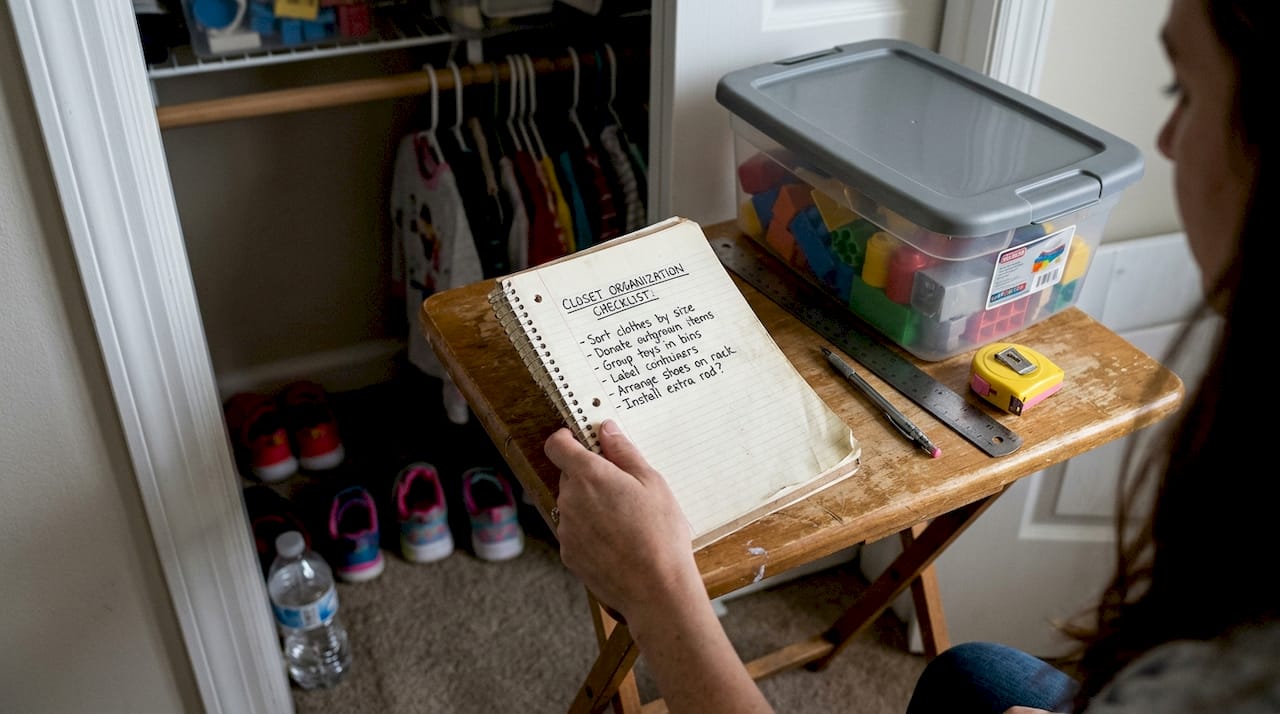
The average wardrobe contains 166 items, yet 80% go unused. That means most of what’s crowding your closet right now doesn’t need to be there at all. Clearing that out first makes every other step faster and easier.
Here’s your step-by-step checklist:
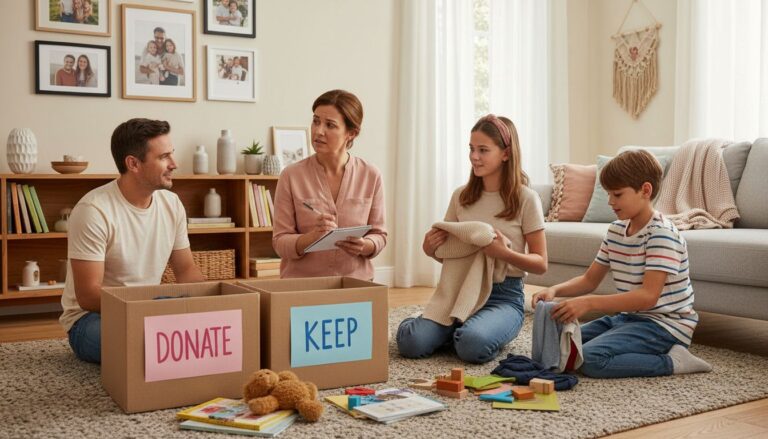
- Declutter first. Pull everything out. Sort into keep, donate, and toss piles. Be honest.
- Sort what remains. Group by category: everyday wear, seasonal, special occasion, and outgrown.
- Clean the space. Wipe shelves, vacuum the floor, and fix any broken rods or hooks before putting anything back.
- Assign zones. Give every category a dedicated spot. Daily items go at eye level and within easy reach.
- Label everything. Labels are your best friend, especially for kids. Use pictures for little ones who can’t read yet.
- Add organizers. Bins, dividers, shelf risers, and hanging organizers multiply your usable space without a renovation.
- Maintain the system. Schedule a quick weekly tidy and a monthly donation check to keep things from creeping back.
“A place for everything, and everything in its place.” That old saying is the heart of every great closet system.
Not sure which add-ons are worth the investment? Here’s a quick comparison:
| Feature | Basic setup | Advanced setup |
|---|---|---|
| Hanging storage | Single rod | Double rod with dividers |
| Shelf organization | Open shelves | Labeled bins and risers |
| Floor space | Shoe pile | Tiered shoe rack or cubbies |
| Seasonal storage | Mixed in | Separate labeled bins or vacuum bags |
| Kid access | Adult height | Low hooks and reachable cubbies |
Pro Tip: Before buying organizers, measure your closet and sketch a simple layout. Buying the wrong size is the most common (and costly) mistake families make.
For a deeper look at systems that work beyond the closet, explore effective home organization systems that can support your whole household.
Organization strategies for every family scenario
Not all families face the same challenges. Here’s how to tailor your efforts for the tricky situations that trip most people up.
Shared closets are one of the biggest sources of sibling conflict in a family home. The fix is simpler than you think. Labeled zones per child and color-coded bins make ownership clear and arguments rare. Assign each child a specific color. Their bin, their hooks, their shelf section. Done.
Here are strategies for the most common family closet challenges:
- Shared sibling closets: Use color-coded bins and clearly labeled sections so each child owns their space.
- Sentimental keepsakes: Limit each family member to one labeled memory box. Rotate items in and out as needed, but the box stays the same size.
- Growth spurts: Keep a “size-out” bin at the bottom of the closet. When something no longer fits, it goes straight in. At the end of each season, the bin gets donated or passed down.
- Small spaces: Think vertically. Add a second hanging rod, use behind-door racks, and choose modular organizers that can be reconfigured as needs change.
- Toy and gear overflow: If sports equipment or backpacks are eating your closet, assign them a dedicated hook zone near the door instead.
“Sentimental items should be limited to a labeled box.” This one rule alone has saved countless families from closets that become storage units for the past.
Small spaces especially reward creative thinking. A few well-placed hooks on the back of a door can hold a week’s worth of backpacks, hats, and jackets without taking up any floor space at all. For more ideas on making the most of every inch, check out these overlooked storage space ideas that most families never think to use.
Pro Tip: Reassess your closet layout every six months. Kids grow fast, and a system that worked beautifully for a five-year-old may frustrate an eight-year-old who wants more independence.
Maintaining an organized closet (and building new habits)
Once your closet is in order, here’s how to keep it that way for the long haul. The secret isn’t willpower. It’s building simple habits that become second nature for your whole family.
Decluttering boosts productivity by 30%, and life satisfaction is 30% higher in low-clutter homes. That’s not a small return for a few minutes of tidy-up time each week. Here’s what a sustainable maintenance routine looks like:
- Weekly 10-minute tidy. Pick one evening where everyone spends 10 minutes returning items to their zones. Make it a family habit, not a chore.
- Monthly donation check. Walk through the closet and pull anything that hasn’t been touched. If it’s been ignored for a month, it’s probably not needed.
- Quarterly size sort. Every three months, check kids’ clothes for fit. Move outgrown items to the size-out bin immediately.
Here’s a quick look at how organization habits connect to real family benefits:
| Habit | Time investment | Benefit |
|---|---|---|
| Weekly 10-minute tidy | 10 min/week | Prevents backslide and keeps zones clear |
| Monthly donation check | 20 min/month | Reduces clutter by 30% over time |
| Quarterly size sort | 30 min/quarter | Eliminates outgrown items before they pile up |
| One-in/one-out rule | Ongoing | Keeps total volume stable year-round |
The one-in/one-out rule is one of the most powerful habits you can build. Every time a new item enters the closet, one old item leaves. It sounds almost too simple, but it works like a quiet guardian keeping the whole system in balance.
For kids, “zone defense” is a great concept to introduce. Each child is responsible for their own zone, not the whole closet. That small shift in ownership makes a big difference in how willingly they participate.
Pro Tip: Put a small donation bag on a hook inside the closet door. When something no longer fits or gets worn out, it goes straight in the bag. When the bag is full, it leaves the house. No pile-up, no decision fatigue.
For more ideas on keeping your whole family running smoothly, explore these family productivity hacks that complement your new closet system beautifully.
Why most closet makeovers fail—and how busy families can actually win
Here’s something most organizing advice won’t tell you: the problem isn’t your closet. It’s the expectation that a single weekend overhaul will hold forever.
Most closet systems fail because they’re designed for a snapshot of life, not for the living, breathing, ever-changing reality of a family with kids. A system built around your four-year-old will be completely wrong for your seven-year-old. A setup that works in September will be overwhelmed by December holiday gifts. Life moves fast, and your closet needs to move with it.
The families who actually win at this are the ones who choose flexible, modular setups over rigid, expensive built-ins. They embrace natural decluttering strategies that fit into real life rather than requiring a perfect Saturday. And most importantly, they get the whole family on board, because no system survives without buy-in from the people using it every day.
Perfection is not the goal. Resilience is. A closet that can absorb a growth spurt, a new school year, or a holiday season and bounce back quickly is worth far more than one that looks flawless in a photo but falls apart by February.
Make your entire home as organized as your closet
Your closet transformation is just the beginning. When one space in your home runs smoothly, it creates a ripple effect that reaches your entryway, your pantry, your kids’ rooms, and your daily routine. That calm you feel when you open a tidy closet? Your whole home can feel that way.
We’ve built a library of resources designed specifically for busy families who want real systems, not just pretty inspiration boards. From family management systems that keep everyone on the same page, to whole-home decluttering guides that make the process feel natural, to creative ways to save closet space in every room, we’re here to walk with you every step of the way.
Frequently asked questions
What’s the fastest way to start organizing my family’s closet?
Begin with a quick sweep to remove everything unused or outgrown, since 80% of wardrobe items go untouched anyway. Then follow a checklist for sorting and assigning storage zones to what remains.
How do I handle sentimental items that take up closet space?
Choose one dedicated box for sentimental items and commit to keeping only what fits inside it. As the experts put it, limit sentimental items to a single labeled box so they don’t quietly take over your entire closet.
What’s the best way to keep kids’ closets organized as they grow?
Use size-labeled bins for outgrown clothes and schedule a quick check every three months to rotate items. Growth spurts require consistent rotation to keep kids’ closets functional and frustration-free.
Does closet organization really affect productivity and happiness?
Absolutely. Decluttering boosts productivity by 30% and life satisfaction runs 30% higher in low-clutter homes, making an organized closet one of the highest-return projects a busy family can tackle.
Recommended
- Front Closet Organization Ideas: 4 Tips Save 30% Space –
- How to Declutter Home Naturally for Busy Families –
- How to Organize Pantry for Stress-Free Family Living –
- 7 Simple Ways to Refresh Your Home for Busy Families –
- 7 Essential Home Organization Hacks for Everyone | Prodcast
- Why declutter your space for a more functional home – New Way Ref
Want the whole house, not just the closet? The Room-by-Room Reset gives you a checklist like this one for every room, in the order that actually works.