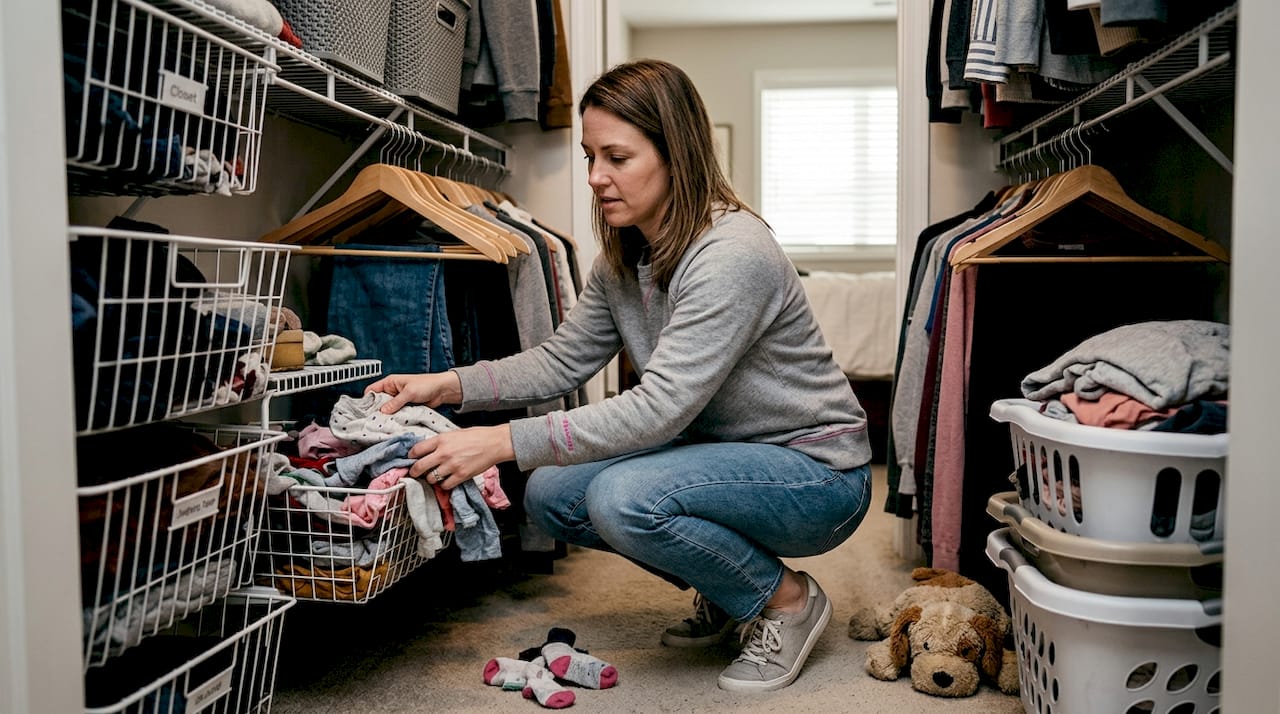
Closet organization workflow for busy parents in 2026
The average parent spends 15 minutes a day searching through overstuffed closets, and 54% say clutter leaves them feeling genuinely overwhelmed. That lost time adds up fast when you’re already juggling school drop-offs, work deadlines, and dinner. The good news? You don’t need a weekend overhaul or a Pinterest-perfect space. What you need is a repeatable workflow that fits real family life, cuts morning chaos, and keeps your closet functional week after week. This guide walks you through exactly that.
Table of Contents
- Why closet chaos happens (and how workflow stops it)
- What you need: Tools and prep for an organized closet
- Step-by-step closet organization workflow for busy parents
- Customizing your workflow: Kids, small spaces, and shared closets
- Making it last: Weekly resets and monthly audits
- Take the next step: Home organization for busy families
- Frequently asked questions
Key Takeaways
| Point | Details |
|---|---|
| Workflow saves time | A clear organization workflow cuts daily searching and parent decision fatigue. |
| Minimal tools needed | Slim hangers, bins, and labels make the process easy, quick, and affordable for families. |
| Weekly resets work | Short, regular resets keep closets under control and end the clutter cycle. |
| Customize for your family | Adapt the workflow for kids’ closets, small spaces, or shared areas for lasting impact. |
Why closet chaos happens (and how workflow stops it)
Most parent closets don’t fall apart because of laziness. They fall apart because life moves fast. Kids outgrow clothes every few months, categories blur together, and there’s rarely a scheduled moment to reset. Before long, you’re digging through a pile of mismatched items just to find a clean shirt.
The numbers back this up. The average wardrobe holds 166 items, yet only 20% of those items get worn regularly. That means roughly 130 pieces are taking up space, creating visual noise, and making every morning harder than it needs to be. Add in the fact that busy parents benefit most from a clear workflow because of decision fatigue and time pressure, and the case for a system becomes obvious.
Here’s what typically causes parent closet chaos:
- Outgrown kids’ clothing that never gets sorted or donated
- No clear categories, so everything gets shoved in together
- Infrequent resets, meaning small messes compound into big ones
- Too many items, with no regular audit to remove what’s unused
- Shared spaces with no defined zones for each person
The shift from a one-time cleanup to a repeatable workflow is what changes everything. A workflow removes the guesswork. You follow the same steps each time, decisions get easier, and the closet stays functional instead of just looking good for a week. Building habits for a tidy home is the foundation that makes any organization system stick.
What you need: Tools and prep for an organized closet
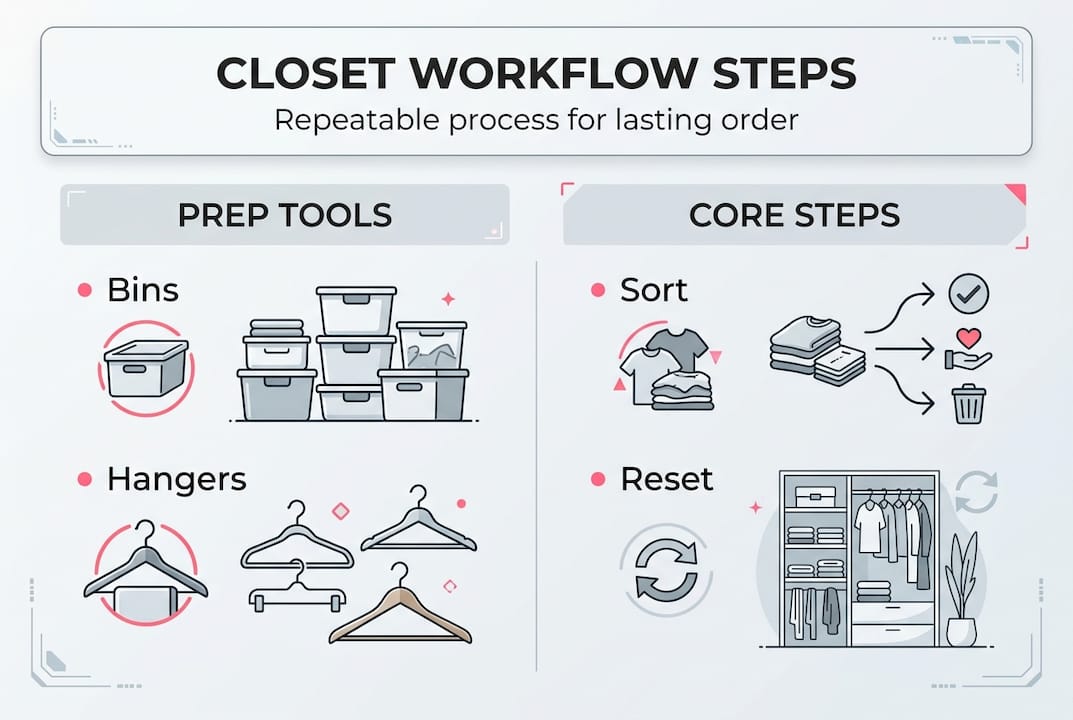
You don’t need to spend hundreds of dollars to get organized. In fact, the simpler your toolkit, the easier it is to maintain. Slim hangers, bins, and labels are proven to keep closets organized without overcomplicating the system.
Here’s what to gather before you start:
- Slim velvet hangers to maximize rod space
- Clear or labeled bins for categories and seasonal storage
- Shelf dividers to keep stacks from toppling
- A label maker or adhesive labels for quick identification
- A timer to keep your session focused and under an hour
- Donation bags or boxes ready to go from the start
If you’re working with a tight budget or a small space, there are solid alternatives. Dollar store bins work just as well as designer ones. Tension rods can double your hanging space. Shoe pockets on the back of a door free up floor space instantly. For more creative ideas, check out these front closet space ideas that work even in the smallest entryways.
| Tool or accessory | Purpose | Budget option? |
|---|---|---|
| Slim velvet hangers | Maximize rod space | Yes, dollar store |
| Clear bins | Visible storage by category | Yes, repurpose shoeboxes |
| Shelf dividers | Keep folded stacks neat | Yes, cardboard DIY |
| Label maker | Quick identification | Yes, masking tape + marker |
| Over-door organizer | Extra storage without drilling | Yes, fabric pocket version |
| Donation bags | Immediate removal of clutter | Yes, reuse grocery bags |
Knowing which organization system types work best for your family’s habits will help you choose the right tools from the start.
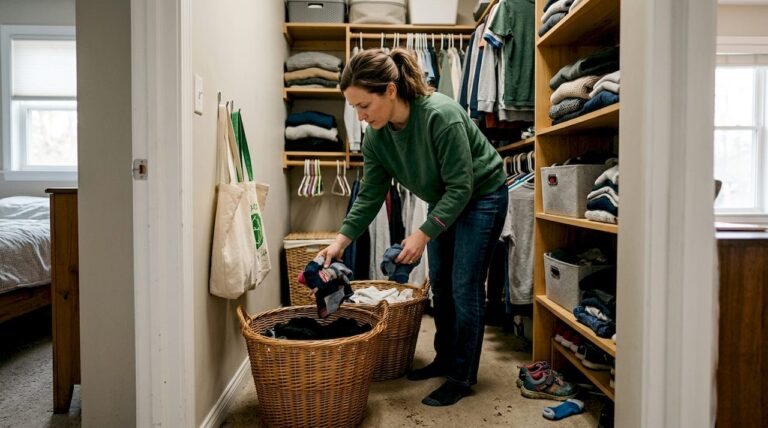
Pro Tip: Place a family laundry basket just outside the closet. When you’re doing laundry anyway, it becomes the natural trigger to return items to their zones, folding the reset into a routine you already have.
With your tools and prep ready, let’s dive into the workflow that delivers lasting order, not just a weekend makeover.
Step-by-step closet organization workflow for busy parents
This workflow is built around the standard six-phase method that professional organizers use: empty and audit, categorize, zone by frequency, add tools, color-code, and maintain. Each step is designed to take less time than you think.
- Empty and audit (20-30 minutes). Pull everything out. Yes, everything. This is the only way to see what you actually have. As you remove items, sort them into three piles: keep, donate, and toss.
- Categorize (10-15 minutes). Group your keep pile by type. Tops together, bottoms together, outerwear together. For kids, group by size and season.
- Zone by frequency (5-10 minutes). Items you reach for daily go at eye level and within arm’s reach. Seasonal or rarely used items go high or low.
- Add your tools (10-15 minutes). Hang slim hangers, place bins on shelves, add dividers, and label everything. This is where the system becomes visible.
- Color-code (5 minutes). Arrange clothing within each category by color. It sounds minor, but it cuts the time to find any item in half.
- Set up your maintenance plan. A 5 to 10 minute weekly reset and a 15 to 20 minute monthly audit are all it takes to keep the system running.
Not sure which decluttering method fits your style? Here’s a quick comparison:
| Method | How it works | Best for |
|---|---|---|
| Reverse hanger | Hang all clothes backward; after 90 days, donate what wasn’t turned forward | Visual learners who need proof |
| 90/90 rule | If you haven’t used it in 90 days and won’t in the next 90, it goes | Minimalists and small spaces |
| KonMari | Keep only what sparks joy; fold and store vertically | Families ready for a full reset |
All three are effective decluttering methods and can be combined with the workflow above. Pick the one that feels least overwhelming and start there. You can explore more natural decluttering methods that work especially well for families with kids.
Pro Tip: Create a “grab-and-go” zone for each child at their eye level, with tomorrow’s outfit already staged the night before. For yourself, a simple “mom uniform” section of 5 to 7 go-to outfits eliminates the morning decision entirely.
You’ve got the framework. But families aren’t one-size-fits-all. Let’s talk exceptions and customizations.
Customizing your workflow: Kids, small spaces, and shared closets
A workflow that works for a single adult closet needs some tweaking for a family of four. The good news is that small adjustments make a huge difference.
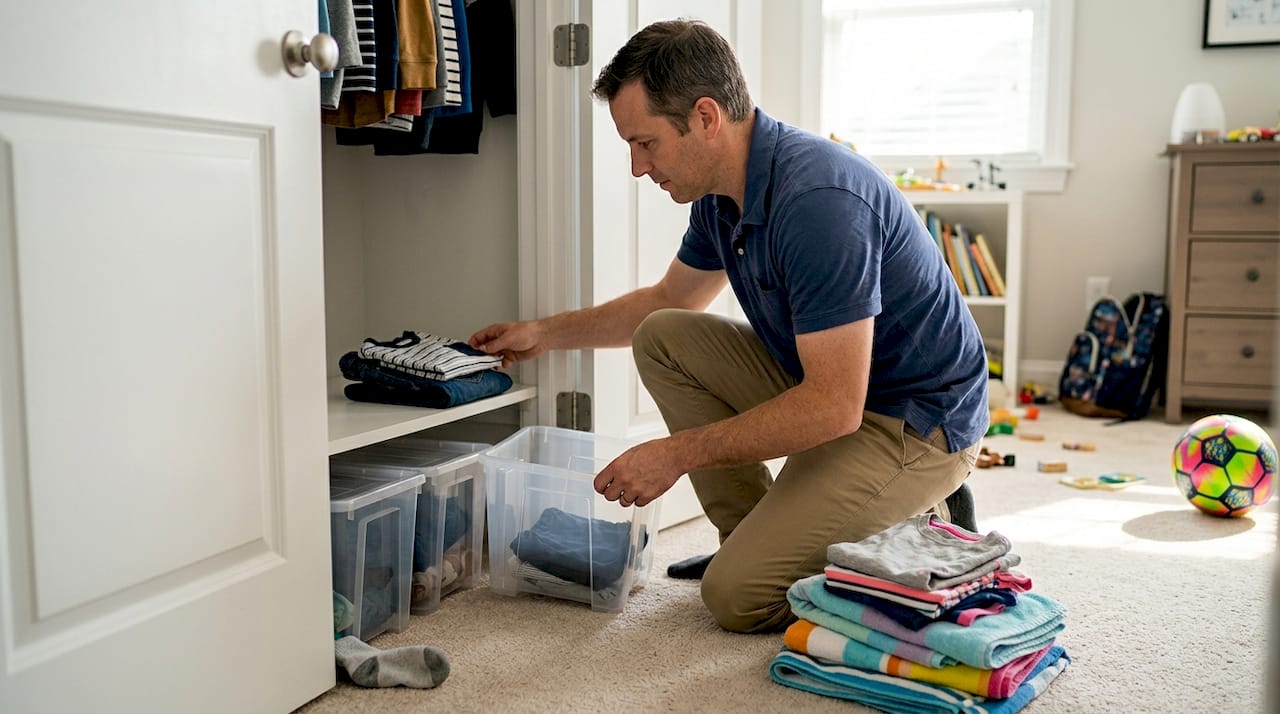
For kids’ closets, the goal is simplicity and accessibility. Kids’ closets work best with low rods they can reach, clear zones for each clothing type, and a dedicated bin for outgrown items. When that bin fills up, it’s donation time. No guilt, no delay. Seasonal swaps twice a year keep the closet from filling with items that no longer fit.
“Function over perfection is the rule for family closets. A bin that gets used beats a beautiful system that gets ignored.” This is the mindset professional organizers return to again and again, especially for households with young children.
For small or awkward spaces, try these solutions:
- Over-door organizers for shoes, accessories, or cleaning supplies
- Vertical shelving to use wall height instead of floor space
- File-fold method for t-shirts and pants so you can see every item at once
- Double hanging rods for kids’ shorter clothing to double your rod capacity
- Hooks on side walls for bags, belts, and frequently grabbed items
For more creative solutions, these front closet ideas and overlooked storage solutions are packed with practical options for tight spaces.
For shared closets, divide the space clearly and fairly. Use a physical divider on the rod, assign specific shelves to each person, and agree on a shared donation rule upfront. When everyone knows their zone, the blame game disappears.
Even the best workflow needs regular checkups. Here’s how to ensure your closet stays tidy not just today, but all year.
Making it last: Weekly resets and monthly audits
Organizing once is satisfying. Staying organized is the real win. Weekly resets of 5 to 10 minutes and monthly audits of 15 to 20 minutes are what keep a family closet functional without requiring another full overhaul.
Over 40% of families reorganize their closets at least once a year, but those who build in weekly resets dramatically cut the chaos between big sessions. Sustained organization comes from routine habits, not one-time projects. That’s the key insight most people miss.
Weekly reset (5 to 10 minutes):
- Do a quick floor check and return anything that’s landed outside its zone
- Put away any clean laundry that’s been sitting on the chair (you know the one)
- Check the donation bin and move it out if it’s full
- Straighten any folded stacks that have shifted
Monthly audit (15 to 20 minutes):
- Pull out anything that wasn’t worn that month and ask if it stays
- Swap seasonal items as needed
- Restock bins or labels that have worn out
- Check kids’ clothing for fit and move outgrown items to the donation bin
The easiest way to make resets stick is to attach them to something you already do. Fold laundry on Sunday? Add a 5-minute closet check right after. Kids’ bedtime routine? Have them put away their own clothes as part of the wind-down. Building tidy home habits into existing routines is far more effective than scheduling a separate “organization time” that never happens.
Take the next step: Home organization for busy families
You’ve already done the hard part by deciding that a better system is worth building. The workflow in this guide gives you a clear, repeatable path from chaos to calm, and it works whether you’re tackling a tiny hall closet or a full walk-in. If you want to keep the momentum going, explore how decluttering your home naturally can extend these same principles to every room. For families ready to build a whole-home system, home management systems show you how to connect closet organization to laundry, schedules, and daily routines. And if your entryway is the next problem spot, these front closet organization tips will help you create a landing zone that actually works. Progress over perfection, always.
Frequently asked questions
What is the fastest way to declutter a closet for busy parents?
Use the reverse hanger or 90/90 rule to identify unworn items quickly, then remove them in a single session under an hour. Focus on one category at a time to avoid getting overwhelmed.
How do you keep a kid’s closet organized long-term?
Kids’ closets need simplicity, accessible zones, and regular seasonal swaps to keep pace with growth. A weekly reset built into bedtime makes it sustainable without extra effort.
Are clear bins better than opaque for closet organization?
Clear bins win on visibility and speed, while opaque bins reduce visual clutter for a calmer look. Choose based on whether you need to find items fast or prefer a streamlined aesthetic.
How can parents get kids involved in closet resets?
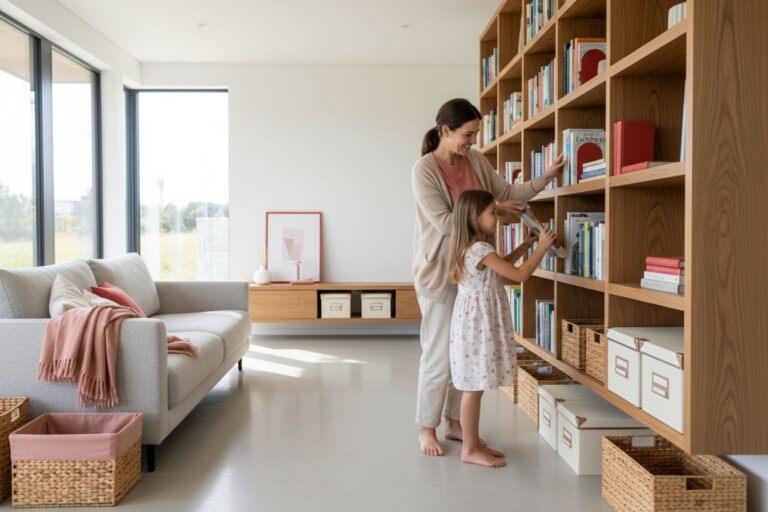
Assign simple, age-appropriate tasks like pairing socks or putting away shoes, and frame the reset as a quick family game with a timer. Regular family involvement in resets builds the habit early and makes kids feel ownership over their space.
Recommended
- Front Closet Organization Ideas: 4 Tips Save 30% Space –
- Time Management Tools for Parents – A Comparison 2025 –
- Essential Tips for Simplifying Schedules in 2025 –
- Boost Productivity with Work-from-Home routines in 2026 –
Ready to take this past the closet? The Room-by-Room Reset is the same workflow, room by room, with the decisions already made for you.