

Understanding Productivity Tips for Parents Guide
Parents juggle more tasks than ever and sometimes it feels like there just is not enough time in the day. But look at this. Research shows that over half of working parents struggle to manage their responsibilities effectively. You might assume getting more done means just working harder, but the real secret lies in using smarter strategies and mindset shifts that can actually lower stress and make family life feel less overwhelming.
Quick Summary
| Takeaway | Explanation |
|---|---|
| Implement targeted productivity strategies | Use practical techniques to manage parental responsibilities and reduce stress effectively. |
| Develop sustainable family routines | Create adaptable systems for daily tasks that support family dynamics and individual needs. |
| Utilize digital and analog tools | Leverage various productivity tools to enhance family communication and organization. |
| Practice a growth mindset | Approach parenting challenges as learning opportunities to improve skills and adapt strategies. |
| Balance personal and professional roles | Integrate work and family responsibilities for improved relationships and reduced burnout. |
What Are Productivity Tips and Why Are They Important for Parents?
Productivity tips are strategic techniques and approaches parents can use to manage their time, energy, and responsibilities more effectively. These practical strategies help transform daily chaos into organized, purposeful actions that support both family needs and personal goals. Research from the National Institutes of Health highlights how targeted productivity strategies can significantly reduce parental stress and improve overall family functioning.
Understanding the Core of Parental Productivity
Parental productivity goes beyond simple time management. It encompasses a holistic approach to organizing family life, balancing multiple responsibilities, and creating systems that support both personal and family goals. Key elements include:
- Efficient task prioritization
- Strategic planning and scheduling
- Creating sustainable family routines
- Managing emotional and physical energy
These strategies are not about doing more but about doing the right things more effectively.
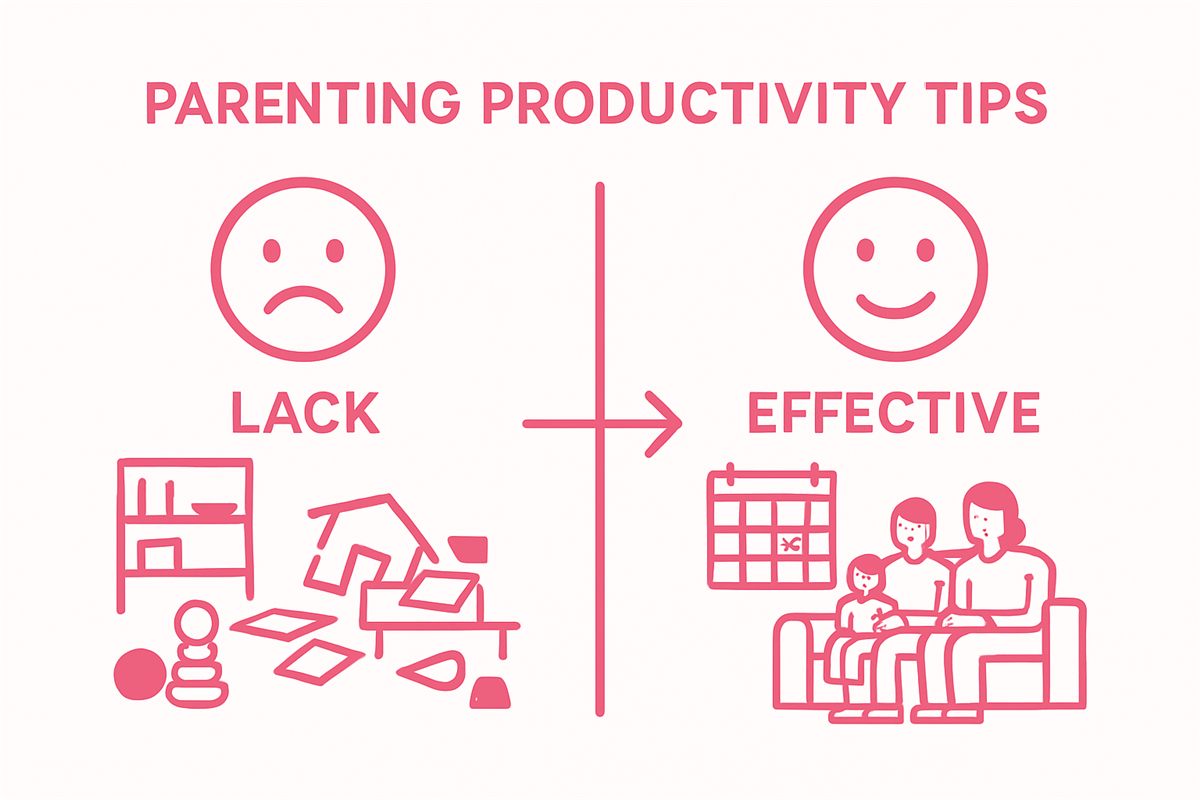 Parents who develop strong productivity skills can reduce overwhelm, create more quality time with their children, and maintain their personal well-being.
Why Productivity Matters for Parents
Parents face unique challenges that require exceptional organizational skills. Between work responsibilities, household management, child care, and personal needs, the potential for burnout is high. Productivity tips provide a framework for managing these complex demands without sacrificing mental health or family relationships.
By implementing targeted productivity strategies, parents can:
- Reduce daily stress and mental fatigue
- Create more meaningful interactions with children
- Develop predictable and comforting family rhythms
- Maintain personal goals and professional aspirations
Successful productivity for parents is not about perfection but about creating flexible, sustainable systems that adapt to changing family dynamics. Check out our guide on overcoming productivity killers to learn more about breaking counterproductive habits and building more effective family management strategies.
The Impact of Effective Time Management on Family Dynamics
Time management represents more than scheduling tasks. It fundamentally shapes family interactions, emotional connections, and overall household harmony. Research from the Journal of Applied Psychology reveals that strategic time management can significantly reduce work-family conflicts and improve family relationships.
How Time Management Transforms Family Relationships
Effective time management goes beyond simply allocating hours. It involves creating intentional spaces for connection, understanding individual family members’ needs, and developing flexible systems that accommodate everyone’s schedules. When parents master time management, they create environments that foster:
- Reduced household stress
- Increased quality family interactions
- Better emotional regulation
- Predictable and secure family rhythms
By consciously designing family time, parents can transform potential chaos into meaningful moments of connection. This approach recognizes that time is not just a resource to be divided but a precious opportunity to build stronger family bonds.
The Psychological Benefits of Structured Time
Structured time management provides psychological safety for children and parents alike. When family schedules are predictable, children feel more secure, parents experience less anxiety, and overall family communication improves. This predictability helps children develop:
- Better emotional intelligence
- Stronger sense of family identity
- Improved personal time management skills
- Enhanced feelings of security and belonging
Discover our step by step guide to family time management to learn practical strategies for implementing these transformative approaches. By understanding and implementing effective time management techniques, families can create more harmonious, connected, and fulfilling home environments.
Balancing Personal and Professional Responsibilities: Key Concepts
Balancing personal and professional responsibilities is a complex dance of strategic planning, emotional intelligence, and intentional boundary setting. Modern parents face unprecedented challenges in maintaining meaningful connections across multiple life domains. Research from the Pew Research Center highlights that over half of working parents struggle to effectively manage their diverse responsibilities.
Understanding Role Integration
Role integration is not about perfect separation but about creating flexible, interconnected systems that allow smooth transitions between work and family life. This approach recognizes that personal and professional identities are not competing entities but complementary aspects of a holistic life experience. Successful integration involves:
- Establishing clear but permeable boundaries
- Developing adaptive communication strategies
- Practicing intentional presence in each role
- Maintaining personal well-being as a foundational priority
Parents who master role integration understand that energy and attention are renewable resources that can be strategically allocated across different life domains.

Emotional and Practical Strategies
Effective responsibility balancing requires both emotional resilience and practical tools. Emotional strategies involve managing stress, practicing self-compassion, and recognizing that occasional imperfection is normal. Practical strategies include:
- Creating flexible work arrangements
- Developing shared family responsibility systems
Learn more about prioritizing self-care in your personal journey to support your ability to manage multiple responsibilities effectively. By understanding these key concepts, parents can transform potential overwhelm into opportunities for growth, connection, and meaningful life experiences.
Tools and Techniques to Enhance Productivity in Family Life
Enhancing productivity in family life requires a strategic approach that combines technological tools, organizational techniques, and intentional communication strategies. Research from the National Institutes of Health reveals that evidence-based productivity techniques can significantly improve family functioning and reduce household stress.
Digital and Analog Productivity Tools
Modern families have access to an unprecedented range of productivity tools that can transform household management. These tools bridge digital and analog approaches, offering flexible solutions for different family styles and preferences. Effective productivity tools include:
- Shared digital calendars for coordinating schedules
- Family task management applications
- Physical family planning boards
- Color-coded organizational systems
- Routine tracking applications
The key is selecting tools that match your family’s unique communication style and technological comfort level.
This table organizes the key types of digital and analog productivity tools mentioned in the article, along with their primary purposes and potential benefits for families.
| Tool Type | Example Application | Primary Purpose | Benefits to Family |
|---|---|---|---|
| Digital Calendar | Shared online family calendar | Coordinate schedules | Reduces conflicts, enhances visibility |
| Task Management App | Mobile to-do/task app | Track and assign family tasks | Encourages accountability, organizes workload |
| Physical Planning Board | Wall-mounted visual schedule | Display weekly activities | Increases clarity, engages all ages |
| Color-coded System | Color labels for events/tasks | Organize by family member/task | Simplifies identification, boosts structure |
| Routine Tracking App | Habit/routine tracker app | Reinforce daily routines | Builds consistency, develops good habits |
Not every tool works for every family, so experimentation and adaptation are crucial.
Communication and Coordination Techniques
Productivity in family life transcends mere scheduling. It involves creating robust communication systems that promote transparency, shared responsibility, and mutual understanding. Successful families develop techniques that:
- Establish regular family meetings
- Create clear responsibility distributions
- Develop age-appropriate accountability mechanisms
- Practice active listening and collaborative problem solving
Learn more about effective time management strategies to integrate these communication techniques seamlessly into your family routine. By thoughtfully implementing these tools and techniques, families can transform potential chaos into harmonious, productive living environments.
Understanding the Role of Mindset in Parental Productivity
Parental productivity is deeply rooted in psychological frameworks, with mindset playing a critical role in how parents approach challenges, manage responsibilities, and create family environments. Research from Frontiers in Psychology reveals that a parent’s cognitive approach fundamentally influences their ability to navigate complex family dynamics and maintain effective productivity.
Growth Versus Fixed Mindset in Parenting
Mindset represents the fundamental beliefs parents hold about their capabilities and potential for growth. A growth mindset recognizes that skills, abilities, and approaches can be developed through dedication and strategic learning. Parents with a growth mindset understand that:
- Challenges are opportunities for learning
- Effort creates skill development
- Failures are temporary setbacks
- Personal adaptation is possible
- Continuous improvement is achievable
This perspective transforms parental productivity from a rigid performance metric into a dynamic, evolving journey of personal and family development. Parents who embrace growth mindset principles approach tasks with curiosity, resilience, and openness.
Below is a table comparing the characteristics and benefits of Growth Mindset versus Fixed Mindset in the context of parenting, as described in the article.
| Mindset Type | Core Beliefs | Parental Approach | Key Benefits |
|---|---|---|---|
| Growth Mindset | Skills and abilities can be developed through dedication and effort | Sees challenges as opportunities to learn | Encourages adaptability, resilience, and continuous improvement |
| Fixed Mindset | Abilities are static and unchangeable | Avoids challenges, sees setbacks as failures | Can limit development and lead to frustration |
Cognitive Strategies for Productive Parenting
Cognitive strategies involve intentional mental approaches that support productivity and emotional regulation. Successful parents develop mental frameworks that:
- Reframe challenges as learning experiences
- Practice self-compassion
- Maintain flexible problem solving skills
- Cultivate positive emotional responses
Explore techniques for focused productivity to complement your mindset development. By understanding and intentionally shaping your cognitive approach, you can create more resilient, adaptive, and productive family systems that thrive amid complexity and change.
Ready to Turn Parental Productivity Challenges Into Lasting Solutions?
Feeling overwhelmed by family schedules, endless to-dos, and the stress of balancing work with home life? You are not alone. This guide highlights the daily chaos many parents face—juggling priorities, managing emotional energy, and striving to create sustainable routines. If you want to find realistic strategies for more harmony, less clutter, and a productive family environment, you are in the right place.

Take the first step toward a calmer, more organized life. Discover proven tools, actionable hacks, and home management systems that can truly transform how your family functions every day. Visit ItsaSouthernLifeYall.com for even more decluttering solutions, time management tools, and simple productivity tips. Ready for your breakthrough? Explore our library and start building your most efficient lifestyle today.
Frequently Asked Questions
What are some practical productivity tips for parents?
Productivity tips for parents include efficient task prioritization, strategic planning and scheduling, establishing sustainable family routines, and managing both emotional and physical energy to create organized family life.
How can time management improve family relationships?
Effective time management enhances family relationships by fostering intentional connections, reducing household stress, and providing a structured environment that promotes emotional regulation and secure family rhythms.
What is role integration, and why is it important for parents?
Role integration involves creating flexible systems that allow parents to balance personal and professional responsibilities effectively. It is important because it helps parents navigate the demands of work and family life without compromising their well-being or family relationships.
How can parents cultivate a growth mindset to enhance productivity?
Parents can cultivate a growth mindset by reframing challenges as learning opportunities, practicing self-compassion, and maintaining flexible problem-solving skills to adapt and improve over time.