
Mindful Spending Cuts Family Expenses 40% for Parents
Busy parents often find themselves caught in cycles of stress spending and impulse purchases. Studies show families practicing mindful spending reduce discretionary expenses by up to 40% while lowering financial stress by 30%. This guide provides practical strategies to align your spending with family values, creating financial breathing room without restrictive budgeting that never seems to stick.
Table of Contents
- Understanding Mindful Spending: Definition And Principles
- Benefits Of Mindful Spending For Busy Families
- Common Misconceptions About Mindful Spending
- Mindful Spending Compared To Traditional Budgeting
- Implementing Mindful Spending: A Practical Framework
- Tools And Resources To Facilitate Mindful Spending
- Practical Outcomes And Family Dynamics
- Discover Family Systems And Productivity Solutions For Mindful Spending Success
- FAQ
Key Takeaways
| Point | Details |
|---|---|
| Values-driven approach | Mindful spending prioritizes family values over strict budget categories, creating flexibility with purpose. |
| Significant savings | Families reduce discretionary spending by 25-40% and financial stress by approximately 30%. |
| Different from traditional budgeting | Focuses on intentional choices and emotional awareness rather than rigid spending limits. |
| Four-step framework | Track spending, clarify values, align purchases, and reflect regularly to maintain balance. |
| Digital tools simplify adoption | Apps and worksheets reduce cognitive load for time-strapped parents implementing mindful spending. |
Understanding Mindful Spending: Definition and Principles
Mindful spending is defined as intentional, values-aligned expenditure rather than impulsive or habitual purchasing. Unlike traditional budgeting’s focus on numerical limits, this approach asks whether each purchase reflects what truly matters to your family.
The psychological foundation centers on awareness. When you pause before swiping your card, you create space between impulse and action. This gap allows rational evaluation rather than emotional reaction.
Think of mindful spending as financial meditation. You observe your spending patterns without judgment, then gently guide decisions toward alignment with your stated priorities. Over weeks and months, this practice builds new neural pathways that make values-based choices feel natural.
Core principles include:
- Intentionality: Every dollar serves a conscious purpose
- Values alignment: Spending reflects family priorities
- Awareness: Regular observation of patterns and triggers
- Flexibility: Adjustments based on changing needs
Mindful spending makes your values visible in bank statements. If family experiences rank high but restaurant bills dominate your budget, there’s a disconnect worth examining.
Pro Tip: Start each month by writing your top three family values on a sticky note attached to your credit card. This physical reminder prompts reflection before purchases.
The beauty of this approach lies in its adaptability. Busy parents don’t need hours of spreadsheet work. A few minutes of daily awareness creates compound effects that traditional budgeting often fails to achieve.
Benefits of Mindful Spending for Busy Families
Research shows mindful spending reduces discretionary spending by 25-40% and financial stress by about 30%. These aren’t just numbers on paper. They translate to real breathing room in tight budgets.
Financial savings emerge naturally. When you question whether that online shopping cart truly serves your family’s wellbeing, unnecessary purchases drop away. Parents report feeling liberated rather than restricted.
Tangible benefits include:
- Fewer regretted purchases cluttering closets
- More money for priorities like family vacations
- Reduced decision fatigue from constant spending choices
- Lower credit card balances and associated stress
The emotional payoff matches the financial gains. Families practicing mindful spending report better communication around money. Parents model healthy financial behavior their children absorb and replicate.
“Since adopting mindful spending, our family argues less about money and enjoys shared goals more. We’re actually excited about our financial future now.”
Quality of life improvements extend beyond bank accounts. When family time becomes a spending priority, weekends shift from mall browsing to meaningful experiences. Children remember the camping trip, not the forgotten toy.
Statistical snapshot:
- 40% reduction in impulse purchases
- 30% decrease in financial anxiety
- 25% increase in savings rate
- 50% improvement in financial communication
Busy parents particularly appreciate reduced mental load. Instead of tracking dozens of budget categories, you ask one question: Does this align with our values? This simplification frees cognitive resources for parenting challenges that actually matter.
The compound effect amplifies over time. Small daily choices create substantial annual savings, but more importantly, they build financial confidence and family cohesion that money can’t buy directly.
Common Misconceptions About Mindful Spending
Mindful spending myths include beliefs that it always means spending less or ignoring financial responsibility. These misconceptions prevent families from exploring this valuable approach.
The biggest myth equates mindfulness with deprivation. Reality proves more nuanced. You might spend more on quality family experiences while drastically cutting mindless purchases. Total spending could stay constant while satisfaction skyrockets.
Another misunderstanding suggests mindful spending ignores practical necessities like emergency funds and debt repayment. Actually, responsible mindful spenders prioritize financial security as a core value. Your values framework should include stability alongside joy.
Common myths debunked:
- Myth: Always spend less on everything
- Reality: Spend more on values, less on noise
- Myth: No structure or planning needed
- Reality: Intentional framework guides decisions
- Myth: Incompatible with aggressive savings goals
- Reality: Values can include financial independence
Some parents worry mindful spending lacks the accountability of traditional budgets. The opposite proves true. When purchases must align with stated values, you face harder questions than “Did I exceed my clothing budget?”
Pro Tip: Create a “values violation” alert. When spending contradicts your priorities, investigate the emotional trigger rather than just the transaction. This builds awareness faster than guilt.
The flexibility of mindful spending intimidates people accustomed to rigid rules. They fear they’ll rationalize every purchase as “aligned with values.” Honest reflection and regular reviews prevent this trap. Your bank balance provides objective feedback.
Another misconception positions mindful spending as too time consuming for busy parents. Proper systems actually save time by eliminating hours of detailed budget tracking and reconciliation. A quick daily check-in replaces weekend spreadsheet marathons.
The key lies in recognizing that mindful spending isn’t about perfection. It’s about progress toward alignment. Some months you’ll nail it. Others you’ll drift. The practice itself builds the muscle memory that eventually makes values-based choices automatic.
Mindful Spending Compared to Traditional Budgeting
Traditional budgeting is rigid with strict categories while mindful spending is flexible and values-driven, leading to higher satisfaction and adherence. Understanding these differences helps you choose the right approach.
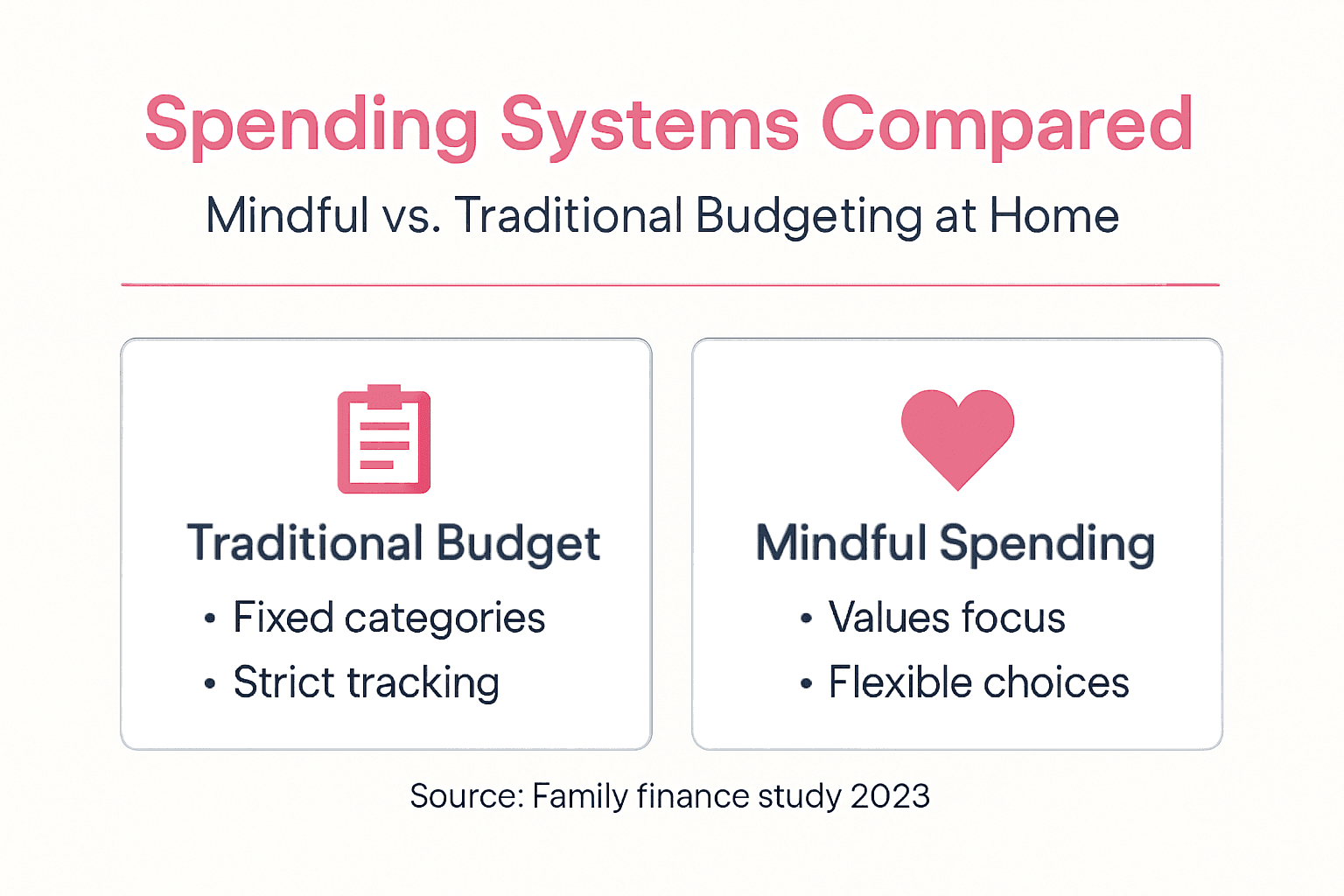
Traditional budgeting operates like a financial straitjacket. You allocate specific amounts to predetermined categories, then track every transaction against these limits. Overspending in one area requires offsetting cuts elsewhere.
Mindful spending functions more like a compass than a map. Instead of predetermined paths, you navigate by principles. Each spending decision asks whether it moves you toward or away from your values destination.
Comparison table:
| Aspect | Traditional Budgeting | Mindful Spending |
|---|---|---|
| Structure | Fixed categories and limits | Values-based guidelines |
| Flexibility | Low, strict adherence required | High, contextual decisions |
| Focus | Numerical compliance | Intentional alignment |
| Time investment | High tracking overhead | Lower, principle-based |
| Psychological impact | Can feel restrictive | Generally empowering |
| Best for | Detail-oriented planners | Values-driven families |
Traditional budgets excel at providing clear boundaries. If you allocated $200 for dining out, you know exactly when to stop. This clarity helps some families maintain discipline.
Mindful spending trades precision for adaptability. You might spend more on restaurants during a stressful month if family connection ranks as a top value. The question isn’t “Did I exceed my limit?” but “Did this serve our wellbeing?”
Key distinctions:
- Traditional: Prescriptive, rule-based system
- Mindful: Descriptive, principle-guided approach
- Traditional: Success measured by compliance
- Mindful: Success measured by alignment
Many families find hybrid approaches work best. Maintain traditional budgets for fixed expenses like housing and insurance. Apply mindful spending to discretionary categories where values play a larger role.
The psychological difference matters most. Traditional budgets often trigger rebellion or guilt when violated. Mindful spending encourages curiosity about misalignments. This gentler approach sustains long-term behavior change better than rigid rules.
Busy parents particularly appreciate mindful spending’s lower maintenance requirements. You don’t need perfect tracking or category assignment. A weekly reflection on major purchases provides sufficient feedback for course correction.
Implementing Mindful Spending: A Practical Framework
A four-step framework includes awareness, values clarification, purchase alignment, and reflection. This structured approach makes mindful spending actionable for busy families.

Step 1: Build Spending Awareness
Track every expense for one month without judgment. Use a simple app or notebook. The goal isn’t perfection but pattern recognition. Where does money actually go versus where you think it goes?
Step 2: Clarify Family Values
Gather your family for a 30-minute conversation. List your top five values: experiences, education, health, community, creativity, or security. Be honest about what truly matters, not what should matter. Write these down and post them visibly.
Step 3: Align Purchases with Values
Before each discretionary purchase, pause and ask: “Which value does this serve?” If the answer isn’t immediate and clear, reconsider. This doesn’t mean never buying anything fun, but that fun should align with values like joy or family bonding.
Step 4: Reflect and Adjust
Schedule 15 minutes weekly to review major purchases. Did they deliver expected value? Do spending patterns match your values list? Adjust your approach based on honest assessment.
Pro Tip: Use time blocking to schedule your weekly money reflection. Treating it like any other appointment ensures consistency without overwhelming your schedule.
Digital tools dramatically reduce implementation friction. Apps with spending alerts catch misalignments in real time. Cloud-based systems let both partners stay synchronized without lengthy update conversations.
The framework works because it creates accountability without restriction. You’re free to spend on anything that serves your values. This positive framing maintains motivation better than negative budget enforcement.
Start small. Choose one spending category for your first month of practice. Master mindful grocery shopping or entertainment spending before expanding to other areas. Proactive planning in stages prevents overwhelm.
Consistency matters more than perfection. Missing a day of tracking or making one impulsive purchase doesn’t erase progress. The practice builds over time like compound interest, with small daily choices creating substantial long-term transformation.
Tools and Resources to Facilitate Mindful Spending
Budgeting apps with mindfulness features help maintain values-aligned spending and encourage reflection. The right tools transform intention into sustainable habit.
Top recommended apps:
- YNAB (You Need A Budget): Emphasizes intentional dollar assignments and regular reflection
- Monarch: Customizable categories, family sharing, and spending alerts
- EveryDollar: Simple interface perfect for budget beginners
- Goodbudget: Envelope system adapted for digital age
Look for features that support mindfulness specifically. Spending alerts create pause moments before purchases. Category customization lets you organize by values rather than generic labels. Reflection prompts encourage regular assessment.
Essential tool features:
| Feature | Why It Matters | Best Apps |
|---|---|---|
| Custom categories | Align with your values | YNAB, Mint |
| Spending alerts | Prompt mindful pauses | All major apps |
| Partner sync | Family coordination | YNAB, Goodbudget |
| Reflection prompts | Encourage assessment | YNAB |
| Visual dashboards | Quick pattern recognition | Mint, EveryDollar |
Beyond apps, simple worksheets provide tactile engagement some families prefer. Print a monthly values tracker with columns for each family value and rows for each day. Mark which values your spending served.
Community support accelerates progress. Online forums and local groups provide accountability and idea sharing. Knowing others face similar challenges normalizes the journey and provides encouragement during difficult moments.
Budget tracking systems integrated with values reflection create powerful habit loops. The tracking provides data, while reflection transforms data into wisdom and adjusted behavior.
For busy parents, automation becomes crucial. Link credit cards and bank accounts for automatic transaction import. Set up recurring reviews as calendar reminders. Reduce friction until mindful practices become as automatic as brushing teeth.
The investment in good tools pays dividends. An hour spent setting up systems saves dozens of hours in manual tracking and decision fatigue throughout the year. Choose tools that fit your tech comfort level and family situation.
Practical Outcomes and Family Dynamics
Mindful spending improves family communication and reduces money-related conflicts. The ripple effects extend far beyond bank balances into daily family life quality.
Families report more open conversations about money once mindful spending replaces blame-based budget discussions. Instead of “You overspent again,” conversations shift to “How does this purchase serve our values?” This reframing removes defensiveness.
Joint financial goals emerge naturally. When both partners clarify shared values, spending decisions become collaborative rather than competitive. You’re working toward the same vision instead of negotiating separate agendas.
Real family impacts:
- Weekly money talks replace monthly budget battles
- Children learn healthy financial modeling through observation
- Reduced stress improves overall family mood and connection
- Shared accomplishments strengthen partnership bonds
One family shared that scheduling dedicated time for values discussions transformed their relationship with money. What started as financial planning became deeper conversations about life priorities and dreams.
The reduction in impulsive spending eliminates common conflict triggers. When both partners commit to the mindful pause before purchases, accusations of irresponsibility decrease dramatically. Trust builds as actions consistently match stated values.
Children absorb lessons through observation rather than lectures. They see parents making thoughtful choices and discussing tradeoffs openly. This modeling creates financial literacy more effectively than any allowance system or classroom lesson.
Families practicing mindful spending report feeling more aligned and purposeful. Money becomes a tool for expressing values rather than a source of stress and disagreement. This fundamental shift in perspective creates lasting positive change across all family dynamics.
The ultimate outcome isn’t just financial stability but family harmony. When everyone understands and pursues shared values, daily decisions become easier and relationships strengthen through consistent alignment and mutual support.
Discover Family Systems and Productivity Solutions for Mindful Spending Success
Implementing mindful spending becomes easier with the right home management systems supporting your family’s financial and organizational goals. Our comprehensive guides help busy parents create sustainable routines that maintain mindful spending practices alongside other household responsibilities.
Explore our budgeting systems guide for family-specific strategies that complement mindful spending principles. Discover how to integrate values-based financial decisions into your existing home management approach without adding overwhelming complexity.
Busy families benefit from productivity hacks designed specifically for parents juggling multiple priorities. Learn time-saving strategies that create space for the reflection and planning mindful spending requires while maintaining work-life balance and family connection.
FAQ
What is mindful spending and why is it important for busy parents?
Mindful spending means making intentional, values-aligned purchases rather than impulsive or habitual ones. It helps busy parents reduce unnecessary expenses by up to 40% while lowering financial stress by 30%, creating both financial breathing room and improved family wellbeing through purposeful resource allocation.
How can busy parents start practicing mindful spending with limited time?
Start by tracking expenses for one month using simple time blocking techniques to schedule 15-minute weekly reviews. Use automated apps to eliminate manual entry work. Focus on awareness before making changes, allowing patterns to reveal themselves naturally without adding overwhelming complexity to already busy schedules.
What common pitfalls should parents avoid when adopting mindful spending?
Avoid equating mindful spending with always spending less or eliminating enjoyment from your budget. Maintain emergency funds and debt repayment plans alongside values-based spending. The goal is alignment with priorities, not deprivation or financial irresponsibility disguised as flexibility.
Which tools best support mindful spending for families?
Apps like YNAB and Mint offer spending tracking with customizable categories that align with family values rather than generic labels. Look for features including spending alerts, partner synchronization, and reflection prompts. Worksheets and budgeting tool systems provide community support that enhances accountability and sustained practice.
Recommended
- 20 Time-Tested Family Hacks to Break the Paycheck-to-Paycheck Cycle (Strategies That Actually Work with Kids) –
- Budgeting for Families – Creating Stability at Home –
- How to Feed a Family on a Budget –
- How to Track Family Expenses: A Simple Guide for 2025 –
- 7 Practical Ways To Save Money In Nigeria Today
- NYE on a budget! – LoveBelfast
Want a little more help with this? The Money Mindset is a CFO’s approach to the beliefs underneath the spending — three parts, about fifteen minutes each.