
Positive Discipline Strategies That Work for Strong-Willed Children
Every parent faces those moments when their strong-willed child seems ready to test every limit in the book. Balancing effective discipline with warmth and structure is a common challenge, especially for busy North American families striving for both harmony and order at home. By learning to recognize your child’s unique temperament and emotional triggers, you can lay the foundation for more peaceful days and foster a truly organized environment built on positive discipline strategies that work.
Table of Contents
- Step 1: Assess Your Child’s Temperament And Triggers
- Step 2: Set Clear And Consistent Boundaries In Your Home
- Step 3: Model Calm Responses During Challenging Moments
- Step 4: Implement Positive Reinforcement For Desirable Behavior
- Step 5: Review Progress And Adjust Discipline Strategies
Quick Summary
| Important Insight | Explanation |
|---|---|
| 1. Understand child’s temperament and triggers | Observing how your child reacts helps anticipate conflicts and create effective discipline strategies. Track emotional responses to develop supportive methods. |
| 2. Set clear and consistent boundaries | Establishing explicit rules provides a predictable environment that fosters security and respect, helping children know expectations. |
| 3. Model calm responses during challenges | Maintaining composure teaches emotional regulation and resilience, demonstrating how to handle stress effectively to your child. |
| 4. Implement positive reinforcement | Recognizing good behavior with specific praise builds confidence and encourages repeat of desirable actions, promoting a positive relationship. |
| 5. Review and adjust discipline strategies | Regularly reassessing your approach keeps parental guidance effective and responsive to your child’s developmental changes and needs. |
Step 1: Assess your child’s temperament and triggers
Understanding your strong-willed child’s unique temperament is like decoding a personal roadmap to more peaceful interactions. By recognizing their specific emotional patterns and triggers, you can develop more effective and compassionate discipline strategies.
Start by observing your child’s reactions in different scenarios. Notice how they respond to changes, new experiences, and emotional challenges. Understanding temperament characteristics helps you anticipate potential conflicts and design supportive responses.
Key temperament traits to assess include:
- Emotional intensity: How strongly they react to situations
- Activity level: Their typical energy and movement patterns
- Frustration tolerance: How quickly they become overwhelmed
- Adaptability: Their comfort with changes and new experiences
Recognizing your child’s unique temperament is the first step in creating a supportive and understanding parenting approach.
Pay attention to specific triggers that cause emotional meltdowns or resistance. These might include unexpected schedule changes, sensory overload, hunger, or feeling misunderstood. Documenting these patterns can help you develop proactive strategies.
Pro tip: Keep a simple journal tracking your child’s emotional reactions and potential triggers to identify consistent patterns and improve your response strategies.
Here’s how temperament traits can influence discipline strategies:
| Temperament Trait | Influence on Discipline Approach | Suggested Adjustment |
|---|---|---|
| High Emotional Intensity | May escalate quickly or overreact | Use calm reassurance and patience |
| Low Frustration Tolerance | Short temper when challenged | Break tasks into smaller steps |
| High Activity Level | Difficulty sitting still or focusing | Offer frequent activity breaks |
| Low Adaptability | Resists change or new routines | Provide advance notice for changes |
Step 2: Set clear and consistent boundaries in your home
Establishing clear boundaries is crucial for creating a harmonious household with strong-willed children. Your goal is to create a predictable environment where your child understands expectations and feels secure in knowing exactly what’s acceptable.
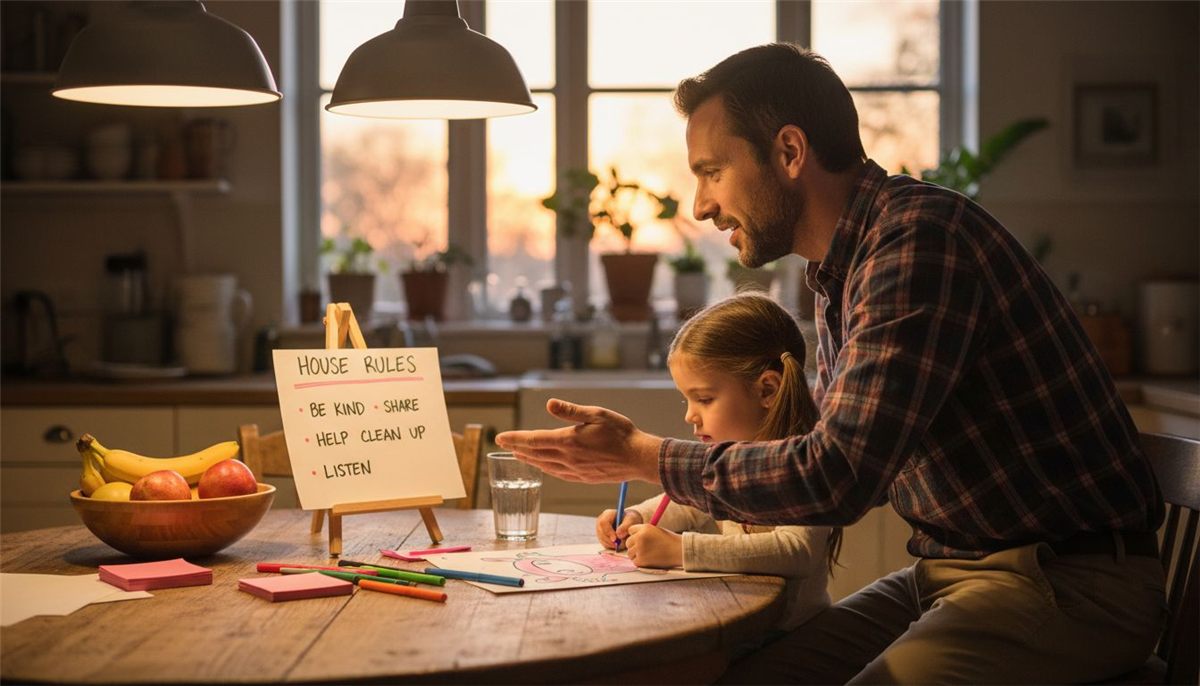
Positive discipline involves setting clear boundaries that help children develop respect and problem-solving skills. Start by creating a family rules framework that is both transparent and age-appropriate.
Key strategies for setting effective boundaries include:
- Define specific rules with clear language
- Explain the reasoning behind each boundary
- Consistently enforce established guidelines
- Use positive reinforcement when rules are followed
Boundaries provide children with a sense of safety and help them understand how to interact appropriately in different situations.
Important boundary-setting techniques involve creating visual reminders like rule charts, using calm and firm communication, and offering limited choices within acceptable parameters. This approach helps strong-willed children feel empowered while maintaining necessary structure.
Pro tip: Create a family rules poster together, allowing your child to contribute ideas and help design the visual representation, which increases their buy-in and understanding.
Step 3: Model calm responses during challenging moments
Managing your emotional reactions during intense moments is perhaps the most challenging yet critical aspect of parenting a strong-willed child. Your ability to remain composed becomes a powerful teaching tool for emotional regulation and resilience.
Monitoring personal emotional triggers helps you respond thoughtfully instead of reactively. When you feel tension rising, pause and take a deep breath before responding.
Key strategies for maintaining emotional composure include:
- Recognize your personal stress signals
- Practice deep breathing techniques
- Use a calm, neutral tone of voice
- Speak slowly and deliberately
- Validate your child’s emotions
Modeling emotional control teaches your child more effectively than any lecture ever could.
Important techniques involve preparing mental scripts for challenging scenarios, developing a consistent calm response approach, and understanding that your reaction sets the emotional temperature of the interaction. Remember that your strong-willed child is watching and learning from your every response.
Pro tip: Create a personal “emotional reset” routine like taking three deep breaths or silently counting to five before responding during heated moments.
Step 4: Implement positive reinforcement for desirable behavior
Positive reinforcement is a powerful tool for shaping your strong-willed child’s behavior and strengthening your relationship. By strategically acknowledging and celebrating good choices, you create a supportive environment that encourages repeated positive actions.
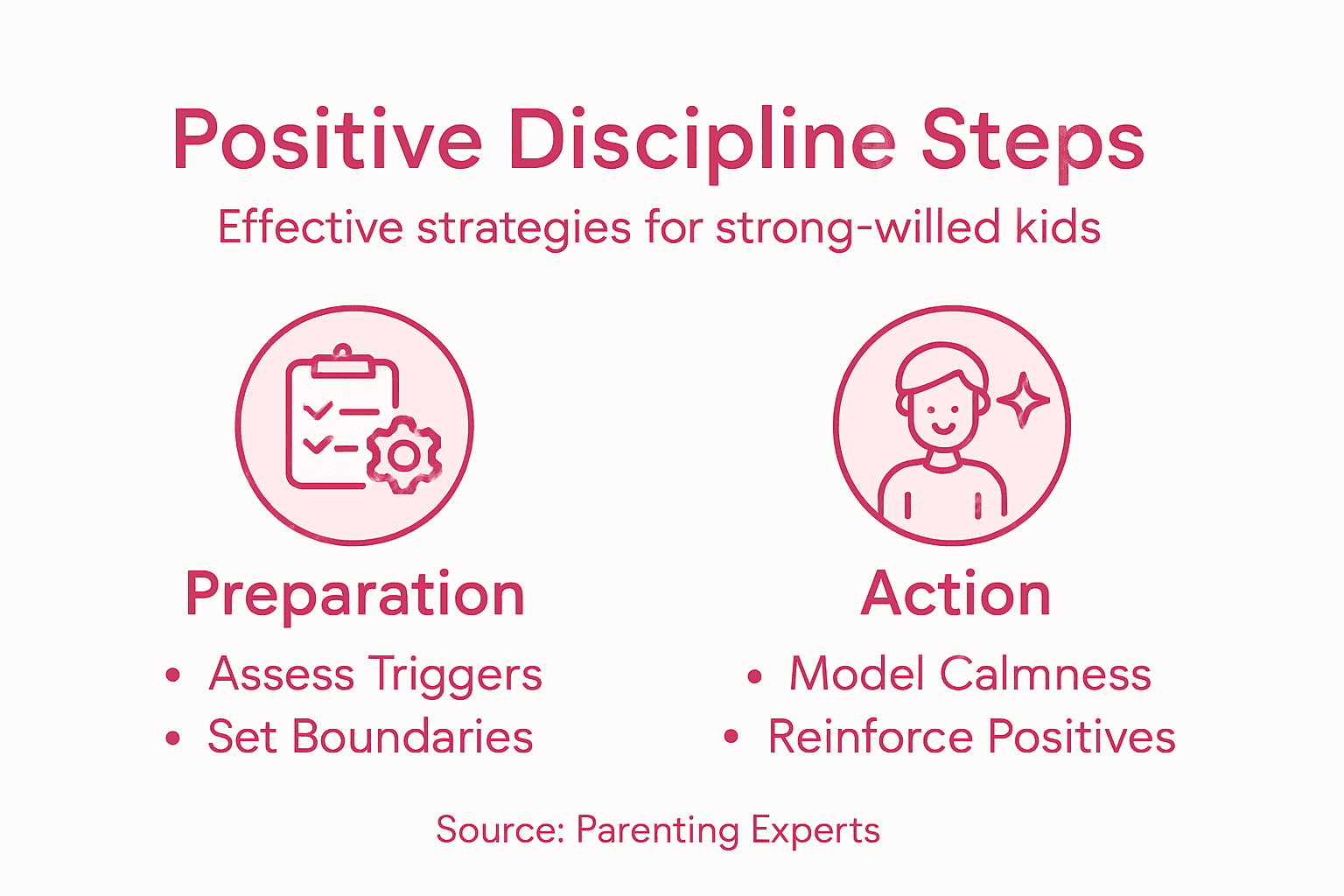
Effective positive reinforcement strategies can transform challenging interactions into opportunities for growth. The key is finding meaningful ways to recognize your child’s efforts and accomplishments.
Key approaches for implementing positive reinforcement include:
- Offer specific verbal praise
- Use immediate acknowledgment
- Create a reward system
- Show genuine excitement
- Focus on effort over outcome
Positive reinforcement builds confidence and motivates children to continue making good choices.
Successful reinforcement requires consistency and authenticity. Choose rewards that matter to your child, whether that’s extra one-on-one time, a special privilege, or a small token of recognition. Remember that the emotional connection matters more than the actual reward.
Pro tip: Create a visual progress tracker like a sticker chart where your child can see their positive behaviors accumulating, turning motivation into a fun and engaging process.
Compare common positive reinforcement methods and their potential impact:
| Reinforcement Method | Best For | Motivation Type |
|---|---|---|
| Specific Verbal Praise | Building self-esteem | Internal/self-motivation |
| Reward System | Encouraging consistency | Tangible/goal-oriented |
| Extra Privileges | Strengthening connection | Relationship-based |
| Visual Progress Chart | Tracking improvement | Visual motivation |
Step 5: Review progress and adjust discipline strategies
Parenting a strong-willed child requires flexibility and continuous learning. Regular assessment of your discipline strategies helps you stay responsive to your child’s evolving needs and emotional development.
Evidence-based discipline strategies emphasize ongoing evaluation and collaborative approach. Take time to reflect on what’s working, what’s not, and how you can support your child’s growth more effectively.
Key elements of reviewing and adjusting your approach include:
- Track behavior patterns
- Document successful interventions
- Notice subtle changes in response
- Be willing to modify strategies
- Celebrate incremental improvements
Discipline is a dynamic process, not a fixed set of rules. Stay curious and compassionate about your child’s development.
Consistent review allows you to fine-tune your approach, ensuring that your discipline methods remain age-appropriate and aligned with your child’s unique temperament. Pay attention to both verbal and nonverbal cues that indicate your strategies are effective or need refinement.
Pro tip: Schedule a monthly “strategy review” with yourself or your partner, using a simple journal to track progress and brainstorm new approaches.
Create a Calm and Organized Home for Your Strong-Willed Child
Parenting a strong-willed child means facing challenges like emotional intensity, low frustration tolerance, and setting consistent boundaries. These factors can make managing daily routines feel overwhelming and chaotic. If you want to build a home environment that supports positive discipline and emotional growth, it starts with simple living strategies that bring order and peace.
Discover proven organization hacks, time management tools, and home management systems designed to reduce stress and create structure. At It’s a Southern Life Y’all, we offer practical solutions to help busy families like yours transform cluttered, hectic spaces into calm, efficient homes where positive discipline can thrive. Don’t wait to make life easier and more balanced—explore our simple living strategies now and take the first step toward a peaceful household that nurtures your child’s growth.
Frequently Asked Questions
How can I identify my child’s temperament and triggers?
Understanding your child’s temperament starts with careful observation. Track their behaviors and responses to various situations, such as transitions or emotional challenges, to uncover consistent patterns. Keep a journal to document these instances, which can help you tailor your discipline strategies effectively.
What are some effective ways to set clear boundaries for a strong-willed child?
Establish clear and specific rules for your child, explaining the reasoning behind each boundary. Use visual reminders, like a rules chart, and consistently reinforce expectations to create a structured yet supportive environment. Engage your child in the process by co-creating these guidelines.
How can I remain calm during my child’s challenging moments?
Modeling calmness is essential when addressing your child’s strong emotions. Before responding, take a deep breath and pause to collect yourself, using a neutral tone to validate your child’s feelings. Prepare calming scripts for common scenarios to help maintain your composure during challenging interactions.
What types of positive reinforcement work best for strong-willed children?
Effective positive reinforcement strategies include specific verbal praise and creating reward systems that resonate with your child. Acknowledge and celebrate their good behaviors immediately to strengthen their motivation. For example, you could use a visual progress tracker, like a sticker chart, to make progress visible and engaging.
How often should I review and adjust my discipline strategies?
Regularly reviewing and adjusting your discipline strategies is crucial for supporting your child’s development. Set aside time at least once a month to assess what’s effective and explore new approaches. Keep track of behavioral patterns and successes to refine your strategies over time for greater effectiveness.
What are some common challenges when using positive discipline strategies?
Common challenges include staying consistent and navigating your own emotional triggers during intense moments. To overcome these difficulties, ensure you communicate openly with your child about expectations and adjust your strategies as needed. Regular self-reflection and journaling can help you identify areas for improvement.
Recommended
- 5 Ways to Build Unshakeable Confidence in Your Child –
- How to Teach Your Kids the Value of Hard Work (Without Nagging) –
- Raising Confident Kids: Practical Strategies for Resilience – It’s a Southern Life Ya’ll
- 10 Simple Ways to Teach Kids Gratitude and Kindness – It’s a Southern Life Ya’ll
- How to Deal With Parenting Conflicts
- Making Learning Fun: Engaging Activities for Your Kids
- The Impact of Positive Reinforcement on 11 Plus (11+) Preparation | 11+ Tuition
Keep reading: more parenting help
Want a little more help with this? I made a free Age-by-Age Chore Chart that pairs right up with this post — y’all can grab it over on my Free Resources page.