
Priority Budgeting: Complete Guide for Busy Families
Did you know that over 60 percent of families say traditional budgets leave them feeling stressed and inflexible? Priority budgeting offers a smarter way to put your money where it matters most. This approach helps you match your spending with your real goals, adjusting as your needs change. Learn how making intentional choices with your finances can create a more adaptable and meaningful plan for your family’s unique journey.
Key Takeaways
| Point | Details |
|---|---|
| Flexibility in Budgeting | Priority budgeting allows for dynamic adjustments to align with changing family needs and financial goals. |
| Goal-Oriented Approach | Focus on prioritizing financial objectives fosters intentional and meaningful resource allocation. |
| Collaborative Involvement | Engaging all family members in the budgeting process promotes shared understanding and commitment to financial goals. |
| Ongoing Assessment | Regular reviews of priorities and expenses ensure the budget remains relevant and effective in achieving family objectives. |
Table of Contents
- What Is Priority Budgeting? Core Definition And Principles
- How Priority Budgeting Differs From Traditional Budgeting
- Step-By-Step Priority Budgeting Process For Families
- Real-Life Priority Budgeting Examples For Households
- Common Pitfalls And How To Avoid Them
What Is Priority Budgeting? Core Definition and Principles
Ever feel like your family’s money just seems to disappear without a clear plan? Priority budgeting might be the game-changing strategy you need. According to finance strategists, priority-based budgeting is a method that allocates resources based on intentional goal ranking, ensuring your most important financial objectives get funded first.
At its core, priority budgeting flips traditional budgeting on its head. Instead of rigidly splitting income into fixed percentage buckets, this approach helps families align their money with their actual values and current life stage. As research from Finance Strategists indicates, the method provides incredible flexibility for households experiencing changing priorities or irregular income streams.
Here’s what makes priority budgeting different from traditional approaches:
- Focuses on goals, not just numbers
- Adapts to your family’s evolving needs
- Provides emotional connection to financial planning
- Allows strategic resource allocation based on current life priorities
Think of priority budgeting like creating a family mission statement for your money. You’re not just tracking expenses – you’re deliberately directing your financial resources toward what matters most right now. Whether that’s saving for your children’s education, building an emergency fund, or planning a family vacation, priority budgeting helps you make intentional choices that reflect your family’s unique journey.
How Priority Budgeting Differs From Traditional Budgeting
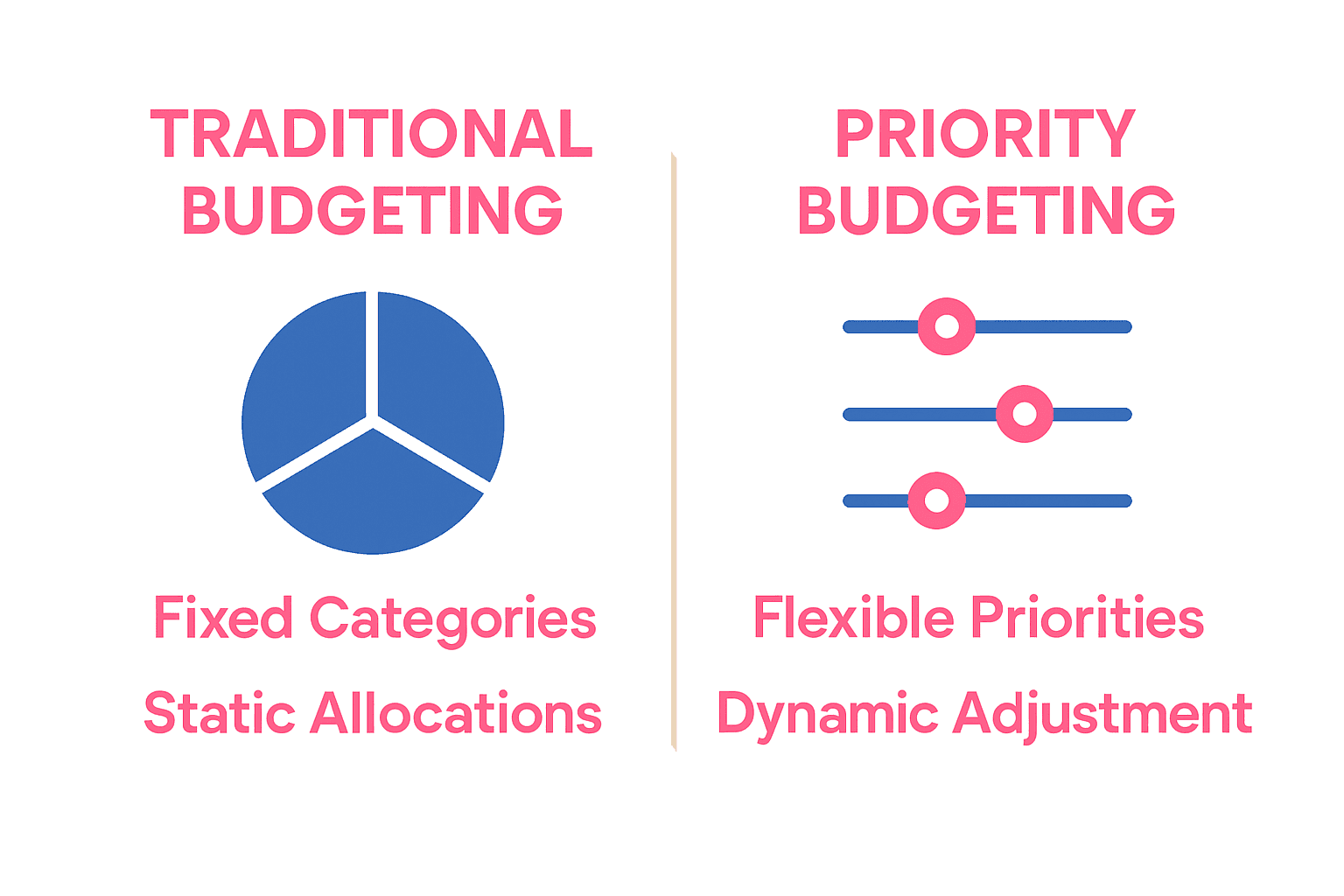
Traditional budgeting often feels like trying to squeeze your family’s complex financial life into a rigid, one-size-fits-all template. According to Finance Strategists, the classic approach typically involves preset categories and inflexible percentage allocations that don’t reflect the dynamic nature of family finances.
In contrast, priority budgeting is like having a financial GPS that constantly recalculates based on your family’s current journey. As research from Success Guardian highlights, while traditional methods like the 50/30/20 rule lock you into fixed spending percentages, priority budgeting offers remarkable adaptability. Imagine being able to shift funds quickly when unexpected opportunities or challenges arise – that’s the power of this approach.
Key differences between traditional and priority budgeting include:
Here’s a comparison of key differences between traditional and priority budgeting:
| Feature | Traditional Budgeting | Priority Budgeting |
|---|---|---|
| Structure | Fixed categories Set percentages |
Flexible categories Adjustable ranges |
| Focus | Expense tracking | Goal alignment |
| Adaptability | Static, changes infrequently | Dynamic, changes as needs shift |
| Emotional Connection | Limited, mechanical | High, intentional and collaborative |
| Response to Change | Slow to adapt | Rapid adjustments possible |
- Flexibility: Traditional budgets are static; priority budgets are dynamic
- Focus: Fixed percentages vs. strategic goal alignment
- Adaptability: Rigid categories vs. responsive resource allocation
- Emotional Connection: Mechanical tracking vs. intentional financial planning
Think of traditional budgeting like wearing the same outfit every day, regardless of the weather or occasion. Priority budgeting, however, is like having a versatile wardrobe that adapts to your changing needs. It’s not just about tracking money – it’s about empowering your family to make conscious, value-driven financial decisions that truly reflect your current life stage and goals.
Step-By-Step Priority Budgeting Process for Families
Priority budgeting isn’t just about crunching numbers – it’s about creating a financial roadmap that truly reflects your family’s unique journey. Before diving into the process, check out our comprehensive budget tracking guide to set yourself up for success.
Here’s a practical, step-by-step approach to implementing priority budgeting for your family:
-
Family Financial Vision Meeting
- Gather all family members (age-appropriate)
- Discuss collective financial goals and dreams
- Create a shared understanding of financial priorities
-
Inventory Current Financial Landscape
- Track all income sources
- List existing expenses
- Identify fixed and variable spending
-
Rank Financial Priorities
- Emergency fund
- Debt reduction
- Educational savings
- Future investments
- Discretionary spending
-
Design Flexible Allocation Strategy
- Assign percentage ranges, not strict percentages
- Build in adjustment mechanisms
- Create quarterly review checkpoints
The magic of priority budgeting is its adaptability. Your budget becomes a living document that grows and changes with your family, not a restrictive spreadsheet that feels disconnected from real life. By involving everyone and staying flexible, you transform financial planning from a chore into a collaborative family mission.

Real-Life Priority Budgeting Examples for Households
Priority budgeting isn’t just a theoretical concept – it’s a practical approach that adapts to your family’s unique financial landscape. Before we dive into examples, learn how to optimize your family’s grocery budget to maximize your financial strategy.
Young Family with Growing Expenses
Scenario: Sarah and Mike, parents of a toddler, with mixed income and student loan debt
- Priority 1: Emergency Fund (30% of surplus income)
- Priority 2: Debt Reduction (25% of surplus income)
- Priority 3: Childcare Savings (20% of surplus income)
- Priority 4: Discretionary Spending (15% of surplus income)
- Priority 5: Personal Development (10% of surplus income)
Single-Income Household Approaching Retirement
Scenario: Karen, a single mother with a teenager preparing for college
- Priority 1: College Savings (35% of surplus income)
- Priority 2: Retirement Preparation (30% of surplus income)
- Priority 3: Home Maintenance Fund (15% of surplus income)
- Priority 4: Healthcare Savings (10% of surplus income)
- Priority 5: Family Experiences (10% of surplus income)
The beauty of priority budgeting lies in its flexibility. These examples demonstrate how families can create personalized financial roadmaps that reflect their unique circumstances, values, and goals. By continuously reassessing and adjusting priorities, you transform budgeting from a restrictive exercise into a dynamic, empowering process.
Common Pitfalls and How to Avoid Them
Even the most well-intentioned families can stumble when implementing priority budgeting. Understanding potential roadblocks is crucial to maintaining a successful financial strategy. If you’re looking to strengthen your budgeting skills, check out our comprehensive family budget guide for additional insights.
According to research from Teka Loan, there are several common mistakes that can derail your priority budgeting efforts. The top pitfalls include:
- Not tracking expenses consistently
- Underestimating small, recurring costs
- Failing to budget for savings and emergencies
- Setting unclear or inflexible financial goals
- Overcomplicating the budgeting process
- Neglecting to involve all family members
The most critical mistake families make is treating their budget like a static document instead of a living, breathing financial plan. Flexibility is key. Research from Big Assist emphasizes the importance of monthly reviews and adjustments. This means sitting down regularly – perhaps quarterly – to reassess your priorities, track your progress, and make necessary modifications.
Think of your priority budget like a family road trip GPS. Sometimes you’ll encounter unexpected detours, construction, or scenic routes you didn’t anticipate. The magic isn’t in following a perfect plan, but in being adaptable, communicative, and committed to your collective financial journey. By staying flexible, involving everyone, and maintaining open communication, you’ll transform potential pitfalls into opportunities for financial growth and family alignment.
Take Control of Your Family’s Budget and Home Life
Feeling overwhelmed by competing financial priorities and shifting family needs? You are not alone. Many families struggle with rigid budgeting systems that simply do not adapt to real-life changes. As this guide highlighted, priority budgeting is all about flexibility and intentional planning so you can direct your money toward what matters most. But organization does not stop with budgeting alone. True peace and balance come from aligning every part of your home life with your family’s top goals.
It is time to transform chaos into clarity. Visit Its a Southern Life Y’all and discover proven home management systems that work with your new budget strategy. Learn budget tracking skills just for families or master your grocery spending with our grocery store budgeting guide. Do not let another month go by feeling stuck. Start creating a simpler, more joyful family routine today.
Frequently Asked Questions
What is priority budgeting?
Priority budgeting is a financial strategy that allocates resources based on intentional goal ranking, ensuring that your most important financial objectives are funded first, rather than simply dividing income into fixed categories.
How does priority budgeting differ from traditional budgeting?
Priority budgeting focuses on aligning financial resources with actual values and evolving family needs, while traditional budgeting uses fixed categories and percentages that often don’t adapt to changing circumstances.
What steps should families follow to implement priority budgeting?
Families should engage in a financial vision meeting, take inventory of their current financial landscape, rank their financial priorities, and design a flexible allocation strategy that adjusts over time.
What are common pitfalls to avoid when using priority budgeting?
Common pitfalls include not tracking expenses consistently, underestimating small recurring costs, failing to budget for savings, setting unclear goals, and neglecting to involve all family members in the budgeting process.
Recommended
- Understanding What is a Family Budget: A Clear Guide –
- Understanding Your Budget Tracking Guide for Families –
- How to Track Family Expenses: A Simple Guide for 2025 –
- 20 Time-Tested Family Hacks to Break the Paycheck-to-Paycheck Cycle (Strategies That Actually Work with Kids) –
- Best Newborn Carriers Under $100: Budget-Friendly Comparison | Caregiver Carry
- Expert Tips for Skincare on a Budget: Clean, Effective Routines
Want the done-for-you version? First Budget in 30 Minutes gets the first version on paper tonight.