Raising Emotionally Intelligent Kids: 7 Proven Strategies
Every American parent knows the daily challenge of helping their child navigate big feelings while juggling a packed schedule. Building emotional intelligence in children is more than teaching good manners—it means nurturing skills like empathy, self-control, and self-awareness that support lifelong resilience and healthy relationships. You will discover actionable ways to help your child grow their emotional intelligence even in the midst of a busy home routine, laying the groundwork for their future success and happiness.
Table of Contents
- What Is Emotional Intelligence in Children?
- Core Benefits of Emotional Intelligence Skills
- Common Myths About Emotional Intelligence
- Essential Strategies for Nurturing EI Daily
- Role of Family Routines and Communication
- Common Pitfalls and How to Avoid Them
Key Takeaways
| Point | Details |
|---|---|
| Emotional Intelligence is Essential | Developing emotional intelligence equips children with skills to navigate social situations and enhances their well-being. |
| Benefits Extend Beyond Childhood | Emotional intelligence influences academic performance, mental health, and future success throughout life. |
| Parental Role is Crucial | Parents can foster emotional intelligence in children through intentional communication and modeling emotional awareness. |
| Common Myths Must Be Addressed | Understanding that emotional intelligence is a skill that can be developed helps combat misconceptions and encourages growth. |
What Is Emotional Intelligence in Children?
Emotional intelligence isn’t just a fancy buzzword – it’s a critical life skill that helps children navigate complex social landscapes and understand themselves deeply. Researchers define emotional intelligence as the ability to perceive, understand, regulate, and effectively function with emotions.
At its core, emotional intelligence encompasses several key abilities that help children develop strong interpersonal and intrapersonal skills:
- Self-awareness: Recognizing and naming one’s own emotions
- Empathy: Understanding and sensing the feelings of others
- Self-regulation: Managing emotional reactions appropriately
- Social skills: Communicating feelings effectively
- Motivation: Channeling emotions toward positive goals
Children with high emotional intelligence tend to have significant advantages. They can better manage stress, build stronger relationships, communicate more effectively, and develop resilience in challenging situations. These skills aren’t just beneficial during childhood – they form the foundation for healthy emotional functioning throughout adulthood.
Below is a comparison of emotional intelligence (EI) and traditional intelligence (IQ) in child development:
| Aspect | Emotional Intelligence (EI) | Traditional Intelligence (IQ) |
|---|---|---|
| Focus | Understanding and managing emotions | Reasoning, logic, memory |
| Impact on Relationships | Improves empathy and communication | Limited influence |
| Academic Influence | Enhances classroom participation | Drives test performance |
| Long-term Success | Supports adaptability and resilience | Predicts academic achievement |
| Development Method | Nurtured through guidance and modeling | Developed via instruction and study |
Understanding emotions isn’t about suppressing them, but learning to process and express them constructively. Think of emotional intelligence like a personal navigation system that helps kids steer through complex social interactions and internal experiences.
Emotional intelligence is not about being “nice” all the time, but about being honest, self-aware, and appropriately responsive to different emotional situations.
Pro tip: Start teaching emotional vocabulary early by helping your child name and describe their feelings in specific terms, which builds crucial emotional awareness skills.
Core Benefits of Emotional Intelligence Skills
Emotional intelligence is far more than a trendy concept – it’s a powerful predictor of lifelong success and personal well-being. Social and emotional learning research reveals remarkable benefits that extend well beyond childhood.
Children who develop strong emotional intelligence experience significant advantages across multiple life domains:
- Academic Performance: Higher engagement and improved test scores
- Social Relationships: Better communication and conflict resolution skills
- Mental Health: Reduced emotional distress and increased resilience
- Behavioral Regulation: Enhanced self-control and positive social behaviors
- Future Success: Stronger interpersonal skills and emotional adaptability
These skills aren’t just helpful – they’re transformative. Early care programs emphasizing emotional skills demonstrate profound long-term impacts, helping children develop foundational competencies in reading, math, and social interaction.
Emotional intelligence acts like an internal compass, guiding children through complex social landscapes. By understanding and managing their emotions, kids become more confident, empathetic, and resilient. They learn to navigate challenges with grace, communicate effectively, and build meaningful connections.
Emotional intelligence is the secret weapon that helps children turn potential obstacles into opportunities for growth and understanding.
Pro tip: Create a daily “feelings check-in” routine where your child describes their emotions, helping them build self-awareness and emotional vocabulary.
Common Myths About Emotional Intelligence
People often misunderstand emotional intelligence as a mysterious, unchangeable trait. Psychological research reveals that this belief is fundamentally incorrect – emotional intelligence is actually a set of skills anyone can develop and improve.
Here are the most prevalent myths about emotional intelligence:
- Myth 1: Emotional intelligence is inherited and cannot be learned
- Myth 2: Only naturally empathetic people can be emotionally intelligent
- Myth 3: Emotions should always be suppressed in professional settings
- Myth 4: Emotional intelligence is just about being “nice”
- Myth 5: Men are less capable of developing emotional intelligence
Popular psychological misconceptions often paint emotional intelligence as a fixed personality characteristic. However, scientific evidence proves these skills are trainable and can be systematically developed throughout one’s lifetime.
The truth is that emotional intelligence is more like a muscle – the more you exercise it, the stronger it becomes. By understanding and challenging these myths, parents can help their children develop crucial emotional skills that will serve them for decades.
Emotional intelligence isn’t about being perfect, but about being aware, adaptable, and committed to personal growth.
Pro tip: Challenge emotional intelligence myths at home by discussing feelings openly and demonstrating that emotions are a strength, not a weakness.
Essential Strategies for Nurturing EI Daily
Emotional intelligence isn’t something that happens by accident – it requires intentional, consistent effort from parents and caregivers. Teachers and caregivers can systematically promote emotional skills through daily interactions and thoughtful approaches.
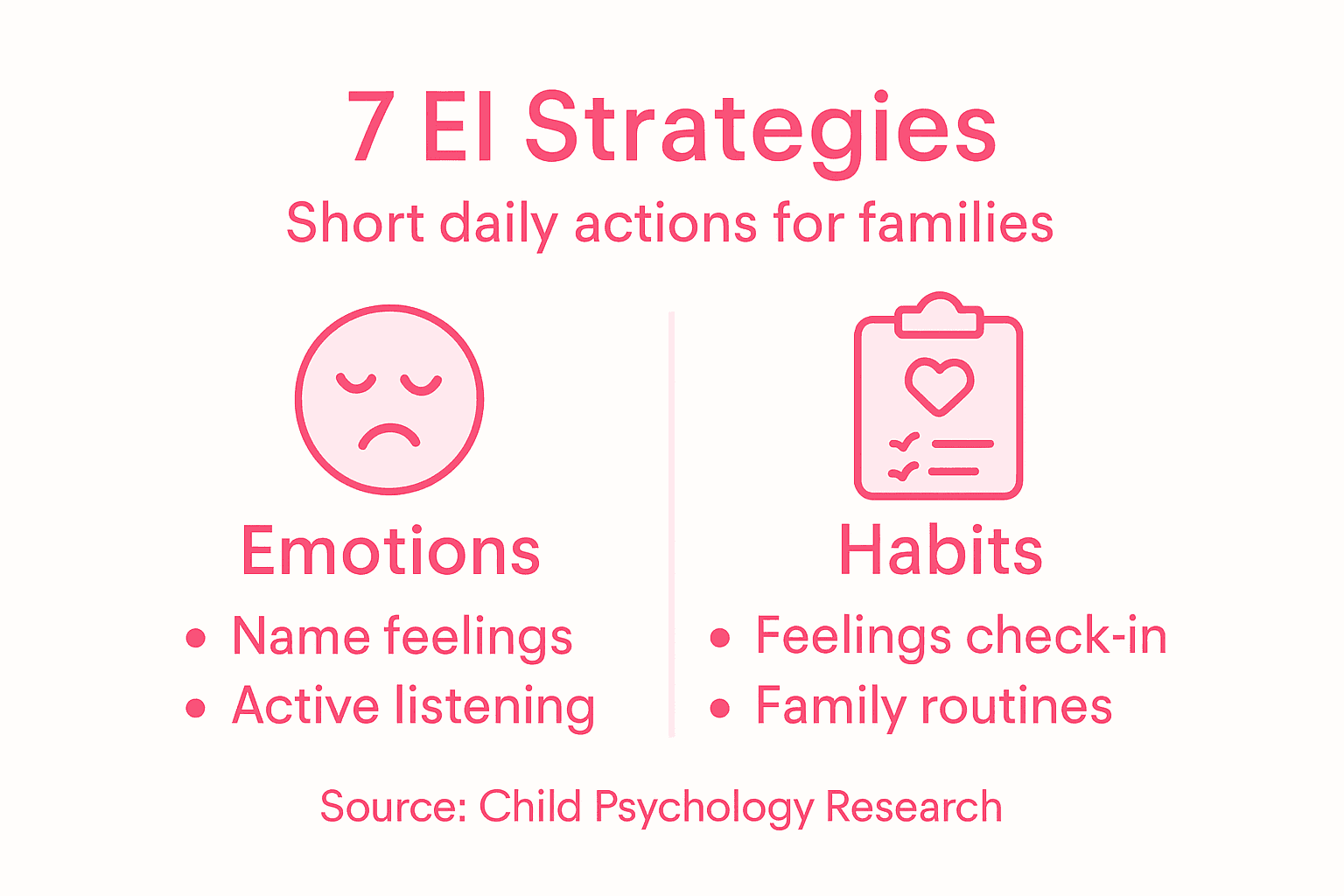
Here are seven practical strategies to nurture emotional intelligence in children:
- Model Emotional Awareness: Openly discuss your own feelings and reactions
- Create Safe Emotional Spaces: Encourage children to express emotions without judgment
- Practice Active Listening: Give full attention when children share their experiences
- Validate Emotional Experiences: Acknowledge feelings before problem-solving
- Teach Emotional Vocabulary: Help children precisely name and describe their emotions
- Develop Empathy Skills: Use storytelling and role-playing to understand different perspectives
- Establish Healthy Emotional Boundaries: Show how to manage strong feelings constructively
Fostering emotional literacy involves creating supportive environments where children learn to recognize, understand, and manage their emotions effectively. This means transforming everyday moments into opportunities for emotional growth.
Parents play a crucial role in this process. By consistently demonstrating emotional intelligence, you’re not just teaching skills – you’re showing your children how to navigate complex social and personal landscapes with grace and self-awareness.
Emotional intelligence is a lifelong journey of understanding, not a destination to be reached.
Pro tip: Create a daily “emotion check-in” ritual where family members share one feeling and why they’re experiencing it, normalizing emotional conversations.
Role of Family Routines and Communication
Family communication is the cornerstone of emotional intelligence development. Family routines create emotional security by providing predictable, nurturing interactions that help children feel safe and understood.
Key elements of effective family communication include:
- Active Listening: Give full, undivided attention
- Nonverbal Awareness: Notice body language and tone
- Emotional Validation: Acknowledge feelings without judgment
- Open Dialogue: Create safe spaces for honest expression
- Consistency: Maintain regular communication rhythms
- Empathetic Responses: Show genuine understanding
- Respectful Boundaries: Allow age-appropriate emotional independence
Effective family communication strategies involve more than just talking – they’re about creating meaningful connections. This means transforming everyday interactions into opportunities for emotional learning and trust-building.
Routines aren’t just schedules; they’re emotional anchors that provide children with a sense of security and predictability. Whether it’s shared mealtimes, bedtime stories, or weekly family meetings, these consistent interactions build the foundation for strong emotional intelligence.

Here is a summary of family routines that specifically support emotional intelligence:
| Routine Type | Emotional Skill Fostered | Example Activity |
|---|---|---|
| Daily Check-ins | Self-awareness | Sharing feelings after school |
| Weekly Meetings | Emotional expression | Family discusses weekly highs/lows |
| Shared Mealtimes | Communication skills | Conversing about daily events |
| Bedtime Rituals | Emotional security | Reading and reflecting together |
Communication is less about the words spoken and more about the emotional connection they create.
Pro tip: Implement a weekly family meeting where everyone shares their feelings, challenges, and highlights, normalizing emotional expression.
Common Pitfalls and How to Avoid Them
Emotional intelligence development isn’t a straightforward journey, and parents often unintentionally create roadblocks. Common parenting challenges can undermine children’s emotional growth if not carefully navigated.
Key pitfalls to watch out for include:
- Emotion Dismissal: Minimizing or ignoring children’s feelings
- Inconsistent Boundaries: Fluctuating rules and expectations
- Overprotection: Preventing children from experiencing healthy challenges
- Lack of Empathy Modeling: Not demonstrating emotional understanding
- Punitive Emotional Responses: Shaming or criticizing emotional expressions
- Solving Every Problem: Preventing children from developing problem-solving skills
- Emotional Suppression: Encouraging children to hide their true feelings
Raising caring and responsible children requires understanding that emotional intelligence is about guidance, not control. Parents must create environments that encourage emotional exploration while teaching responsibility and empathy.
Self-awareness is crucial. Recognize that your own emotional patterns and stress levels significantly impact how you interact with your children. By maintaining emotional balance and demonstrating healthy emotional processing, you provide the most powerful lesson in emotional intelligence.
Perfection isn’t the goal – progress and genuine connection are what truly matter.
Pro tip: Regularly reflect on your emotional reactions and apologize to your children when you handle emotions imperfectly, showing that emotional growth is a continuous journey.
Build a Calm and Organized Home to Support Emotional Growth
Raising emotionally intelligent kids means more than just teaching feelings and empathy. It involves creating a peaceful, organized environment where your children feel safe to express themselves and you can manage family routines with ease. If daily chaos and clutter steal your focus from nurturing emotional skills like self-awareness and empathy then you are not alone. Our goal at It’s A Southern Life Y’all is to help busy families reclaim their time and space so emotional intelligence can thrive alongside healthy communication and strong family bonds.
Discover simple living strategies and proven organization hacks that turn your home into an intentional space for emotional growth. From practical home management systems to efficient time management tools, you can reduce stress and build consistency in daily routines that support your child’s emotional development. Start today and create an environment that empowers your entire family to connect deeper, respond better, and grow stronger together.
Frequently Asked Questions
What is emotional intelligence in children?
Emotional intelligence in children refers to their ability to perceive, understand, and manage their own emotions, as well as recognize and empathize with the emotions of others. It encompasses skills such as self-awareness, empathy, self-regulation, social skills, and motivation.
Why is emotional intelligence important for kids?
Emotional intelligence is crucial for children as it helps them navigate social interactions, manage stress, communicate effectively, and build strong relationships. It also fosters resilience and emotional well-being, benefiting them throughout their lives.
How can I nurture emotional intelligence in my child?
You can nurture emotional intelligence by modeling emotional awareness, creating safe spaces for expression, practicing active listening, validating feelings, teaching emotional vocabulary, developing empathy through storytelling, and establishing healthy emotional boundaries.
What are common myths about emotional intelligence?
Common myths about emotional intelligence include the beliefs that it is inherited and cannot be learned, only naturally empathetic people can be emotionally intelligent, and that emotions should always be suppressed in professional settings. In reality, emotional intelligence is a set of skills that can be developed by anyone.
Recommended
- Raising Confident Kids: Practical Strategies for Resilience – It’s a Southern Life Ya’ll
- 10 Simple Ways to Teach Kids Gratitude and Kindness – It’s a Southern Life Ya’ll
- Talking to Kids About Money—Building Lifelong Skills – It’s a Southern Life Ya’ll
- Sibling Rivalry: Restore Harmony and Build Lifelong Bonds – It’s a Southern Life Ya’ll
- The Ultimate Guide to Thoughtful Gift Ideas for a Mom in 2026 | PriceLix
Keep reading: more parenting help
Want a little more help with this? I made a free Age-by-Age Chore Chart that pairs right up with this post — y’all can grab it over on my Free Resources page.