

Role of planner systems for busy parents in 2026
Juggling school drop-offs, meal prep, work deadlines, and bedtime routines can leave you feeling like your brain is a cluttered browser with 47 tabs open. Many parents believe planner systems add another task to an already impossible list. The truth is simpler: planner systems reduce the invisible cognitive work that drains your energy and helps you reclaim time for what actually matters.
Table of Contents
- Understanding The Mental Load Of Busy Parents
- What Planner Systems Are And How They Help Family Organization
- Leveraging Ai Tools Like Chatgpt In Planner Systems
- Balancing Personal, Constrained, And Essential Time With Planner Systems
- Explore Practical Planner Systems And Tools For Busy Families
- Frequently Asked Questions
Key takeaways
| Point | Details |
|---|---|
| Planner systems centralize information | They reduce cognitive overload by keeping family schedules and tasks in one accessible place. |
| Different systems fit different families | Choose digital, paper, or hybrid planners based on your household’s unique needs and rhythms. |
| AI tools enhance modern planning | ChatGPT and similar tools offer instant meal ideas, activity suggestions, and parenting advice to save decision-making energy. |
| Protecting recovery time matters | Effective time management requires deliberately scheduling personal downtime to prevent burnout. |
Understanding the mental load of busy parents
The mental load is the invisible weight you carry when remembering doctor appointments, anticipating that your child needs new shoes before the growth spurt becomes obvious, and tracking which family member dislikes which vegetable. This cognitive demand constantly pulls at your executive functions like planning, prioritizing, and impulse control. Women manage 71% of family tasks like planning, organizing, and scheduling, creating an unfair distribution that compounds stress.
Parenting adds effort that rarely shows up on a to-do list: anticipating, remembering, checking, adjusting. That cognitive work leans heavily on executive function, the mental capacity you need for everything else in life. When your brain is constantly running background processes about permission slips and grocery lists, you have less energy for creative problem solving or enjoying family moments.
Recognizing this load is the first step toward building systems that actually help. You cannot organize your way out of an unfair division of labor, but you can reduce the cognitive burden through smart planning structures. Different parental time management types approach this challenge differently, but all benefit from externalizing the mental tracking work.
Consider these common mental load tasks that drain your focus:
- Remembering upcoming events and coordinating family schedules
- Tracking what supplies, groceries, or gear each family member needs
- Anticipating conflicts between activities and planning workarounds
- Managing communication with schools, doctors, and activity leaders
Pro Tip: Write down every task you remember or anticipate for one week. The list will shock you and validate why you feel exhausted. This awareness helps you decide what to systematize first.
What planner systems are and how they help family organization
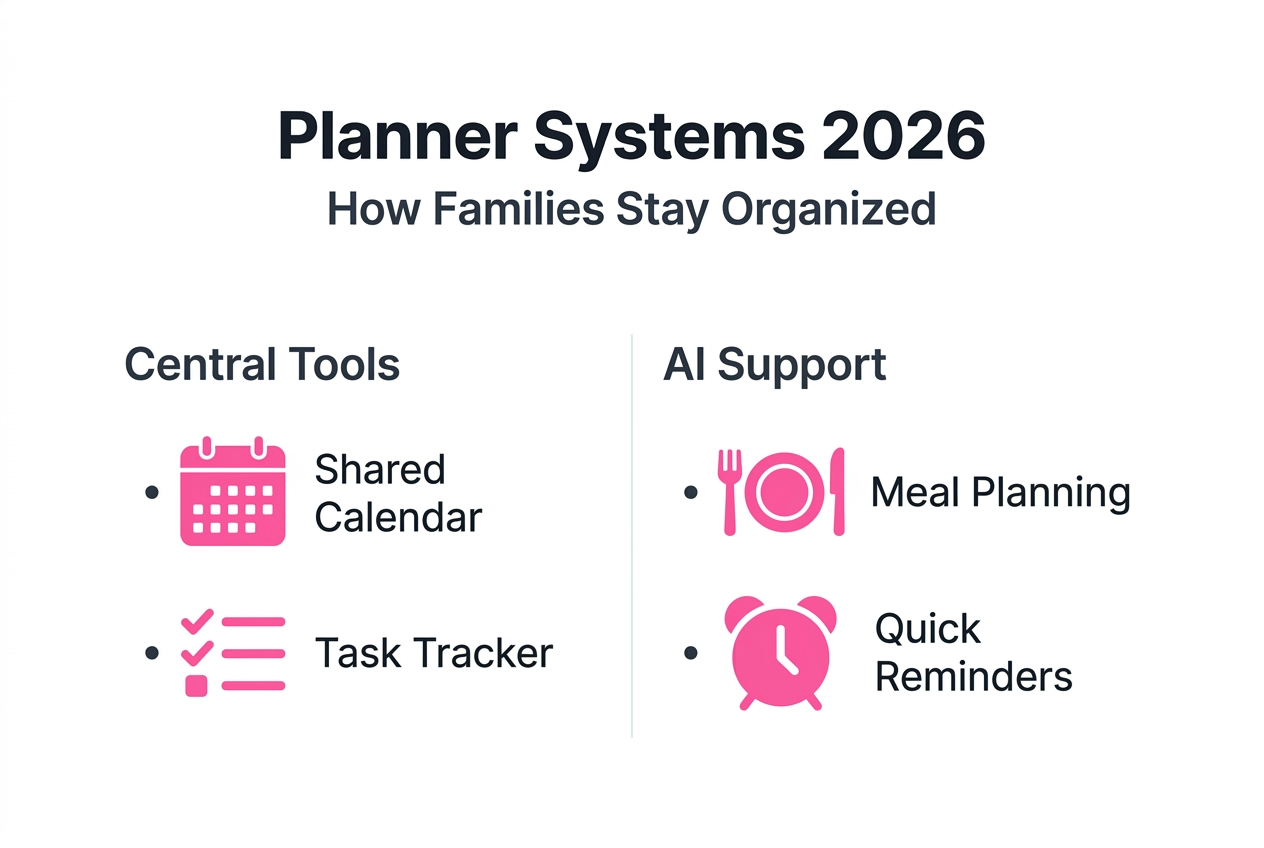
A planner system is not just a calendar or notebook. It is a comprehensive approach to centralizing information, coordinating schedules, and reducing the number of decisions you make daily. Successful family operating systems require a central place for information, easy information flow, and a weekly check-in process that keeps everyone aligned.
The family calendar should be the center of the family operating system, serving as the single source of truth for commitments and activities. This eliminates the exhausting back and forth of “Did I tell you about soccer practice?” and “When is that dentist appointment?” Everything lives in one place, accessible to everyone who needs it.
Effective planner systems smooth transitions, the moments when switching between activities causes friction and stress. When everyone knows what comes next and has prepared accordingly, mornings become less chaotic and evenings flow more peacefully. This clarity extends to home management systems that integrate chores, maintenance, and household tasks into the larger planning framework.

Weekly check-ins transform planning from reactive scrambling to proactive preparation. Sitting down for 20 minutes each Sunday to review the upcoming week, identify potential conflicts, and delegate responsibilities prevents most crisis situations. Daily planning then becomes a simple matter of executing what you already mapped out together.
Key components of an effective family planner system include:
- Shared digital or physical calendar visible to all family members
- Central location for important documents and information
- Regular weekly planning session with all stakeholders
- Clear communication channels for schedule changes
- Defined roles and responsibilities for recurring tasks
Pro Tip: Start small with just a shared calendar and weekly 15-minute check-in. Add complexity only when the basic system runs smoothly for a month.
Leveraging AI tools like ChatGPT in planner systems
Modern technology offers unprecedented support for family planning through AI tools that act as on-demand assistants. ChatGPT provides meal plans, activity ideas, and suggestions for connecting with children, helping busy parents manage daily logistics without extensive research. Rather than spending an hour scrolling Pinterest for dinner inspiration or age-appropriate activities, you can get tailored suggestions in seconds.
ChatGPT helps in brainstorming parenting strategies and solutions, acting as a parenting coach available 24/7. When you are trying to figure out how to handle a tantrum or explain a complex concept to your child, having instant access to frameworks and approaches reduces stress. This does not replace human judgment or professional advice, but it offers a starting point when you are too tired to think clearly.
Integrating AI into your planner system works best when you use it for specific, repeatable tasks. Generate weekly meal plans based on your dietary preferences and what is in your pantry. Ask for activity ideas that match your children’s ages and interests when planning weekend outings. Request templates for family meeting agendas or chore charts customized to your household dynamics.
The proactive planning approach becomes more powerful when you combine human insight with AI efficiency. You provide the context about your family’s unique needs and values, while AI handles the brainstorming and option generation that normally drains mental energy.
Practical ways to use AI in family planning:
- Generate weekly meal plans with shopping lists based on dietary needs
- Create age-appropriate activity suggestions for rainy days or school breaks
- Draft templates for family rules, chore systems, or reward structures
- Get quick answers to common parenting questions without scrolling forums
- Brainstorm solutions to recurring family conflicts or scheduling challenges
Pro Tip: Save your best AI prompts in a note file. When you find a phrasing that gives great meal plans or activity ideas, reuse it weekly instead of starting from scratch.
Balancing personal, constrained, and essential time with planner systems
Every parent juggles three competing time categories that fight for space in your day. In real parent time management, you are balancing Personal recovery time, Constrained time, and Essential time. Personal recovery includes sleep, nutrition, exercise, and mental decompression. Constrained time covers fixed commitments like work hours, school schedules, and appointments. Essential time handles everything else: chores, errands, childcare, and household management.
Planner systems help you see these categories visually and protect the boundaries between them. When you map out your week, color coding by time type reveals whether you are shortchanging recovery time or overcommitting to constrained activities. This awareness lets you make intentional tradeoffs instead of defaulting to burnout.
Protecting recovery time is not selfish; it is strategic. Without adequate sleep and downtime, your productivity plummets across all other time categories. You make worse decisions, handle stress poorly, and need more time to complete simple tasks. Time blocking for parents explicitly schedules these recovery periods as non-negotiable appointments.
Interruptions carry hidden costs that planner systems help minimize. When someone interrupts your focused work, you lose not just those two minutes but the 15 to 20 minutes needed to rebuild your concentration and remember where you were. Clear family schedules reduce unnecessary interruptions by setting expectations about when you are available versus when you are in focused mode.
| Time Category | Examples | Protection Strategy |
|---|---|---|
| Personal Recovery | Sleep, meals, exercise, hobbies | Schedule as fixed blocks; treat as non-negotiable appointments |
| Constrained | Work hours, school drop-off, medical appointments | Plan other activities around these; build buffer time before and after |
| Essential | Meal prep, laundry, homework help, errands | Batch similar tasks; delegate when possible; use time blocking |
Implementing time category awareness in your planner:
- Audit one typical week by tracking how you actually spend time in each category.
- Calculate your minimum recovery time needs: sleep hours plus basic self-care.
- Block recovery time in your planner first, before adding other commitments.
- Map constrained time second, identifying any conflicts or tight transitions.
- Fit essential tasks into remaining slots, batching similar activities together.
- Review weekly to ensure recovery time is not shrinking over time.
The step by step family success approach and proven time management tips for families emphasize this balance as foundational to sustainable routines. You cannot run on empty and expect to manage a household effectively.
Explore practical planner systems and tools for busy families
Ready to reduce your mental load and create systems that actually work for your family? Implementing effective planner systems starts with understanding your household’s unique needs and choosing tools that fit your lifestyle. Explore comprehensive guides on home management systems for families that integrate planning with daily operations. Compare options through detailed time management tools for parents to find what matches your preferences. When clutter compounds planning challenges, decluttering strategies for families help create the physical space for mental clarity. Small, consistent steps toward organized systems transform overwhelming family logistics into manageable routines that support the balanced life you want.
Frequently asked questions
What is a planner system and why do busy parents need one?
A planner system centralizes family schedules, tasks, and information in one accessible place to reduce cognitive load. It eliminates the mental work of constantly remembering, anticipating, and coordinating dozens of family details. By externalizing this tracking work, parents free up mental energy for more important decisions and reduce daily stress.
How can AI tools like ChatGPT improve my family planning?
AI tools offer instant, tailored suggestions for meals, activities, and parenting challenges without hours of research. They reduce decision fatigue by generating options quickly when you are too tired to brainstorm. Use them as starting points for planning, not replacements for your judgment about what works for your family.
What are some tips for protecting personal recovery time as busy parents?
Schedule recovery time as non-negotiable appointments in your planner before adding other commitments. Set clear boundaries about when you are unavailable, and communicate these to family members. Prioritize sleep, regular meals, and brief mental breaks throughout the day to maintain the energy needed for everything else.
How do planner systems reduce the invisible cognitive work parents face?
Cognitive work includes anticipating needs, remembering tasks, and adjusting plans constantly without visible effort. Planner systems offload this mental tracking by creating external systems that remember and prompt for you. This reduces the background mental processing that drains executive function and causes decision fatigue.
Recommended
- Guide to the Role of Proactive Planning –
- Time Management Tools for Parents – A Comparison 2025 –
- How to Start a Family Blog for Busy Parents in 2026 –
- Block Scheduling: Transform Time for Busy Families –
Want a system that already works? The Sunday Blueprint is the weekly planner system this post is describing, ready to use.