

What is productivity debt? A family guide to avoid burnout
Most parents believe that getting more done equals being more productive. But here’s the quiet truth: you can check off every item on your to-do list and still be falling behind. Productivity debt is psychological, not a coding problem or a calendar glitch, and it can silently undermine your family’s well-being before you even notice it. This guide will walk you through what productivity debt actually is, how it sneaks into busy family life, and most importantly, how you can start paying it down so your home feels peaceful again instead of perpetually behind.
Table of Contents
- Understanding productivity debt: What it is and why it matters
- How productivity debt builds up in family life
- Spotting the warning signs: Symptoms and consequences of productivity debt
- Productivity debt vs. other invisible debts: How are they related?
- How to audit and pay down productivity debt as a family
- Sustainable habits: Preventing productivity debt in busy family life
- Next steps: Tools to help your family break the productivity debt cycle
- Frequently asked questions
Key Takeaways
| Point | Details |
|---|---|
| Productivity debt defined | Productivity debt is the hidden cost of pushing too hard without recovery, and it quietly drains family energy and well-being. |
| Early warning signs | Watch for chronic fatigue, family tension, and frequent crises—they are red flags that productivity debt is building up. |
| Audit and prevention | Families should regularly assess routines and focus on prevention, not just crisis response, to pay down and avoid new debt. |
| Involve everyone | Sharing the invisible workload and teaching kids good habits builds resilience and prevents debt from accumulating again. |
Understanding productivity debt: What it is and why it matters
Productivity debt is what happens when you consistently borrow from your future capacity to get through today. Think of it like a credit card you keep swiping without paying the balance. Every time you skip rest to finish laundry, push through exhaustion to meet a deadline, or say yes to one more commitment, you’re adding interest to a growing invisible bill.
“Productivity debt is analogous to energy, priority, and attention debts — each one quietly draining your capacity to show up fully.”
For families, this is especially dangerous because the costs don’t show up immediately. You might feel fine for weeks, even months, before the fatigue, resentment, or overwhelm hits all at once. It’s like planting seeds of exhaustion every day and wondering why the garden looks so overgrown by Sunday night.
The good news? Productivity debt is avoidable with proactive habits. Building in self-care strategies before you hit empty is far easier than recovering after a full burnout. Recognizing the debt early is the first and most powerful step.
How productivity debt builds up in family life
Productivity debt doesn’t arrive with a warning label. It sneaks in through the small, everyday choices that feel completely reasonable in the moment. Saying yes to the school fundraiser when your plate is already full. Staying up late to prep lunches because the afternoon was chaos. Skipping your own downtime because the kids needed help with homework.
Unconscious debt accumulation and something called “time confetti” fragment your family time and unevenly burden one partner more than the other. Time confetti refers to those tiny, scattered pockets of time that feel productive but never add up to real rest or deep focus.
Here are the most common ways productivity debt builds up in busy households:
- Multitasking constantly instead of focusing on one thing at a time
- Skipping rest to squeeze in more tasks, especially after the kids go to bed
- Saying yes to too much out of guilt, habit, or people-pleasing
- Ignoring the invisible workload like mental planning, scheduling, and emotional labor
- Decision fatigue from making hundreds of small choices every single day
- Last-minute rushes that drain energy and create stress spirals
One partner often ends up carrying more of this hidden debt, especially when the invisible workload isn’t shared equally. Learning to reduce overwhelm starts with naming what’s actually on your plate.
Pro Tip: Build a ten-minute wind-down ritual into your evening routine. It sounds small, but consistent effective rest strategies are one of the most powerful ways to stop debt from accumulating overnight.
Spotting the warning signs: Symptoms and consequences of productivity debt
How do you know when you’ve crossed from busy into debt territory? The signs are often physical and emotional before they become logistical.

Energy depletion links to burnout, and parents frequently report high stress from invisible labor that never makes it onto any official to-do list. Your body and your relationships will usually signal the problem before your calendar does.
Watch for these warning signs:
- Persistent fatigue that sleep doesn’t seem to fix
- Crankiness or short fuses with your kids or partner over small things
- Forgetfulness about appointments, school events, or simple tasks
- Frequent conflicts that seem to come out of nowhere
- A constant feeling of being behind, no matter how much you accomplish
- Physical symptoms like headaches, tension, or getting sick more often
Your kids feel it too. When parents are running on empty, children pick up on the tension and their own moods and behavior often reflect it. Family harmony is deeply connected to the emotional energy in the home.
The cascading effects are real. Lost time, health issues, growing resentment, and chronic overwhelm can all trace back to unaddressed productivity debt. Breaking habits that kill productivity is one of the fastest ways to stop the spiral. And investing in your mental health through practices that improve your well-being creates a buffer that protects your whole family.
Productivity debt vs. other invisible debts: How are they related?
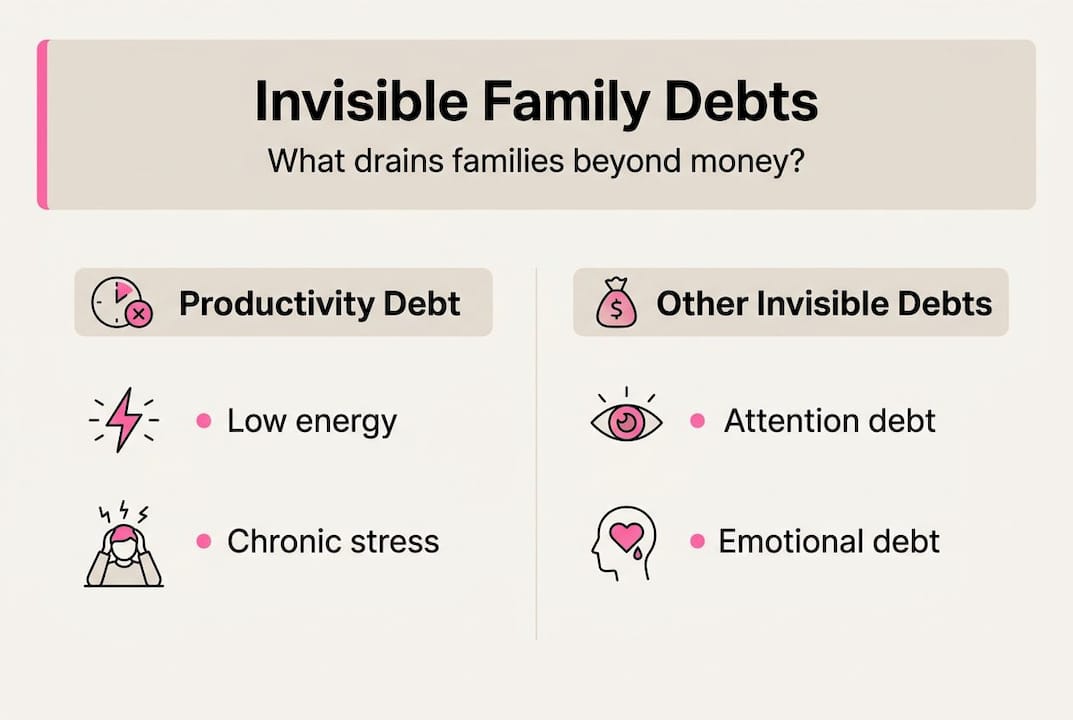
Not all invisible debts feel the same, and understanding the differences helps you target the right solution. Analogous concepts include energy, priority, and attention debts, each with its own flavor of drain.
Importantly, productivity debt is personal and psychological, not code-based like technical debt in software development. It lives in your habits, your mindset, and your daily choices.
Here’s a simple comparison to help you see how these debts relate:
| Type of debt | What it drains | Common cause | Family impact |
|---|---|---|---|
| Productivity debt | Output capacity | Overcommitment, no recovery | Chronic overwhelm, burnout |
| Energy debt | Physical and emotional fuel | Poor sleep, no breaks | Irritability, health issues |
| Priority debt | Focus on what matters most | Reactive living, no planning | Important things get ignored |
| Attention debt | Deep focus and presence | Constant interruptions, screens | Disconnection from family |
These debts overlap and feed into each other. Energy debt makes productivity debt worse. Attention debt fuels priority debt. Busy families need a holistic approach that addresses all four, not just the most visible one.
Exploring work-life balance strategies can help you see the bigger picture. And learning how to prevent burnout before it starts is always easier than recovering from it after the fact.
How to audit and pay down productivity debt as a family
Ready to take action? The first step is an honest audit of where your family’s time, energy, and attention are actually going.
Auditing debts by interest rate, tracking via commitment budgets, and focusing on prevention rather than crisis management are the core methods that work. Here’s how to apply them at home:
- List every recurring commitment your family holds, from school pickups to work deadlines to social obligations.
- Rate each one by how much energy it costs versus how much value it returns.
- Identify your highest-interest debts, the commitments that drain the most for the least return.
- Create a simple commitment budget that limits how many high-drain activities you carry at once.
- Schedule recovery time as a non-negotiable, not an afterthought.
- Review monthly to catch new debt before it compounds.
Here’s a simple family commitment budget framework to get you started:
| Commitment | Energy cost (1-5) | Value return (1-5) | Keep or cut? |
|---|---|---|---|
| Weekly sports practice | 3 | 5 | Keep |
| Monthly committee meeting | 4 | 2 | Cut or delegate |
| Daily social media scroll | 3 | 1 | Reduce |
| Sunday family meal prep | 2 | 5 | Keep |
Learning to organize multiple tasks with a clear system makes this process much less overwhelming. You can also explore quick productivity hacks to reclaim pockets of time, and review avoid debt mistakes for principles that apply just as well to time as they do to money.
Pro Tip: Involve your kids in age-appropriate ways. Even young children can help sort laundry or set the table, which teaches responsibility and lightens the invisible load you carry alone.
Sustainable habits: Preventing productivity debt in busy family life
Paying down debt is a great start, but the real goal is building a life where debt doesn’t keep piling back up. Debt-financed productivity can look like high output on the surface, but it is unsustainable without recovery and genuine mindset shifts.
Here are the habits that create a real protective buffer for your family:
- Schedule recovery time weekly, not just when you’re already exhausted. Rest is productive.
- Hold a quarterly family audit to review commitments, routines, and what’s working or not.
- Share the invisible workload by making it visible. Write it down, talk about it, and divide it intentionally.
- Delegate age-appropriately so children grow in responsibility and you grow in breathing room.
- Protect your mornings or evenings as sacred time for connection, not more tasks.
- Shift from hustle to sustainability by celebrating consistency over intensity.
- Practice mindset sovereignty, which means choosing how you respond to demands rather than reacting automatically.
Building self-care for families into your weekly rhythm is not a luxury. It is the foundation that makes everything else possible. When you protect your capacity, you show up better for your kids, your partner, and yourself. That is the real goal.
Next steps: Tools to help your family break the productivity debt cycle
You now have a strong foundation for understanding and tackling productivity debt. But knowing is only half the journey. The other half is building systems and routines that make the change stick for the long term.
We have put together resources specifically for busy families like yours. Explore productivity hacks for families to find practical shortcuts that actually work in real households. Dig into our productivity tips for parents for strategies tailored to the unique demands of raising kids while managing a home. And if you want to build lasting structure, our guide to family home management systems will help you create routines that run on autopilot. Small, consistent steps plant seeds that grow into a calmer, more connected family life.

Frequently asked questions
How is productivity debt different from just being busy?
Productivity debt erodes long-term capacity by creating hidden costs that compound over time, while simply being busy doesn’t always leave lasting damage. Debt means you’re borrowing from your future self, not just filling your present schedule.
Can children accumulate productivity debt too?
Yes, kids can absolutely feel the effects of fragmented or overscheduled routines, leading to stress and lower well-being over time. Productivity debt affects the whole family, including children’s moods and the overall harmony in your home.
What’s the fastest way to pay off productivity debt?
Triage high-interest debts first by prioritizing rest, delegating tasks, and cutting non-essential commitments that drain more than they give back. Focus your energy on what genuinely moves your family forward.
How can families prevent productivity debt in the future?
Schedule regular recovery time, share the invisible workload openly, and build sustainable routines that protect your energy. Recovery prioritization and mindset shifts are what keep unsustainable debt from creeping back in.
Recommended
- Boost Productivity with Work-from-Home routines in 2026 –
- Boost productivity with effective rest strategies in 2026 –
- Understanding Productivity Tips for Parents Guide –
- Productivity Killers and How to Overcome Them –
- Why Review Productivity Matters for Centurions – Optio Station: Best Project Management App for Prioritization
Want a little more help with this? The Home Rhythm Planner helps you build a week that leaves room to breathe instead of borrowing against next week.