

Block Scheduling: Transform Time for Busy Families
More than 60 percent of American parents feel overwhelmed by balancing work, family, and household tasks every week. With endless to-do lists and packed schedules, finding a practical way to manage time has never felt more urgent. Block scheduling offers a proven solution that helps families regain control, break the cycle of constant task-switching, and build smoother daily routines for both parents and children.
Table of Contents
- Block Scheduling Defined And Common Myths
- Types Of Block Scheduling For Families
- How Block Scheduling Works Day-To-Day
- Benefits For Productivity And Family Balance
- Challenges, Mistakes, And How To Avoid Them
- Alternatives To Block Scheduling Systems
Key Takeaways
| Point | Details |
|---|---|
| Understanding Block Scheduling | Block scheduling allows families to manage time in flexible, focused segments, significantly enhancing concentration and productivity. |
| Common Myths | Many misconceptions, such as the need for perfect adherence and complexity, prevent families from effectively using block scheduling. |
| Daily Implementation | Successful block scheduling requires intentional time allocation for various activities, helping balance work and personal life. |
| Alternatives Available | Families can explore alternatives like the Pomodoro Technique or Time Boxing for a tailored approach to time management. |
Block scheduling defined and common myths
Block scheduling is a strategic time management approach that transforms how families organize their daily activities. Unlike traditional rigid time planning, block scheduling breaks your day into intentional, flexible chunks of time dedicated to specific tasks or categories of work. Understanding block scheduling’s core principles helps families reclaim control over their increasingly complex schedules.
At its heart, block scheduling replaces constant task switching with focused time segments. Imagine dividing your day into 90-minute or 2-hour blocks instead of bouncing between tiny 30-minute increments. This method allows deeper concentration and reduces the mental energy wasted in constant transitions. Research from educational scheduling studies reveals that longer, purposeful time blocks can dramatically improve productivity across work, home, and personal development areas.
Several common myths prevent families from embracing block scheduling effectively. Many believe block scheduling is rigid or requires perfect execution – but it’s actually incredibly flexible. Here are key misconceptions:
- Myth 1: Block scheduling means every minute must be scheduled
- Myth 2: You can’t adjust blocks once they’re planned
- Myth 3: Block scheduling works only for work tasks
- Myth 4: It requires complex planning tools
In reality, block scheduling is about creating intentional space for priorities while maintaining adaptability. The goal isn’t perfection but progressive improvement in how you manage time and energy.
Pro tip: Start with just two or three blocks per day and adjust gradually, allowing yourself grace as you learn this transformative scheduling approach.
Types of block scheduling for families
Families interested in transforming their time management approach have several strategic block scheduling models to choose from. Each model offers unique advantages for organizing daily activities, work, and personal responsibilities. Understanding these variations helps parents select the most suitable approach for their household dynamics and lifestyle demands.
The most popular block scheduling types for families include the 4×4 Model, Alternate-Day Schedule, and Hybrid Blocking. Professional education resources reveal that each model provides distinct benefits depending on family size, work schedules, and children’s activities. The 4×4 Model divides the day into four substantial 90-minute blocks, allowing deep focus on specific categories like work, household management, child activities, and personal development.
Here’s a breakdown of each block scheduling type:
- 4×4 Model
- Four extended time blocks per day
- 90-minute to 2-hour dedicated segments
- Ideal for complex tasks requiring concentration
- Alternate-Day Schedule
- Rotating blocks between different priority areas
- Allows flexibility for changing daily needs
- Prevents monotony in routine
- Hybrid Blocking
- Combines multiple scheduling approaches
- Customizable to unique family requirements
- Adaptable to changing life stages
Successful implementation requires understanding your family’s unique rhythm and being willing to experiment with different approaches. The key is finding a system that reduces stress while increasing productivity and quality family time.
Here’s how popular block scheduling types differ for families:
| Model | Block Count Per Day | Flexibility Level | Best For |
|---|---|---|---|
| 4×4 Model | Four main blocks | Moderate flexibility | Structured, focused households |
| Alternate-Day Schedule | Varies with rotation | High adaptability | Families with shifting needs |
| Hybrid Blocking | Custom arrangement | Maximum customization | Blended or unique routines |
Pro tip: Start by testing one block scheduling model for two weeks, tracking your family’s energy levels and task completion, then adjust accordingly.
How block scheduling works day-to-day
Block scheduling transforms daily routines by reorganizing time into intentional, focused segments that align with your family’s unique priorities. A/B block scheduling systems demonstrate how strategic time management can revolutionize how families approach their daily responsibilities. Instead of fragmenting time into tiny increments, block scheduling creates deliberate windows for concentrated work, family interaction, personal development, and essential tasks.
Professional educational resources reveal that successful day-to-day block scheduling involves creating 90-120 minute dedicated time segments. These blocks might look like:
- Morning Family Block
- Breakfast preparation
- Getting children ready
- Morning communication and planning
- Work/Professional Block
- Focused professional tasks
- Email and communication management
- Project completion
- Household Management Block
- Cleaning and organization
- Meal preparation
- Errands and administrative tasks
- Personal Development Block
- Exercise
- Learning or skill development
- Self-care activities
The magic of block scheduling lies in its flexibility. Unlike rigid time management approaches, these blocks can shift and adapt based on daily realities. Some days might require longer work blocks, while others might prioritize family time or personal care.

Pro tip: Create a visual block schedule on a shared family whiteboard, allowing everyone to see and understand the day’s intentional time allocations.
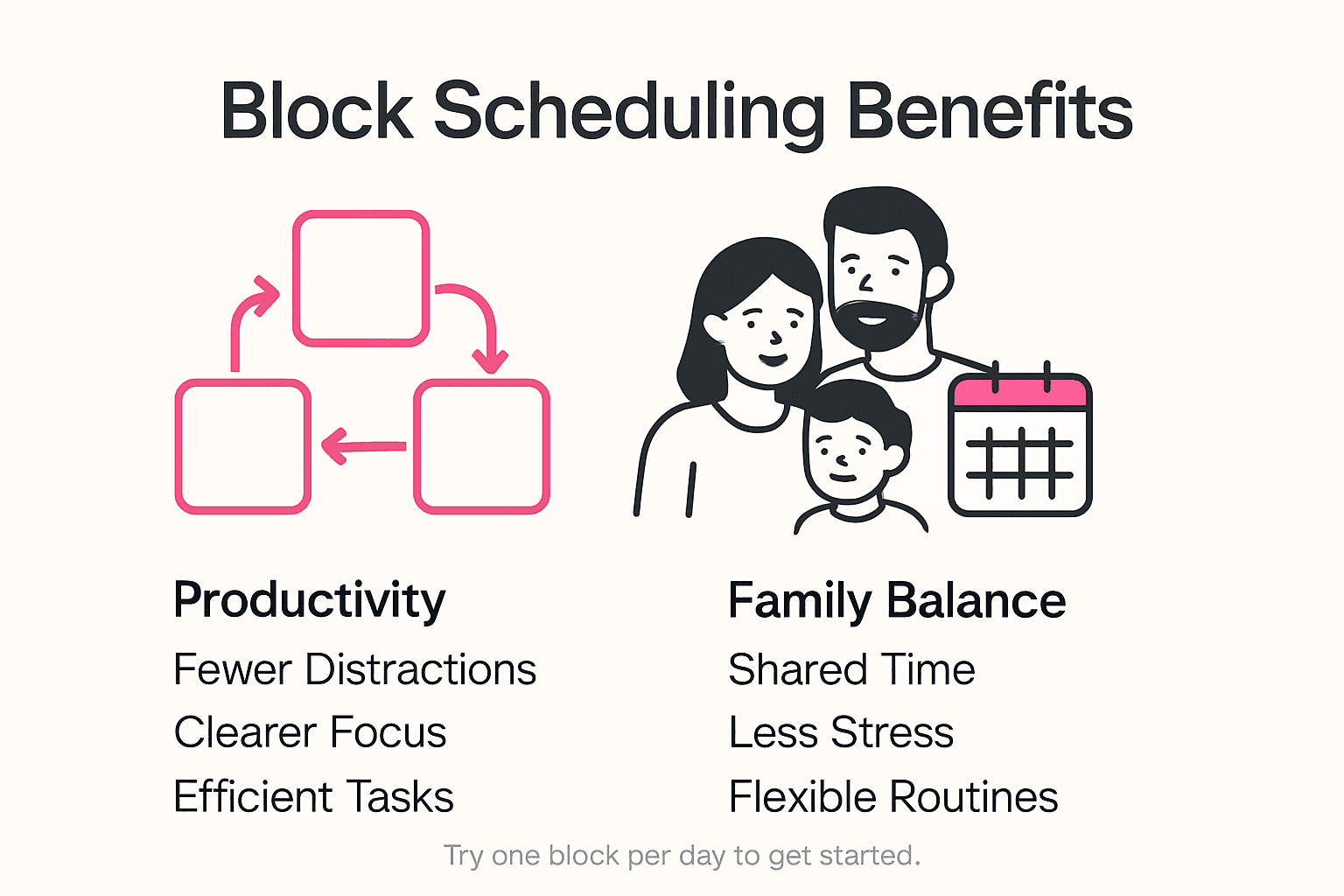
Benefits for productivity and family balance
Block scheduling offers transformative advantages for families seeking to maximize productivity while maintaining healthy personal connections. Educational research demonstrates that strategic time management can dramatically reduce stress and create more meaningful interactions between family members. By intentionally structuring time, parents can simultaneously boost work efficiency and create space for genuine relationships.
A/B block scheduling models reveal several key benefits for family productivity:
- Reduced Daily Transitions
- Fewer mental gear shifts
- Lower cognitive fatigue
- More concentrated energy
- Enhanced Quality Time
- Deliberate family interaction periods
- Predictable scheduling
- Less fragmented daily experiences
- Improved Work Performance
- Longer uninterrupted work blocks
- Better focus and task completion
- Decreased multitasking stress
- Balanced Personal Development
- Dedicated self-improvement windows
- Consistent learning opportunities
- Space for physical and mental wellness
The most significant breakthrough is how block scheduling reimagines time as a flexible, intentional resource rather than a rigid, stressful constraint. Families gain the ability to design days that honor both professional responsibilities and personal connections, creating a more harmonious lifestyle.
Pro tip: Start by identifying your family’s three most important daily priorities and design initial block schedules around those core values.
Challenges, mistakes, and how to avoid them
Block scheduling sounds perfect in theory, but real-world implementation can be tricky for busy families. Educational research highlights critical challenges that can derail even the most well-intentioned scheduling efforts. Understanding these potential pitfalls helps families proactively design more effective time management strategies.
Common block scheduling mistakes can significantly disrupt family productivity. Here are the most critical challenges families encounter:
- Overambitious Scheduling
- Cramming too many tasks into blocks
- Unrealistic time expectations
- Lack of flexibility
- Poor Transition Management
- Inadequate buffer time between blocks
- No contingency planning
- Rigid adherence to schedule
- Communication Breakdown
- Insufficient family involvement
- Unclear schedule expectations
- Limited individual input
- Energy Management Failures
- Ignoring personal energy rhythms
- Scheduling high-focus tasks during low-energy periods
- Not accounting for individual differences
Successful block scheduling requires constant adaptation. Families must remain flexible, communicate openly, and view their schedule as a living document that evolves with their changing needs. Perfection isn’t the goal – consistent, incremental improvement is.
Pro tip: Review and adjust your block schedule every two weeks, involving all family members in the conversation to ensure ongoing buy-in and effectiveness.
Alternatives to block scheduling systems
Time management is never one-size-fits-all, and families seeking flexibility have multiple scheduling approaches beyond traditional block scheduling. Exploring alternative scheduling models reveals innovative ways to structure time that can adapt to unique family dynamics and individual needs.
Here are compelling alternatives to standard block scheduling:
- Pomodoro Technique
- 25-minute focused work intervals
- Short 5-minute breaks
- Ideal for maintaining high concentration
- Trimester Scheduling
- Divide year into three focused periods
- Rotate priorities systematically
- Provide natural reset opportunities
- Time Boxing
- Assign fixed time periods to tasks
- Strict start and end times
- Prevents task overflow and procrastination
- Copernican Plan
- Combines variable-length periods
- Flexible core and elective time segments
- Allows personalized scheduling approaches
Successful time management isn’t about rigidly following one system but finding a personalized approach that resonates with your family’s unique rhythm and energy levels. The key is experimentation, open communication, and willingness to adapt.
See how block scheduling compares with alternative systems:
| Approach | Time Segments | Adaptability | Ideal User |
|---|---|---|---|
| Block Scheduling | 90-120 minute blocks | High | Families needing structure |
| Pomodoro Technique | 25-minute intervals | Moderate | Those needing frequent breaks |
| Time Boxing | Fixed time blocks | Moderate | Goal-oriented planners |
| Trimester Scheduling | Multi-week periods | Low | Long-term project families |
| Copernican Plan | Variable periods | Very high | Families seeking full control |
Pro tip: Experiment with different scheduling techniques for two weeks each, tracking productivity and family satisfaction to find your ideal approach.
Master Your Family’s Time with Proven Organization Hacks
Busy families face the challenge of managing multiple priorities while avoiding the stress of overambitious schedules and constant transitions highlighted in block scheduling strategies. If you want to overcome these pain points and create focused, flexible time blocks that honor your family’s unique rhythm block scheduling alone is not enough. You need actionable solutions that simplify your daily routines and protect your family’s most important moments.
At Its A Southern Life Yall, we offer practical time management tools and home management systems designed to complement your block scheduling efforts. From decluttering advice that clears your space and mind to productivity tips that help sustain energy during your focused work blocks, our resources empower busy families to build balanced, peaceful days. Start transforming your lifestyle now with our easy-to-follow strategies and see how purposeful schedules bring freedom instead of frustration.
Ready to take control of your family’s time and create meaningful routines? Explore our full collection of simple living strategies.
Frequently Asked Questions
What is block scheduling?
Block scheduling is a time management method that divides the day into intentional, flexible chunks of time dedicated to specific tasks, allowing for deeper concentration and reduced task switching.
How can block scheduling benefit busy families?
Block scheduling helps busy families maximize productivity, reduce stress from constant transitions, and enhance quality time spent together by allowing for focused periods on tasks and family activities.
Can I adjust my block scheduling plan once it’s set?
Yes, block scheduling is designed to be flexible. You can and should adjust your time blocks as needed to adapt to changing daily realities and family needs.
What are some common myths about block scheduling?
Common myths include the belief that block scheduling requires rigid, minute-by-minute planning, that it cannot be adjusted once made, and that it is only suitable for work-related tasks. In reality, it is a flexible and adaptable approach that works for various responsibilities.
Recommended
- Time Blocking Guide for Parents – It’s a Southern Life Ya’ll
- 7 Time Management Tips for Families to Balance Life – It’s a Southern Life Ya’ll
- Essential Tips for Simplifying Schedules in 2025 – It’s a Southern Life Ya’ll
- Time Blocking Schedule – simplify your day | It’s a Southern Life Y’all