

What is a money date? Boost family finances in 2026
Most families talk about money only when something goes wrong. A bill is overdue, a card is maxed out, or a big expense sneaks up and throws everything off balance. But what if a simple, regular conversation could change all of that? A “money date” is exactly that kind of conversation, and it’s one of the most underused tools in family life. It’s not about spreadsheets or stress. It’s about building trust, modeling healthy habits, and giving your kids a front-row seat to financial wisdom. This article walks you through everything you need to know to make money dates work for your family.
Table of Contents
- Understanding the money date: More than just budgeting
- Money dates in action: What happens, who joins, and how often
- Benefits of money dates for families: Communication, stress, and financial habits
- How to start a family money date: Practical tips for success
- A fresh perspective: Why traditional budgeting falls short and how money dates change the game
- Take action: Level up your family’s financial habits
- Frequently asked questions
Key Takeaways
| Point | Details |
|---|---|
| Money dates explained | A money date is a regular, low-pressure conversation about family finances, open to all members. |
| Family benefits | Money dates improve communication, reduce stress, and model positive financial habits for children. |
| Easy to start | Setting a routine and simple agenda makes it easy for any family to begin money dates. |
| Involve everyone | Kids can meaningfully join and learn from these meetings when included appropriately. |
Understanding the money date: More than just budgeting
Now that you know why most families miss out on money dates, let’s clarify what they actually are and what they are not.
A money date is a scheduled, intentional conversation between family members about your household finances. It’s different from a formal budget meeting in one important way: it’s built on connection, not correction. Think of it less like a board meeting and more like a check-in around the kitchen table with people you love and trust.
“Money dates aren’t just about numbers. They’re about building a shared vision for your family’s future.”
Many parents assume money talks should happen only when there’s a crisis. But waiting for a problem to start the conversation is like only watering a plant when it’s already wilting. Regular conversations plant seeds that grow into financial resilience, even in young children.
Here’s what a money date is not:
- A blame session for overspending
- A one-time event after a financial shock
- Only for adults or couples
- A replacement for professional financial advice
When you make teaching kids about money part of your regular routine, something beautiful happens. Children begin to see money as a tool, not a taboo. They watch you make decisions, set goals, and problem-solve together. That modeling is priceless.
For families with children, money dates improve communication, reduce stress, and model healthy financial habits. They can even extend into broader quarterly family meetings that cover goals, values, and big-picture planning.
Even a five-year-old can sit at the table and hear that your family is saving for a vacation. A ten-year-old can understand the concept of a budget category. Teens can engage with real numbers. The key is meeting each child where they are, so everyone feels included without being overwhelmed.
Pro Tip: Keep your first money date short, around 20 to 30 minutes. The goal is to build a habit, not solve every financial problem in one sitting. Consistency matters far more than perfection.
Exploring family hacks for finances alongside money dates gives you a powerful combination of conversation and action that actually moves the needle.
Money dates in action: What happens, who joins, and how often
Understanding what a money date is leads to an obvious next question: how do they actually work in daily family life?
A basic money date follows a simple three-part agenda:
- Check-in: How are we feeling about money this week or month? Any surprises, wins, or worries?
- Review goals: Are we on track with savings, debt payoff, or a specific financial target?
- Action step: What is one thing we will do before the next money date?
That’s it. Simple, focused, and repeatable. You can add more structure as your family grows comfortable with the process.
Who should join? That depends on your family’s makeup and your children’s ages. Here’s a general guide:
- Partners or co-parents: Always. This is the core of the money date.
- Teens (13+): Include them fully. They can handle real budget numbers and benefit from the transparency.
- Tweens (9 to 12): Invite them in for the goals portion. Let them share ideas for family savings targets.
- Young children (under 8): A brief, simple version works well. “We’re saving for something special” is enough.
How often you meet matters too. Knowing why you should review finances regularly helps you choose the right rhythm for your family.
| Frequency | Best for | What to cover |
|---|---|---|
| Weekly | Families paying off debt or in tight budget seasons | Spending check, upcoming bills |
| Monthly | Most families | Budget review, goals, wins |
| Quarterly | Stable families with solid habits | Big-picture goals, annual planning |
Real families have used this approach to change their financial story entirely. Families have eliminated $50,000 in debt over 14 years while raising children, simply by committing to regular money conversations. That kind of transformation doesn’t come from a budgeting app alone. It comes from showing up consistently and talking to kids about money in ways that feel natural and safe.

Pro Tip: Rotate who leads the meeting. When older kids or teens take a turn running the agenda, they build confidence and ownership over the family’s financial goals.
Good budgeting for families works best when it’s paired with consistent communication. The numbers only tell part of the story. The conversation fills in the rest.
Benefits of money dates for families: Communication, stress, and financial habits
With a clearer view of what happens in a typical money date, let’s look at why they’re so powerful for family well-being, not just for budgets.
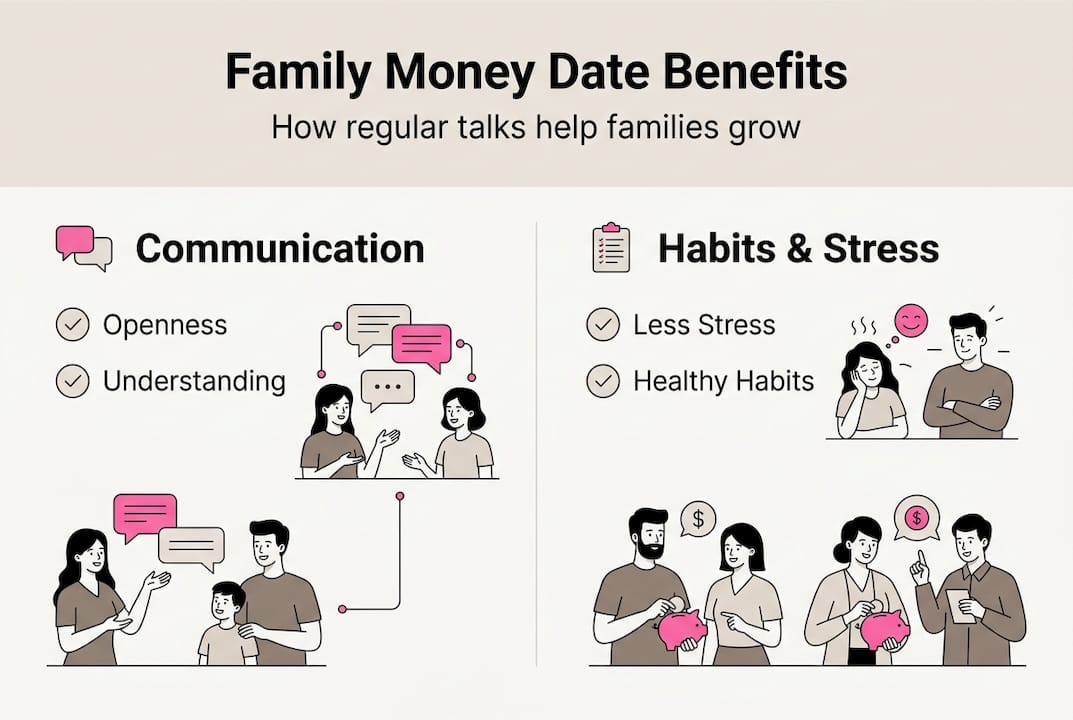
The benefits go far deeper than a balanced checkbook. When families talk about money regularly, something shifts emotionally. Secrecy fades. Shame loses its grip. Teamwork replaces tension.
Money dates improve communication and reduce stress while modeling healthy habits for children. That’s not a small thing. Financial stress is one of the leading causes of conflict in households, and children absorb that tension even when adults think they’re hiding it.
Here’s a breakdown of who benefits and how:
For parents and couples:
- Fewer money arguments because issues are addressed early
- Shared accountability for spending and saving decisions
- A stronger sense of partnership around financial goals
- Reduced anxiety because nothing is hidden or avoided
For children:
- Early exposure to budgeting concepts builds financial literacy naturally
- They learn that money is a tool, not a source of fear or shame
- They develop resilience by watching parents navigate challenges calmly
- They feel included and respected as part of the family team
For the whole family:
- Breaks the paycheck-to-paycheck cycle through intentional planning
- Builds a shared vocabulary around money that grows with your kids
- Creates a culture of openness that extends beyond finances
Think of money dates as planting seeds. You may not see the harvest immediately, but every conversation adds to the soil. When your teenager eventually manages their own budget or your adult child avoids credit card debt, those are the fruits of the conversations you started years earlier.
Developing healthy spending and saving habits as a family unit is one of the most loving things you can do for your children’s future. Money dates make that possible, one conversation at a time.
How to start a family money date: Practical tips for success
Ready to try a money date? Here’s a step-by-step guide to start strong and avoid common missteps.
- Pick a consistent time. Choose a day and time that works every week or month. Sunday evenings, Friday afternoons, or the first of the month all work well. Consistency is everything.
- Create a low-pressure environment. Sit at the kitchen table with a cup of coffee or tea. Keep the mood light. This is a conversation, not a courtroom.
- Use a simple agenda. Check-in, goals review, one action step. That’s your foundation. Add more as you go.
- Involve kids at their level. Give young children a simple savings jar to track. Let tweens weigh in on a family goal. Assign teens a real budget category to manage.
- Celebrate wins. Did you stay under budget this month? Say so out loud. Gratitude and celebration keep everyone motivated.
Common obstacles and how to handle them:
- “We don’t have time.” Start with 15 minutes. A short, consistent meeting beats a long, occasional one every time.
- “My partner isn’t interested.” Start with just the two of you, or even solo with the kids. Invite, don’t pressure.
- “The kids don’t care.” Make it relevant to them. Tie the family savings goal to something they want, like a trip or a new game.
Family finance organization systems work hand in hand with money dates. When your paperwork, accounts, and goals are organized, the conversation flows much more easily.
For families with teenagers, teaching teens about money through real involvement in money dates is one of the most effective strategies available. Teens who participate in family financial discussions are better prepared for independence.
Pro Tip: Many families find that quarterly family meetings work well for big-picture planning, while monthly money dates handle the day-to-day. You can do both without it feeling overwhelming.
A fresh perspective: Why traditional budgeting falls short and how money dates change the game
Here’s what most guides miss about making family money work: the human element.
Budgeting apps are useful. Spreadsheets have their place. But no tool replaces the power of a real conversation between people who love each other and share a life. Most family budgeting plans fail not because the numbers are wrong, but because no one is talking about the feelings behind the numbers.
Money carries emotion. Fear, hope, shame, pride. When families ignore that reality, even the best budget falls apart. Reviewing finances regularly matters, but it’s the emotional honesty in those reviews that creates lasting change.
Money dates work because they build accountability and compassion at the same time. That combination is rare. It’s also exactly what families need to go from surviving to thriving financially.
Take action: Level up your family’s financial habits
Money dates are a powerful first step, but they work best when they’re part of a broader system for managing your home and finances with intention. If you’re ready to go further, here are next steps and resources designed for families like yours.
Explore our guides on family budgeting systems to find the structure that fits your household. Pair that with home management systems that keep your routines running smoothly, so money dates become just one part of a well-organized family life. And if time always feels short, our productivity hacks for families will help you carve out the space you need to make it all happen consistently.

Frequently asked questions
How often should families hold money dates?
Most families find success meeting monthly, but quarterly family meetings work well for bigger-picture planning. Weekly check-ins are great during high-stress financial seasons.
What should be discussed in a family money date?
Focus on your budget, upcoming expenses, savings goals, and any financial wins or concerns. Keeping the conversation balanced between challenges and celebrations makes it sustainable.
How do money dates help teach kids about money?
Children learn by watching adults handle money openly and calmly. Money dates model healthy habits and build financial literacy through real-life observation, which sticks far better than any classroom lesson.
Are money dates only for couples, or can kids join?
Kids of all ages can participate at their own level, making money dates a full family activity that grows with your children over time.
Recommended
- 20 Time-Tested Family Hacks to Break the Paycheck-to-Paycheck Cycle (Strategies That Actually Work with Kids) –
- What is a savings tracker? Family guide to saving in 2026 –
- Review Finances: Boost Family Stability and Growth –
- How to Track Family Expenses: A Simple Guide for 2025 –
Need something to talk through on your money date? First Budget in 30 Minutes gives the two of you a simple starting point that fits in one sitting.