
Work‑Life Balance: Why It Matters for Busy Families
Over half of American parents say balancing work demands and family needs leaves them feeling constantly stretched. This struggle matters because family life and careers often fight for the same hours, causing burnout and missed moments. Knowing how to set boundaries and find real balance can help families thrive, not just survive the daily juggle. Discover practical approaches that fit real American family lives so everyone can find more peace and connection.
Table of Contents
- Work‑Life Balance Defined for Families
- Common Myths and Misconceptions
- How Work‑Family Interaction Works
- Adapting Balance to Life Seasons
- Smart Family‑Focused Work‑Life Strategies
Key Takeaways
| Point | Details |
|---|---|
| Work-Life Balance Definition | It involves creating healthy boundaries between professional obligations and personal time to prevent burnout. |
| Importance of Communication | Ongoing communication and mutual support among family members are essential for successful work-life balance. |
| Myths Debunked | Work-life balance is about flexibility, not equal time allocation, and is achievable across various professions. |
| Adaptation Required | Families must regularly assess and adjust their balance strategies as life stages and responsibilities evolve. |
Work‑Life Balance Defined for Families
Work-life balance isn’t just a trendy buzzword. It’s a critical strategy for families trying to manage multiple responsibilities without burning out. At its core, work-life balance means creating healthy boundaries between professional obligations and personal time, ensuring that neither career demands nor family needs completely dominate your daily experience.
For busy families, achieving balance means developing intentional systems that allow flexibility and sustainable rhythms. This looks different for every household, but generally involves strategic time management, setting clear priorities, and learning to say no to commitments that don’t align with core family values. Practical time management techniques can help parents create more breathing room in packed schedules.
Successful work-life balance requires ongoing communication and mutual support among family members. Parents must collaborate on distributing household responsibilities, create shared calendars, and establish realistic expectations about work constraints and family time. This might mean negotiating flexible work hours, coordinating childcare, or blocking out dedicated family moments that aren’t interrupted by professional tasks.
Pro Tip – Boundary Setting: Create a physical or digital separation between work and home spaces. Establish specific work hours, put away digital devices during family time, and communicate clear expectations with both your employer and your family about when you are and aren’t available.
Common Myths and Misconceptions
Work-life balance has become a complex concept riddled with misconceptions that often prevent families from achieving genuine harmony. Debunking work-life balance myths reveals that many widespread beliefs about managing professional and personal responsibilities are fundamentally flawed and potentially harmful to family dynamics.
One prominent myth suggests that work-life balance requires perfect 50-50 time allocation between career and personal life. In reality, effective balance is about flexibility and quality of engagement, not rigid mathematical division. Some weeks might demand more professional time, while others allow for increased family connection. The key is maintaining overall harmony and meeting critical needs in both domains without experiencing persistent stress or burnout.
Another dangerous misconception is that work-life balance is achievable only for certain professions or individuals with less demanding jobs. This simply isn’t true. Professionals across various fields, from healthcare to technology, can develop strategies that promote sustainable integration of work and personal responsibilities. This requires intentional boundary setting, effective communication, and a willingness to continuously adapt and reassess personal and professional priorities.
Pro Tip – Myth Busting: Challenge your assumptions about work-life balance by regularly reviewing and adjusting your strategies. What worked six months ago might not serve your current family dynamics, so remain flexible and open to reimagining your approach.
Here’s a summary of common work-life balance myths versus reality:
| Myth | Reality | Impact on Families |
|---|---|---|
| Balance means equal time | Balance means flexibility | Reduces stress by adapting to needs |
| Only easy jobs allow balance | All careers can foster balance | Encourages inclusive strategies |
| Balance is a one-time goal | Continuous reassessment is needed | Promotes adaptability and growth |
| Boundaries harm productivity | Healthy boundaries increase well-being | Supports both work and family life |
How Work‑Family Interaction Works
Work-family interaction is a complex dynamic that involves continuous negotiation between professional responsibilities and personal life commitments. Families today experience intricate intersections between work demands and home needs, requiring sophisticated strategies for maintaining harmony. Practical work-life balance strategies can help families navigate these challenging interactions more effectively.
At its core, work-family interaction involves managing emotional and physical energy across different life domains. When parents transition between work and home roles, they must continuously adapt their communication, emotional availability, and time management. This means recognizing that professional stress can impact family relationships, and family challenges can influence workplace performance. Successful interaction requires developing flexible boundaries that allow for seamless transitions and mutual support.

The modern work-family landscape is characterized by increasing complexity and technological connectivity. Remote work, flexible schedules, and digital communication tools have blurred traditional lines between professional and personal spaces. Families must now develop sophisticated approaches to maintain clear boundaries while remaining responsive to both work and home responsibilities. This often involves creative problem-solving, open communication, and a willingness to continuously adjust strategies as family and professional needs evolve.
Pro Tip – Role Transition: Create deliberate transition rituals that help you mentally shift between work and family modes. This might include a short meditation, changing clothes, or having a brief check-in conversation with your partner to reset your mental space.
Adapting Balance to Life Seasons
Work-life balance is not a static concept but a dynamic process that shifts dramatically across different family stages. Challenging work and family dynamics reveal that families must continuously reassess and recalibrate their strategies as children grow, careers evolve, and personal circumstances change.
Each life season presents unique challenges and opportunities for balancing professional and personal responsibilities. Young parents with infants might require more flexible work arrangements, while families with school-age children need strategies that accommodate academic schedules and extracurricular activities. Empty nesters and parents with adult children can often create more complex professional engagement models that weren’t possible during earlier, more hands-on parenting years.
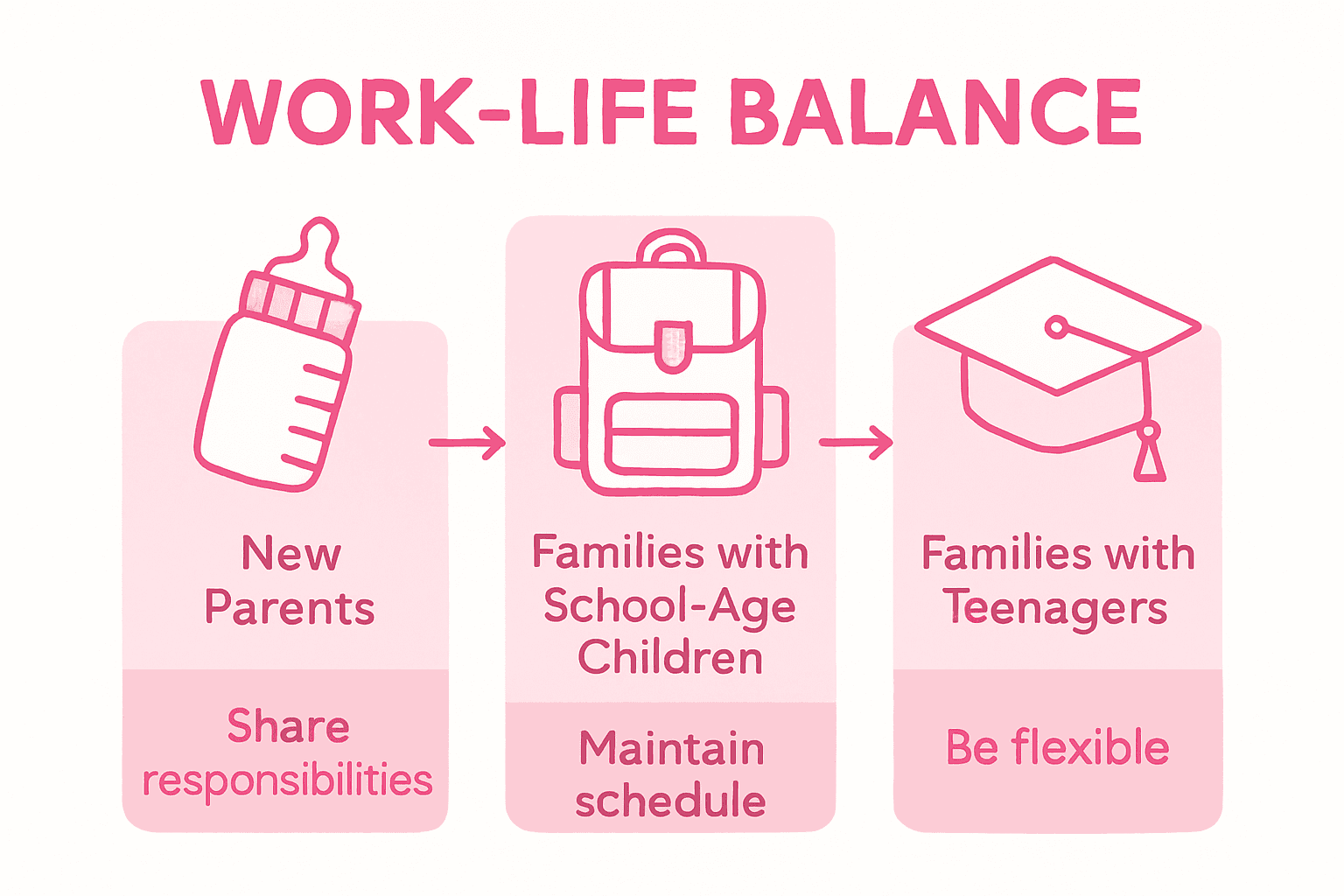
Successful adaptation requires ongoing communication, willingness to experiment, and radical self-compassion. Families must develop a mindset of continuous adjustment rather than seeking a permanent, unchanging balance. This means regularly discussing family needs, being transparent about work constraints, and creating systems that can flex and shift as individual and collective requirements transform over time. Technological tools, creative scheduling, and shared responsibility can help families navigate these intricate transitions more smoothly.
Pro Tip – Seasonal Reassessment: Schedule quarterly family meetings to review and realign your work-life balance strategy. Treat these conversations as collaborative problem-solving sessions where everyone’s perspectives and needs are heard and considered.
Smart Family‑Focused Work‑Life Strategies
Smart family-focused work-life strategies are about intentional, proactive approaches that prioritize both professional success and family well-being. Family-friendly productivity techniques can transform how families manage complex schedules and competing priorities, creating more harmonious and sustainable lifestyles.
Effective strategies involve creating flexible systems that adapt to changing family dynamics. This means developing shared digital calendars, establishing clear communication protocols, and implementing collaborative planning methods. Families can leverage technology and intentional scheduling to create boundaries that protect both work productivity and quality family time. Critically, these strategies require ongoing negotiation, mutual respect, and a willingness to adjust approaches as individual and collective needs evolve.
Successful work-life integration demands a holistic approach that recognizes the interconnected nature of professional and personal responsibilities. This involves developing shared accountability mechanisms, where all family members contribute to managing household tasks, understanding each other’s professional constraints, and supporting individual growth. Strategic time blocking, collaborative task management, and creating dedicated family and work zones can help families maintain balance and reduce stress.
Pro Tip – Collaborative Planning: Create a weekly family meeting where everyone shares their upcoming schedule, discusses potential challenges, and collectively problem-solves to ensure smooth coordination across work and personal commitments.
To help select practical strategies, the table below outlines effective family-focused work-life tactics:
| Strategy | Description | Best For |
|---|---|---|
| Shared Digital Calendars | Coordinate events and tasks online | Busy, tech-friendly families |
| Weekly Family Meetings | Review schedules and problem-solve | Families needing consistent check-ins |
| Flexible Work Hours | Adjust work to personal needs | Parents with varying routines |
| Dedicated Work and Play Zones | Separate spaces for work and family | Homes with remote workers |
Achieve Lasting Work-Life Balance for Your Family Today
Balancing work and family life is a constant challenge for busy households juggling professional demands and personal commitments. This article highlights the critical need for flexible boundaries, intentional time management, and ongoing communication to reduce stress and create harmony. If you find yourself overwhelmed by packed schedules or struggling to set clear priorities, you are not alone. Many families seek effective solutions for managing daily chaos while protecting quality family time.
Discover how you can transform your home and lifestyle with proven organization hacks and productivity tools designed specifically for busy families. From simple living strategies to time management techniques, our resources empower you to build sustainable systems that adapt to your family’s evolving needs. Start bringing balance into your life now by exploring practical tips like shared digital calendars and collaborative planning. Take the first step to reclaim your family’s peace and productivity with expert advice at Its a Southern Life Yall. Don’t wait for the perfect moment create your most efficient lifestyle today and experience the real benefits of a balanced work-family life.
Frequently Asked Questions
What is work-life balance for families?
Work-life balance for families refers to the ability to manage both professional responsibilities and personal commitments without one overwhelming the other, ensuring time for both work and family life.
Why is work-life balance important for families?
Achieving work-life balance is crucial for maintaining mental and emotional well-being, reducing stress, and fostering positive family relationships, allowing families to thrive in both personal and professional spheres.
How can families develop effective work-life balance strategies?
Families can implement effective work-life balance strategies by setting clear priorities, utilizing time management techniques, establishing shared calendars, and encouraging open communication among family members to address needs and expectations.
What common myths exist about work-life balance for families?
Common myths include the belief that work-life balance requires a strict 50-50 split between work and family time, and that only certain professions allow for effective balance. In reality, balance is flexible and can be achieved across various careers and life stages.
Recommended
- 7 Practical Work-Life Balance Tips for Busy Families – It’s a Southern Life Ya’ll
- 7 Time Management Tips for Families to Balance Life – It’s a Southern Life Ya’ll
- Understanding Productivity Tips for Parents Guide – It’s a Southern Life Ya’ll
- Effective Ways to Manage Homework Time for Families – It’s a Southern Life Ya’ll
Want a hand with this part? The Home Rhythm Planner is where that balance stops being a wish and turns into a week you can see.