

How Planning Apps Help Busy Parents Achieve Balance
TL;DR:
- Planning apps significantly reduce parental stress and increase confidence in managing family logistics.
- Key features like shared calendars and reminders improve coordination and family communication.
- Simplicity, consistency, and involving the whole family are crucial for successful app adoption.
Most parents assume planning apps are just glorified digital to-do lists. You download one, add a few tasks, and wonder why your mornings still feel like a fire drill. But here’s what the research actually shows: apps reduce parental stress significantly, with parents reporting higher confidence and greater engagement with their kids. We’re talking about a real shift in how families function, not just a prettier calendar on your phone. This guide walks you through the evidence, the features that matter most, and how to make planning apps work for your real, busy, beautiful family life.
Table of Contents
- Why planning apps matter for busy families
- Key features that make planning apps effective
- How planning apps improve family routines and communication
- Overcoming common challenges with planning apps
- Why planning apps succeed or fail for parents: an insider’s view
- Take the next step to organized family life
- Frequently asked questions
Key Takeaways
| Point | Details |
|---|---|
| Apps reduce parental stress | Research shows using planning apps significantly lowers parental stress, making home life feel more manageable. |
| Family routines run smoother | Shared schedules and reminders help everyone stay on track, reducing confusion and missed tasks. |
| More quality time together | Parents using planning systems spend 86 percent of their 50 weekly hours truly engaged with their children. |
| Start simple for success | Ease your family into app use with basic features, then build up—consistency drives results. |
Why planning apps matter for busy families
Planning apps aren’t just about keeping a list. They act like a central nervous system for your household, pulling together schedules, reminders, chores, and communication into one place everyone can access. Think of it like planting seeds in well-prepared soil. When everything has a place, things actually grow the way they should.
Here’s something that might surprise you. Parents already spend around 50 hours per week with their children. The question isn’t whether you’re present. It’s whether that time is engaged and meaningful. Planning apps help you protect and maximize that quality time by handling the logistics so you don’t have to carry it all in your head.
Research backs this up in a compelling way. Studies show significant stress score decreases among parents who use planning apps regularly, with an F-value of 14.40 and p<0.001. That’s not a small effect. That’s a measurable, meaningful shift in how parents feel day to day.
“Planning apps decreased parental stress scores significantly, while also increasing feelings of competence and trust among users.”
Here’s a quick look at what the data tells us:
| Metric | Result for parents using planning apps |
|---|---|
| Stress score reduction | Significant (F=14.40, p<0.001) |
| Engaged time with children | 86% of weekly hours |
| Perceived parental competence | Increased with continued use |
| Trust in family systems | Improved over time |
The core benefits parents experience include:
- Reduced daily stress from having one reliable place for all family information
- Improved confidence in managing schedules and responsibilities
- More efficient coordination between partners, kids, and caregivers
- Greater intentionality in how family time gets spent
If you’re looking for a starting point, exploring productivity tips for parents can help you layer app use into habits you already have. And pairing your app with solid time management tips for families makes the whole system even stronger.
Key features that make planning apps effective
Not every app feature is created equal. Some are genuinely life-changing for families. Others just add noise. Knowing which features actually move the needle helps you choose the right tool and set it up in a way that sticks.
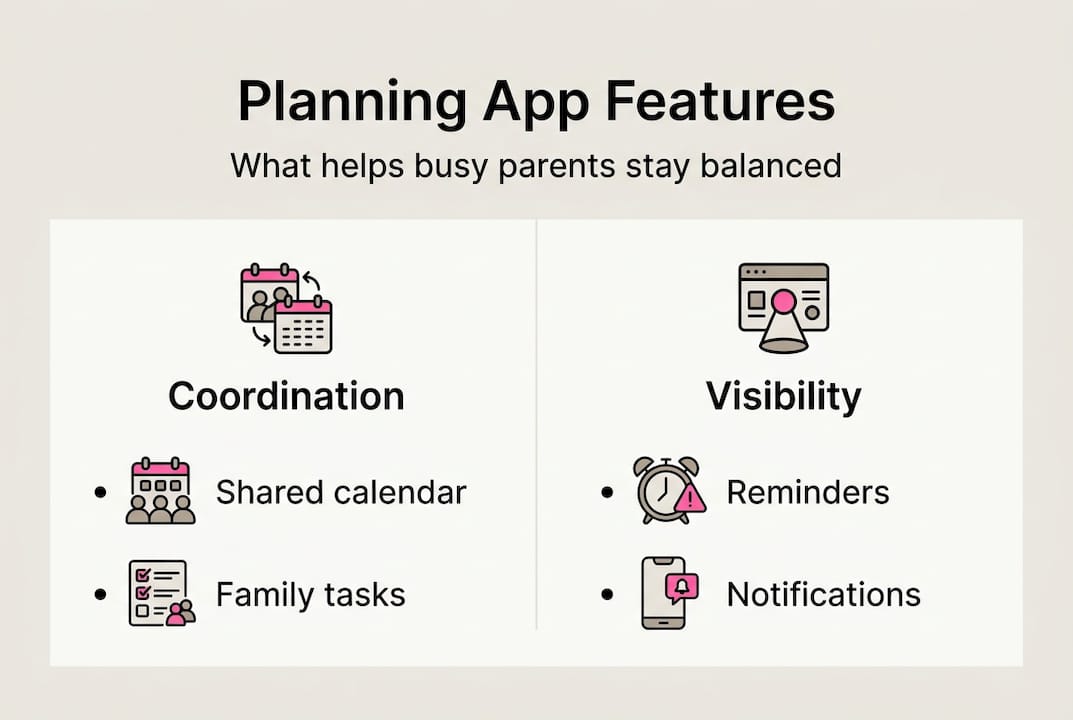
The features that consistently make a difference are the ones that reduce friction and increase visibility. When everyone in the family can see the same information at the same time, confusion drops and accountability rises. Research confirms that perceived competence and trust among parents increase when app features support collaboration and reminders.
Here’s how common family needs match up with the right app features:
| Family need | App feature that helps |
|---|---|
| Knowing everyone’s schedule | Shared family calendar |
| Avoiding forgotten tasks | Recurring reminders and alerts |
| Assigning responsibilities | Individual task lists with names |
| Spotting conflicts quickly | Color-coded schedule views |
| Staying connected on the go | In-app messaging and comments |
Here’s how a typical parent might use a planning app to organize a full family week:
- Sunday evening: Open the app and review the upcoming week. Add school events, practices, and appointments.
- Monday morning: Check notifications for the day’s priorities. Confirm who is handling pickup and dinner.
- Midweek: Use the task assignment feature to delegate age-appropriate chores to kids.
- Thursday: Review the weekend schedule and send a quick in-app message to confirm plans with your partner.
- Friday: Mark completed tasks and prep the next week’s recurring reminders.
This rhythm takes maybe 20 minutes a week once you’re in the habit. That’s a small investment for a much calmer household.
Pro Tip: Set up recurring reminders for weekly chores, school deadlines, and regular appointments the moment you create them. Future you will be so grateful you did.
If you want to see how different tools stack up, comparing time management tools gives you a side-by-side look. You can also pair your app with time blocking for parents to build a schedule that actually holds.
How planning apps improve family routines and communication
Understanding what planning apps can do is only part of the story. Let’s see how they transform everyday routines and family communication in real, practical ways.
One of the biggest wins families report is the end of the “I didn’t know” excuse. When everyone has access to the same shared calendar and task list, there’s no more mystery about who was supposed to pick up the kids or what’s for dinner. Clarity replaces chaos, and that shift alone can lower the emotional temperature in a household.
Planning apps streamline family logistics across every category: school schedules, extracurricular activities, meal planning, grocery lists, and chore rotations. Instead of a dozen sticky notes and three separate text threads, everything lives in one visible, organized place.

Here’s the stat that really puts it in perspective: 86% of parents’ weekly time with their children is engaged time when planning systems are in place. That’s not accidental. It happens because parents aren’t mentally juggling logistics during family moments. They’ve already handled it.
The communication features that make the biggest difference include:
- Instant schedule updates that notify everyone when something changes
- Shared to-do lists so no task falls through the cracks
- In-app messaging for quick coordination without switching to another platform
- Event reminders sent to all family members automatically
- Task completion tracking so everyone can see what’s been done
Pro Tip: Use your app’s comment or chat feature for last-minute changes instead of texting. It keeps everything in one thread and reduces the chance of missed messages.
For parents who want to go deeper, learning about parental time management types can help you identify your natural style and choose an app setup that fits. You might also find that block scheduling for families pairs beautifully with your app to create a rhythm everyone can follow.
Overcoming common challenges with planning apps
Despite their benefits, parents sometimes struggle to get everyone on board with using planning apps. Let’s address the common stumbling blocks and how to solve them.
The most common barrier isn’t the technology itself. It’s the expectation that an app will instantly fix a chaotic household. That mindset sets families up for disappointment. Real change happens gradually, as the app becomes part of your normal rhythm rather than an extra chore.
Other common barriers include tech overwhelm, privacy concerns, kids resisting another screen, and partners who prefer paper systems. These are real, and they’re worth taking seriously.
“Parental trust and competence grow alongside consistent app use, but initial resistance is a natural part of the adoption process.” This is why patience and simplicity matter more than finding the perfect app right away.
Here’s a practical roadmap for getting your family on board:
- Start with one feature only. Don’t activate everything at once. Begin with a shared calendar and nothing else.
- Choose a family-friendly app. Look for clean interfaces, easy navigation, and options for kids to participate at their level.
- Involve everyone in setup. Let each family member add their own events and preferences. Ownership builds buy-in.
- Set a two-week trial. Commit to using it consistently for two weeks before deciding if it’s working.
- Celebrate small wins. When the app helps you avoid a scheduling conflict or remember an important event, point that out. It reinforces the habit.
Research confirms that trust and competence increase with ongoing app use, even when the start is rocky. The key is staying consistent long enough for the system to prove its value.
For families who want to build a proactive mindset around planning, understanding the role of proactive planning is a powerful complement to any app you choose.
Why planning apps succeed or fail for parents: an insider’s view
After exploring both the strengths and hurdles of planning apps, here’s a candid look at why these tools succeed or flop in real homes.
Most planning apps don’t fail because of bad technology. They fail because parents expect the app to do the thinking for them. An app is a tool, not a solution. It’s like a hammer sitting in a toolbox. It only builds something when someone picks it up with intention.
Real improvement comes when apps support existing family habits rather than trying to replace human decision-making. The families I’ve seen thrive with planning apps are the ones who kept it simple, stayed consistent, and used the app to reinforce conversations they were already having.
Here’s the uncomfortable truth: more features don’t mean better results. In fact, overloading your app setup often leads to abandonment within a few weeks. Simplicity creates lasting change. One shared calendar used faithfully beats five features used inconsistently every single time.
Focus on small wins, keep your system visible, and talk openly as a family about what’s working. Explore family-friendly productivity hacks to layer in additional strategies once your app habit is solid.
Take the next step to organized family life
Now that you understand the real role and potential of planning apps, here’s how to continue building your most organized family life. A planning app is a powerful starting point, but it works best when it’s part of a bigger system. At It’s a Southern Life Y’all, we’ve built a library of resources designed specifically for busy parents who want practical, proven frameworks. Explore home management systems to create structure that supports your app. Browse home organization systems to find the style that fits your family best. And when you’re ready to go further, our family productivity hacks give you fresh strategies to keep the momentum going.
Frequently asked questions
What specific planning app features are most helpful for families?
Shared calendars, color-coded schedules, notification reminders, and collaborative task lists are the most useful features for busy families. Research shows that collaboration and reminder features are directly linked to higher perceived competence among parents.
How do planning apps reduce parental stress?
Apps lower stress by centralizing schedules and tasks and making family coordination easier. Studies document significant stress score decreases with an F-value of 14.40 and p<0.001 among parents who use planning apps regularly.
Is it difficult to get the whole family to use a planning app?
It can take some adjustment, but starting with one simple feature and involving everyone in setup usually overcomes resistance. Ongoing consistent use builds trust and makes the system feel natural over time.
Do planning apps increase meaningful family time?
Yes. Research shows that 86% of parents’ weekly time with their children is engaged time when planning systems are in place, reflecting a real improvement in interaction quality.
Recommended
- Guide to the Role of Proactive Planning –
- 7 Practical Work-Life Balance Tips for Busy Families –
- Transform Home and Life Balance with Daily Planning –
- Parental Time Management Types for Busy Families –
- 7 Essential Self Care Tips for Parents Seeking Balance – Mastering Conflict
- 7 Essential Time Management Apps List for Productivity – Optio Station: Best Project Management App for Prioritization
Want a little more help with this? The Sunday Blueprint works with whatever app you land on — fifteen minutes on Sunday, and the week has a rhythm.